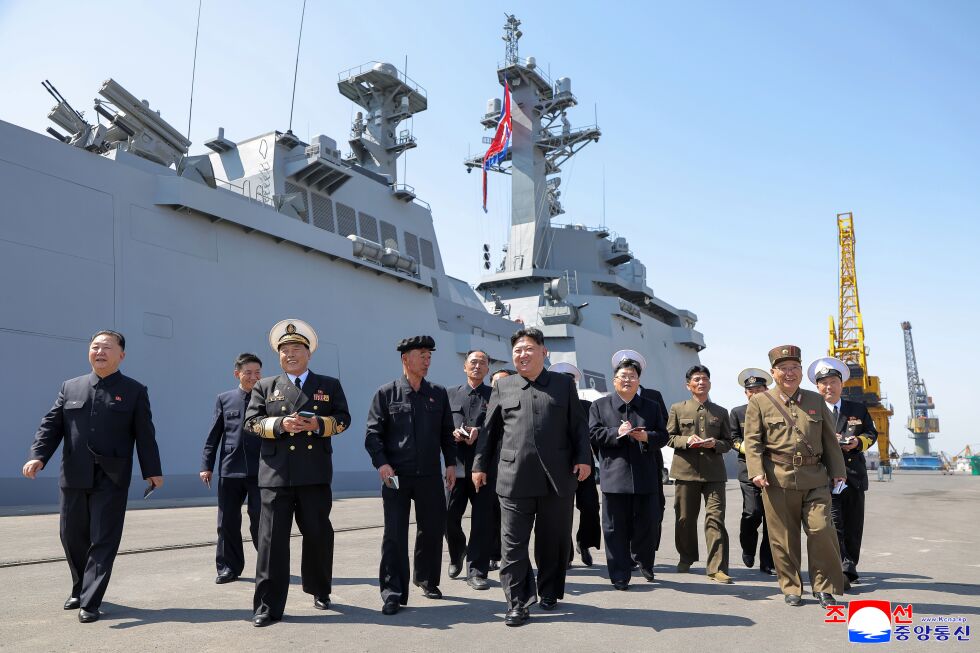
In a fresh demonstration of Pyongyang’s accelerating military modernization push, North Korean leader Kim Jong Un supervised a new series of missile launches from the country’s newly commissioned 5,000-ton-class destroyer Choe Hyon over the weekend, state media confirmed Tuesday. The test activity marks the third round of weapons trials from the recently unveiled warship, as Kim doubles down on his pledge to turn the North Korean navy into a nuclear-capable force capable of projecting power across regional waters.
According to North Korea’s official Rodong Sinmun newspaper, Sunday’s test involved the launch of two strategic cruise missiles and three anti-ship missiles from the Choe Hyon, a vessel first publicly unveiled in April 2025. The outlet reported that the strategic cruise missiles flew for more than two hours along pre-planned flight paths over North Korea’s western sea, while the anti-ship missiles completed a 30-plus-minute flight before both types of weapons hit their designated targets with pinpoint accuracy. The Korean Central News Agency (KCNA), another state-run media outlet, published visual footage of the test, showing Kim and senior military officials observing from a nearby pier as a missile trailed smoke while arcing away from the destroyer’s deck.
This latest test comes just one month after Kim oversaw two prior rounds of missile launches from the Choe Hyon, when he first announced plans to accelerate the nuclear arming of North Korea’s naval forces. Following Sunday’s successful trials, Kim reaffirmed that his administration remains committed to the “limitless expansion” of the country’s nuclear deterrent forces. He also issued new, unspecified directives to enhance Pyongyang’s nuclear strike capacity and rapid response readiness, and reviewed development blueprints for two additional 5,000-ton-class destroyers currently under construction, Rodong Sinmun reported.
Kim has repeatedly framed the development of the Choe Hyon-class destroyers as a transformative milestone for North Korea’s military, saying the vessels will drastically extend the operational range and preemptive strike capabilities of his armed forces. State media outlines that the warship is engineered to carry a full suite of combat systems, including surface-to-air defense weapons, anti-ship armaments, and both nuclear-capable ballistic and cruise missiles. While South Korean government officials and independent defense analysts suspect the destroyer program benefited from technical assistance from Russia amid deepening military cooperation between Moscow and Pyongyang, many experts have raised questions about whether the Choe Hyon is already fully combat-ready.
The troubled history of North Korea’s second Choe Hyon-class vessel, the Kang Kon, has added to these outside doubts. The ship was first unveiled in May 2024, but it sustained serious damage during a botched launch ceremony at the Chongjin port in the country’s northeast, triggering a public rebuke from an angered Kim Jong Un. While Pyongyang announced the Kang Kon was successfully relaunched in June 2024 following repairs, independent defense analysts have not confirmed the vessel is fully operational today.
Per North Korean state media, construction of the third Choe Hyon-class destroyer is ongoing at the Nampo shipyard on the country’s western coast, with completion targeted for October to coincide with the founding anniversary of the ruling Workers’ Party of Korea.
Sunday’s test adds to an unprecedented surge in North Korean weapons testing activity this year, as Pyongyang pushes to expand its arsenal of nuclear-capable systems targeting South Korea against a backdrop of steadily deteriorating inter-Korean relations and a years-long stalemate in diplomatic talks over denuclearization. Just last week, North Korea conducted a separate slate of tests that state media confirmed included trials of new ballistic missiles fitted with cluster-bomb warheads, while senior Pyongyang officials issued harsh public remarks mocking South Korea’s recent overtures for improved cross-border ties.
Diplomatic dialogue between North Korea, the United States and South Korea has been frozen since 2019, when talks between Kim Jong Un and then-U.S. President Donald Trump collapsed with no agreement on denuclearization. Kim has since adopted an uncompromising hard-line stance toward Seoul, redefining South Korea as Pyongyang’s “most hostile” adversary, and rejected offers from the second Trump administration to resume dialogue, demanding that Washington drop its insistence on denuclearization as a precondition for any new negotiations.
In recent years, Kim has prioritized deepening strategic ties with major global powers aligned against the U.S.-led international order. North Korea has supplied thousands of troops and large volumes of conventional weapons to support Russia’s full-scale invasion of Ukraine, while Pyongyang has also strengthened its longstanding alliance with China, North Korea’s primary economic lifeline. Last week, Kim held talks with Chinese Foreign Minister Wang Yi and publicly voiced full backing for Beijing’s stated goal of building a “multipolar world.”