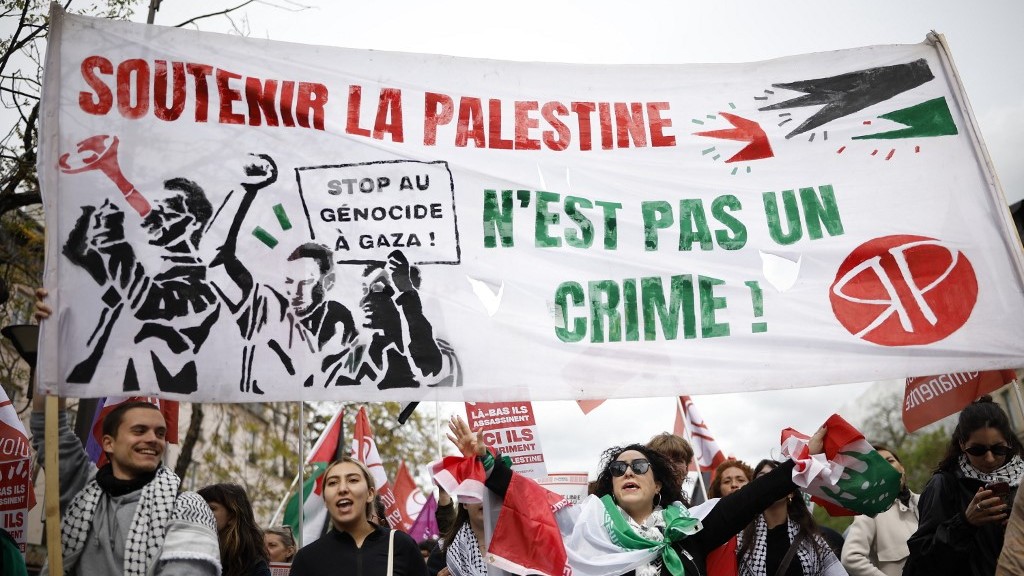
A deeply divisive bill that would impose sweeping new criminal penalties on a wide range of speech related to Israel is currently moving through France’s national parliament, triggering fierce public backlash and reigniting long-simmering debates over the boundaries of political expression in the country.
The legislation, scheduled for its first reading in the National Assembly on April 16, has already earned unusual cross-party support, with backing even from far-right political factions. But the broad political consensus behind the bill has not quelled public opposition: more than 500,000 people have signed a public petition demanding the legislation be scrapped, and organized protests against the measure have spread across multiple French cities as critics warn it poses an unprecedented threat to core free speech protections.
The proposal is the brainchild of sitting French MP Caroline Yadan, a prominent lawmaker who publicly identifies as an “unconditional” supporter of Israel. Yadan represents the 8th constituency for French citizens living overseas, a district where Israeli residents make up a substantial share of the voting electorate, and she has centered her entire political tenure on advancing policies that defend Israeli actions and interests. She has already openly broken with French President Emmanuel Macron over his official recognition of the Palestinian people’s right to statehood, and publicly condemned Macron in October 2024 after the president called for a halt to French weapons deliveries to Israel amid Israel’s ongoing military campaign in Gaza. Yadan, who is Jewish, has defended the bill with an unsubstantiated claim that “For fifteen years, Jews have been killed in France ‘in the name of Gaza.’”
If enacted, the bill would introduce a series of far-reaching new criminal offenses. It would make it a crime to deny Israel’s right to exist, and explicitly criminalize comparisons between the Israeli state and Nazi Germany — a legal protection that is not extended to France itself. The legislation also expands existing terrorism-related statutes to cover what the text labels “implicit” provocation, broadening the definition of “apology for terrorism” to include the “minimising or trivialising” of terror attacks.
Under the bill’s first article, anyone found guilty of speech interpreted as justifying or reframing acts designated as terrorism could face up to five years in prison and substantial financial fines. This broad language could even criminalize framing such acts as “resistance,” or providing contextual background that courts deem insufficiently condemnatory. Critics note the new wording would allow courts to treat attempts to explain the political root causes of violence as criminal acts, opening the door to widespread prosecution of dissenting political speech.
Marc Trevidic, a former French anti-terrorism judge, has issued a sharp public warning about the dangerous implications of the bill’s vague wording. “Implicit provocation to terrorism: do you realize what that means? Becoming a censor of other people’s thoughts, trying to guess what a person really meant,” Trevidic said.
One high-profile provision expands existing French laws on crimes against humanity, explicitly classifying any comparison between Israel and Nazi Germany as “outrageous trivialization” of the Holocaust, a criminal offense under the new legislation. The bill’s preamble makes its core intent unambiguous: it explicitly states that framing the Israeli state as equivalent to the Nazi regime must be treated as a criminal act, effectively shielding Israel from one of the most politically charged forms of criticism directed at the country’s policies.
The legislation builds on France’s already strict existing speech regulations, which have criminalized Holocaust denial under the 1990 Gayssot Act for decades. But legal experts and free speech advocates note the new measures go far beyond existing prohibitions, extending criminal liability into a broad swathe of mainstream political expression. As the first parliamentary vote approaches, the clash between the bill’s cross-party backers and mass public opposition has put France’s commitment to free expression under unprecedented national scrutiny.