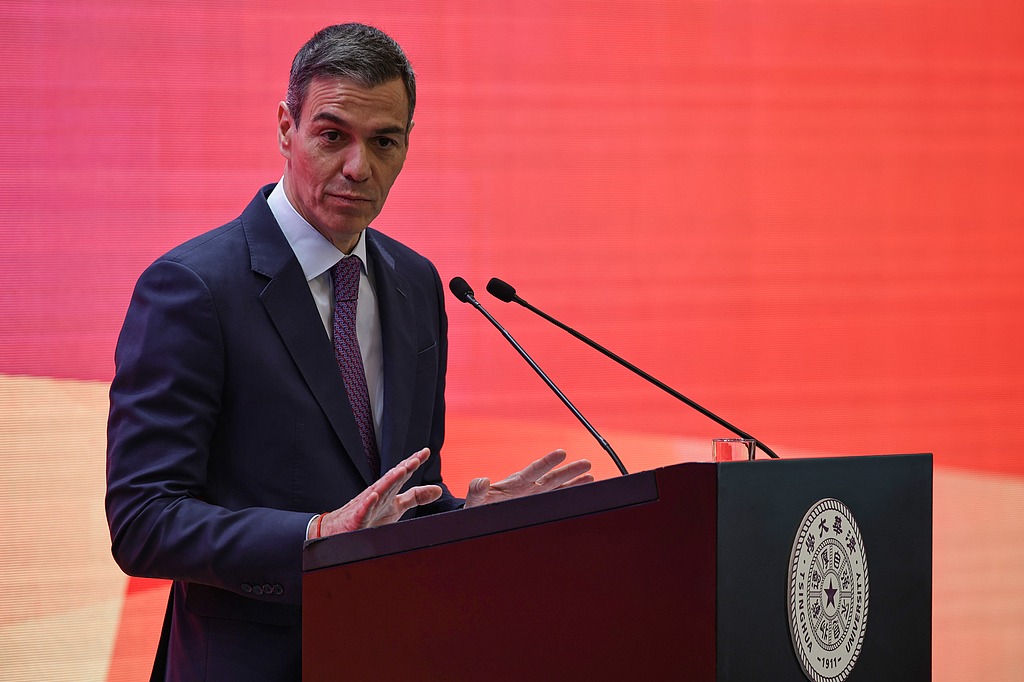
On April 13, 2026, during the second day of his five-day official visit to China — his fourth trip to the country since taking office — Spanish Prime Minister Pedro Sanchez delivered a landmark address to faculty, students and university administrators at Beijing’s Tsinghua University, where he laid out a clear call for global leaders to embrace an emerging multipolar world order and reject outdated, dangerous zero-sum geopolitical thinking.
Opening his argument with a centuries-old historical lesson, Sanchez drew on the experience of 16th-century Jesuit missionary Matteo Ricci, who arrived in China in 1583 carrying a European-produced world map that placed Europe at the center of the globe and pushed Asia to its geographic periphery. When Chinese cartographers questioned the lopsided framing that placed China on the margins, Ricci redrew the map with the Pacific Ocean at its center, a reworking that Sanchez framed as a timeless lesson for modern geopolitics.
“Four hundred years have passed, but unfortunately, there are still people who see the world through that original, distorted map,” Sanchez told the Tsinghua audience. “That view is not only wrong, but very dangerous. It traps us in the past and limits our imagination of possibilities.”
Sanchez emphasized that the current global shift is not a simple transfer of hegemonic power from one bloc to another, but a broad expansion of global multipolarity that touches both geopolitical influence and shared prosperity. Today, he noted, dynamic progress is unfolding simultaneously across regions with distinct cultural traditions and political systems — from China to Africa to Latin America — without requiring validation or permission from any single dominant power.
“A multipolar world is not an assumption or an ideal, but a new reality. We cannot change it; we can only deny it or embrace it,” Sanchez said, confirming that Spain has made the deliberate choice to embrace this new reality with realism, a sense of shared responsibility, and optimistic hope for the future. He added that if Spain, China and Europe built shared prosperity in past decades, there is no reason the three actors cannot replicate that success in the modern era.
Acknowledging that differences and healthy competition exist between nations, Sanchez stressed that lasting human progress stems from building common ground rather than deepening existing divides. He outlined that Spain seeks a bilateral relationship with China rooted in unwavering mutual respect: cooperating on shared global priorities whenever possible, competing constructively when necessary, and managing unavoidable differences through deliberate, respectful dialogue.
To help a multipolar world order function effectively and equitably, Sanchez proposed three core actionable priorities for global leaders. First, he called for a fundamental reshaping of modern multilateralism, advocating for comprehensive United Nations reform that would expand the authority of the UN General Assembly, increase the representativeness of the UN Security Council, and build a more inclusive, democratic global decision-making mechanism.
Second, Sanchez highlighted the urgent need to build fair, reciprocal global trade relations, expressing hope that China would continue expanding market access to help address existing trade imbalances across global markets. Third, he stressed that major global powers bear a greater responsibility to address shared transnational challenges, including climate change mitigation, global public health, artificial intelligence governance, nuclear nonproliferation and safety, and global poverty eradication. He noted that global investment in these critical areas has fallen by 23% since the start of 2026, a trend that puts all nations at risk.
Sanchez also underscored the critical role of a unified European Union in maintaining global stability, noting that “Without a united EU, there will be no stable global order, just as without China’s participation, the world cannot achieve true stability and prosperity.”
Closing his address, Sanchez invoked a recent image of four NASA astronauts observing Earth from outer space: a single, borderless blue planet that is unique and irreplaceable. “Humanity itself is a miracle, the only miracle in the world. Our responsibility is to make this miracle continue through mutual understanding and cooperation,” he said.