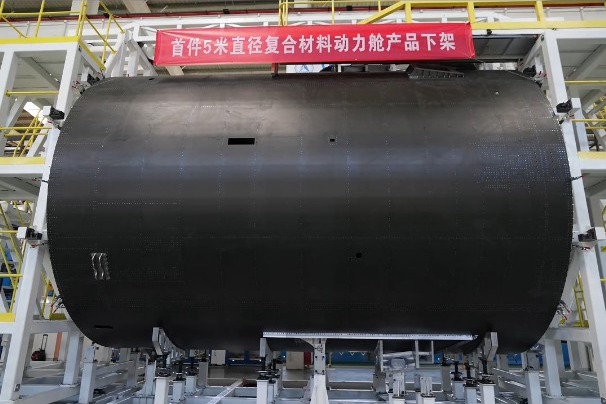
China has achieved a landmark technological milestone in its reusable launch vehicle development program, with the country’s first 5-meter-diameter composite rocket module rolling off the production line on April 11, 2026. Developed by the China Academy of Launch Vehicle Technology based in Beijing, this new component is the largest domestically produced composite module ever built for a reusable launch system, and is slated for use in a high-priority national space initiative.
Composite materials make up more than 60 percent of the module’s total construction, bringing major advantages in weight reduction compared to traditional metallic rocket structures. Despite its lightweight design, the module’s engineered wall panels are capable of withstanding an axial compressive load of up to 1,000 metric tons, while integrated self-adaptive adjustment interfaces add enhanced functionality for vehicle integration. The development team overcame a series of complex engineering hurdles, most notably the challenge of high-precision, high-quality manufacturing of large-scale advanced composite structures. Remarkably, the entire process from initial conceptual design to final production and delivery was completed in just seven months, a timeline that underscores the program’s rapid progress.
The breakthrough comes as China continues to advance its ambitious goal of building a full fleet of reusable rockets, a technology that is expected to slash space launch costs significantly while boosting the efficiency and enabling higher frequency of orbital space missions. Following this successful production milestone, the Beijing-based academy is now preparing to conduct a key recovery test for its reusable rocket prototype in the coming months, moving the program one step closer to operational deployment.