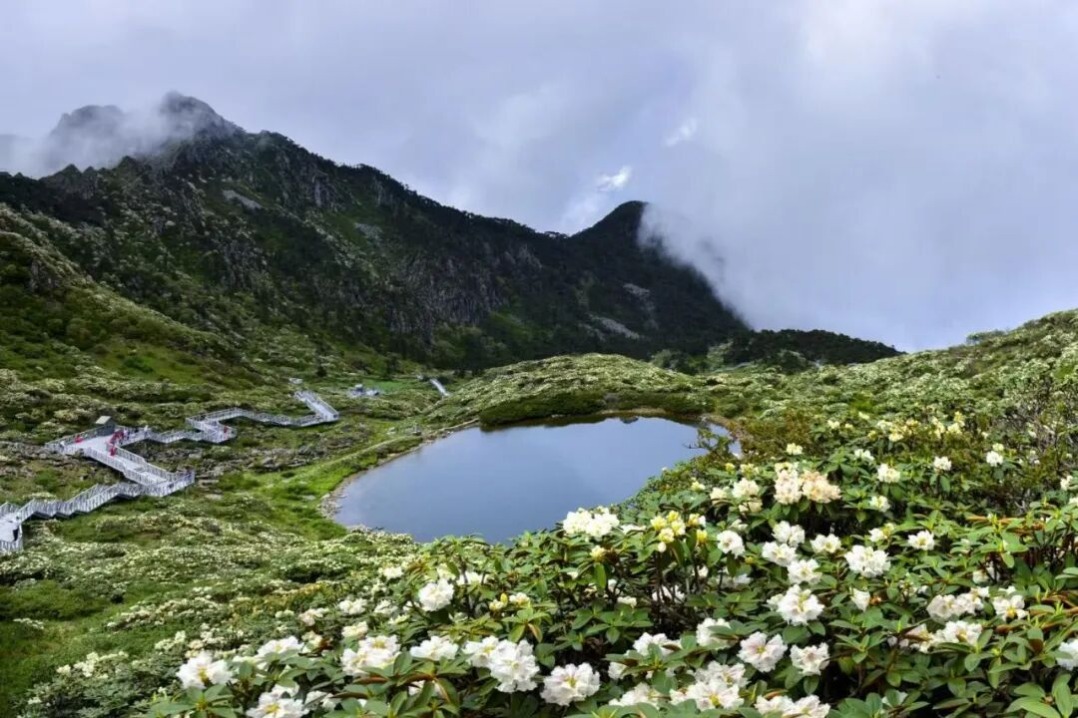
For nearly 40 years, the full extent of biological diversity across the Cangshan Mountain range in Southwest China’s Yunnan Province has eluded scientific understanding. Now, a groundbreaking three-year comprehensive biodiversity census has pulled back the curtain on one of China’s most ecologically significant landscapes, revealing surprising ecological richness that defies its relatively small geographic footprint.
Covering just 1,000 square kilometers — an area equal to 0.25% of Yunnan’s total land mass — the mountain range is home to nearly 25% of all vascular plant species recorded across the entire province, according to the survey results publicly released Friday. This marks the first systematic, full-scope study of Cangshan’s ecosystems since international joint research expeditions conducted work in the region in the 1980s, and it formally confirms the long-suspected status of Cangshan as a globally critical biodiversity hotspot.
Over the course of the three-year survey, research teams from across the country’s top forestry and botanical institutions documented more than 4,600 distinct plant species, 578 vertebrate species, and multiple previously unknown taxa new to global scientific classification. “This is the first time we have gained a complete, evidence-based picture of all the biological life that exists across Cangshan,” noted Zhong Mingchuan, lead research team member and head of the Yunnan Academy of Forestry and Grassland. “This research answers the most fundamental, long-unanswered questions about the region’s biological resources.”
In addition to cataloging species, the research team developed the first comprehensive vegetation classification system specifically for the mountain range, and identified several vegetation types that had not been formally recorded in the region before, including monsoon evergreen broadleaf forests. Xiang Chunlei, a researcher with the Kunming Institute of Botany at the Chinese Academy of Sciences, emphasized that every species documented fulfills a unique, non-substitutable function in maintaining the mountain’s overall ecological balance. “It is misleading to rank species by perceived importance,” Xiang explained. “Every organism has an irreplaceable role within the broader Cangshan ecosystem.”
Beyond its extraordinary biodiversity, the survey also highlights Cangshan’s underrecognized critical role in sustaining the health of Erhai Lake, one of Yunnan’s largest and most ecologically and economically important freshwater resources. Using cutting-edge isotope tracing technology, researchers confirmed that more than 65% of Erhai Lake’s total water volume comes from surface runoff and groundwater recharge originating in Cangshan’s mountain ecosystems.
Encouragingly, the survey data also documents clear, long-term ecological improvement across the mountain range over the past four decades. Since the late 1980s, overall vegetation coverage across Cangshan has increased steadily, and researchers have classified roughly two-thirds of the entire mountain range as being in “good” or “excellent” ecological condition today.
These scientific findings align closely with the on-the-ground changes experienced by local communities who call Cangshan’s slopes home. In Guangming Village, located on the mountain’s western slope, resident Chen Jiaru has observed a sharp rise in the number of domestic and international tourists traveling to the area specifically to learn about the mountain’s unique natural ecosystems. “More and more visitors come here specifically to explore and understand Cangshan’s natural environment,” Chen said. “Our village has become an accessible window for people from across the country and around the world to experience the mountain’s extraordinary biodiversity.”
Local villagers have adapted to this growing interest by partnering with scientific educators to host educational study groups and guided ecological walking tours, while older community members share generations of traditional ecological knowledge about the mountain’s native plants and wildlife with visitors. For conservation managers, the new comprehensive species map has also allowed for far more targeted and effective protection efforts. At the management station for the Cangshan Erhai National Nature Reserve, head ranger Zhao Tichao explained that the survey’s findings have removed much of the uncertainty that previously guided conservation work. “We now have a clear, accurate understanding of exactly which species live here, and where they are located,” Zhao said. “This allows us to focus our limited conservation resources far more effectively than ever before.”