A sharp and public breakdown in diplomatic relations between Israel and Turkey has accelerated this week, with top political leaders from both nations launching fiery, personal accusations against one another. The escalating conflict is rooted in competing geopolitical ambitions across the Middle East, particularly over the ongoing Israeli military campaign in Gaza and long-standing contestation for regional influence in Syria.
The exchange of hostilities began when Israeli Prime Minister Benjamin Netanyahu took to the social platform X to level severe allegations against Turkish President Recep Tayyip Erdoğan. Netanyahu accused Erdoğan of carrying out systematic violence against Kurdish civilians within Turkey’s own borders and providing critical political and logistical support to what he labeled Iran’s terrorist network and its regional proxy groups.
Netanyahu’s increasingly critical rhetoric toward Ankara has aligned with a noticeable shift in Turkish foreign policy over recent months, which has seen Turkey move to strengthen diplomatic and security ties with Greece and Cyprus, two of Israel’s close regional partners. Independent regional analysts note that the emerging bilateral rivalry is increasingly centered on control of influence in Syria, where competing interests between the two states have boiled under the surface for decades.
Turkey’s response to Netanyahu’s accusations was swift and equally incendiary. Senior Turkish officials described Netanyahu as the “Hitler of our era,” justifying the label by pointing to Israel’s large-scale military operations in Gaza and its aggressive actions across the broader Middle East. In an official public statement, the Turkish Ministry of Foreign Affairs argued that Netanyahu’s confrontational foreign policy is a deliberate distraction: its core goal is to derail ongoing peace negotiations in the region and clear the way for continued Israeli territorial expansion. The statement added that without this political diversion, Netanyahu faces potential corruption trials and imprisonment in his own country.
The Turkish foreign ministry also reiterated claims that the International Criminal Court has already issued an arrest warrant for Netanyahu on charges of war crimes and crimes against humanity, noting that Israel is currently facing genocide proceedings at the International Court of Justice brought by South Africa, with Turkey’s formal backing.
The rhetorical clash escalated further when Israeli Defense Minister Yoav Katz echoed Netanyahu’s attacks, labeling Erdoğan a radical Islamist aligned with the Muslim Brotherhood who has overseen mass violence against Kurdish communities. Katz also criticized Erdoğan for what he claimed was passive acceptance of Iranian missile activity near Turkish territory, arguing that Erdoğan’s harsh anti-Israel rhetoric is a distraction from his own weakness. Katz claimed that “after failing to respond to Iranian missile fire into Turkish territory and exposing himself as a paper tiger, Erdoğan has turned to anti-Semitic rhetoric to divert attention, while organizing political show trials against Israeli political and military leadership inside Turkey.”
Senior Turkish officials pushed back immediately against these new attacks. Burhanettin Duran, Turkey’s deputy foreign minister, argued that Netanyahu’s aggressive rhetoric is a desperate tactic to prop up his own political survival at the cost of regional stability. Duran stated that “Netanyahu, who has orchestrated genocide in Gaza and launched attacks on seven countries across the region, is lashing out at our President out of sheer desperation. He is a convicted criminal with open arrest warrants, and he has no allies left.”
Duran added that Israel’s pattern of cross-border military action is a deliberate strategy to drag the entire region into chaos to prop up Netanyahu’s beleaguered government, noting that “Netanyahu has no legitimacy to lecture any country on global or moral standards. He will be held accountable for his crimes against humanity sooner or later.”
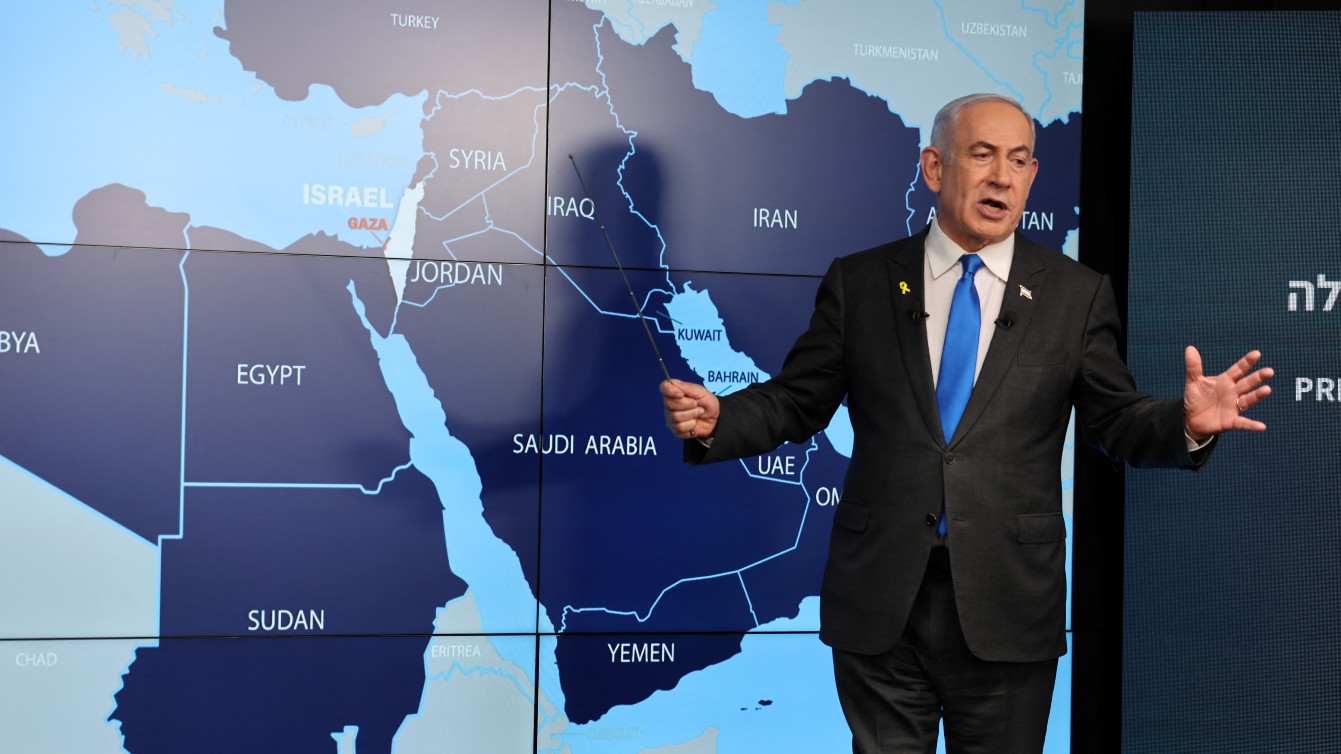
The sharp escalation in verbal attacks followed a recently televised address by Netanyahu that drew widespread criticism for more than just its confrontational tone. Behind the prime minister during the pre-recorded speech, which focused heavily on countering Iranian influence in the region, a map was displayed that critics argue shows an expanded vision of Israeli territorial control, particularly encompassing all occupied Palestinian territories. The map sparked global fears that Netanyahu’s government is planning formal annexation of Palestinian land, a direct violation of international law.
The current rapid deterioration of Israel-Turkey ties marks a dramatic shift in Middle Eastern regional dynamics. Over the past decade, relations between the two countries, which have at times been strategic economic and security partners, have fluctuated dramatically, repeatedly strained by disagreements over Gaza, the legitimacy of Palestinian statehood, and competing visions for regional order.
Tensions have been building for months: back in August, Turkey implemented formal restrictions barring Israeli-owned or Israeli-linked ships from accessing Turkish ports. This week, Reuters reported that Turkish port authorities have begun requiring informal additional checks, mandating shipping agents submit formal declarations confirming that vessels have no connections to Israel and are not carrying military or hazardous cargo destined for Turkish terminals. Later that same August week, Turkish Foreign Minister Hakan Fidan called on all Islamic nations to coordinate action to suspend Israel from all United Nations General Assembly meetings and activities.
Speaking at an emergency summit of Organisation of Islamic Cooperation foreign ministers held in Riyadh, Saudi Arabia, Fidan argued that collective global action is urgently needed to stop what he called Israeli genocide in Gaza and ongoing settler violence in the occupied West Bank. Turkey is also a core backer of The Hague Group, a coalition of eight countries — Bolivia, Colombia, Cuba, Honduras, Malaysia, Namibia, Senegal, and South Africa — formed explicitly to coordinate efforts to hold Israel accountable for its actions under international law.
Turkey’s formal break with Israel accelerated sharply after October 2023, when Ankara joined South Africa’s genocide case against Israel at the International Court of Justice and began mobilizing international diplomatic platforms to build a global coalition opposing Israel’s military campaign in Gaza. The latest round of public accusations has confirmed what many regional analysts had already predicted: the two former partners are now locked in an open geopolitical rivalry that will reshape alliances across the Middle East for years to come.