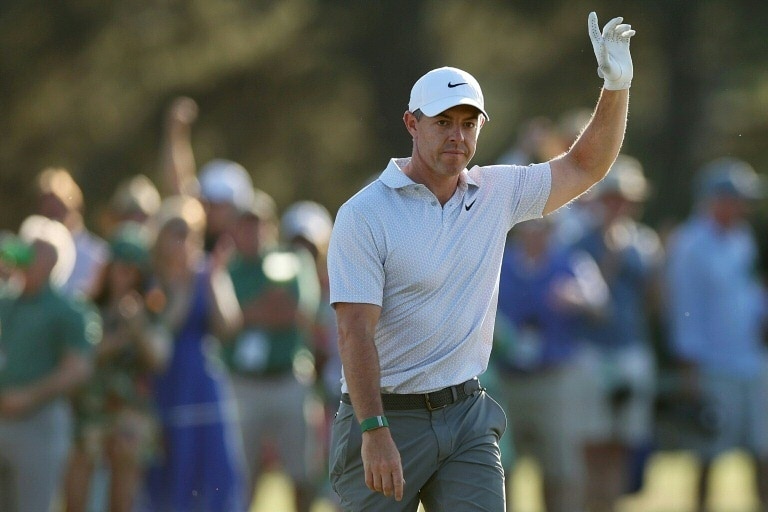
As players prepared to tee off for Saturday’s third round of the Masters Tournament at Augusta National Golf Club, all conversations still centered on one astonishing achievement: Rory McIlroy’s record-breaking 36-hole performance that gave him an unprecedented six-stroke advantage over the entire field.
The 36-year-old Northern Irish golfer put on a late-round clinic on Friday, carding birdies on six of his final seven holes – including the last four in a row – to storm into the top position, leaving fellow pros struggling to find words to describe the display of dominance. “Rory played great, made the most of pretty much everything he could out there and that’s what it takes to be beating the field by six,” said world number three Cameron Young, who competed alongside McIlroy on Friday.
As the defending Masters champion, McIlroy fired a seven-under-par 65 in his second round, pushing his cumulative score to 12-under 132 at the halfway mark of the year’s first men’s major championship. A victory this weekend would see him join an exclusive club of golf legends: only Tiger Woods, Jack Nicklaus and Nick Faldo have ever successfully defended their green jacket titles.
McIlroy navigated Augusta’s notoriously tricky Amen Corner with poise, notching birdies on both the challenging par-three 12th and par-five 13th holes. He closed out his round with a stunning 29-yard chip-in birdie at 17, followed by a clinical six-foot putt for birdie at 18 to etch his name into Masters record books. Even before Friday’s historic round, 1992 Masters champion Fred Couples predicted McIlroy’s momentum after he shared the first-round lead, saying, “Rory may never lose this thing again.”
Heading into Saturday’s play, Americans Patrick Reed and Sam Burns are tied for second place at six-under 138. A further stroke back at five-under 139, Ireland’s Shane Lowry, England’s Justin Rose and Tommy Fleetwood remain within striking distance if McIlroy slips.
McIlroy is set to tee off alongside Burns in Saturday’s coveted final pairing at 2:50 p.m. local time (1850 GMT), aiming to extend his commanding lead. Reflecting on his mindset ahead of the third round, McIlroy said he plans to stick to the strategy that has worked so far: “I have to go out there with the same free, trusting mindset I have the first two days.”
The five-time major champion has delivered a masterclass in adaptive play through the first two rounds. Notably, he has yet to hit a fairway on any of the tournament’s par-five holes, but still has played those holes seven-under par thanks to elite iron play and precision putting. Even with only 13 of 28 fairways found – ranking last among the 54 players who made the cut in driving accuracy – McIlroy ranks second in the field in scrambling percentage. His 334.2-yard average driving distance is second in the tournament, and he has needed only 51 putts through two rounds.
“I haven’t panicked when I’ve hit it off course and into the trees,” McIlroy explained. “When I was in the trees I didn’t mind. I sort of feel like I’m playing with the house’s money, which is a nice place to be.”
Last year’s Masters victory was a career-defining moment for McIlroy, ending a 10-year major championship drought and completing his career Grand Slam, and his comfort at Augusta is clear. “I’ve always loved this course and this tournament even when I felt it didn’t love me back,” he said.
Historically, only two 36-hole leads in major championship history have been larger than McIlroy’s six-stroke advantage: Henry Cotton’s nine-stroke lead at the 1934 British Open and Brooks Koepka’s seven-stroke edge at the 2019 PGA Championship. Friday’s 65 was also McIlroy’s 10th career major round of 65 or lower, matching a record previously shared only by Tiger Woods and Dustin Johnson. For context, Woods holds the 54-hole Masters lead record of nine strokes set during his 12-stroke victory in 1997, while Jordan Spieth and Dustin Johnson share the 54-hole scoring record of 200, set in 2015 and 2020 respectively.