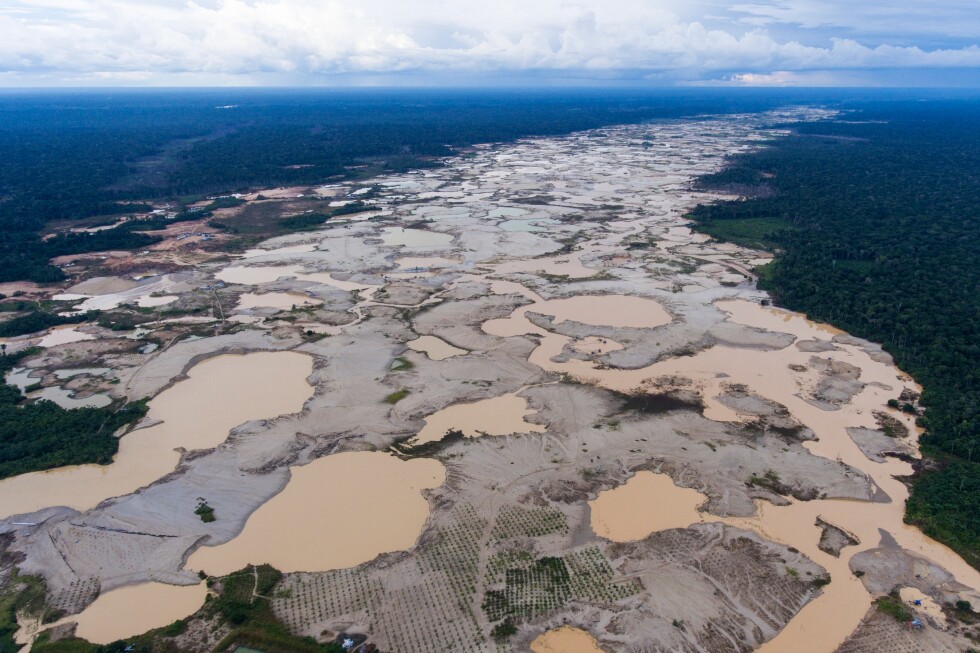
As Peru prepares for a pivotal general election on Sunday that will install a new president and full Congress, one of the country’s most damaging and profitable illicit activities — unregulated illegal gold mining — has been almost entirely sidelined by political candidates, even as the industry pushes deeper into the Amazon rainforest and protected Indigenous territories.
Industry and policy experts warn this widespread silence from campaigners exposes a systemic national failure to confront what is now Peru’s largest illicit economy, a multi-billion dollar trade that inflicts escalating damage on critical ecosystems, public health, and Indigenous communities that have called the Amazon home for millennia.
“Political parties do not grasp that illegal mining has become the country’s dominant criminal enterprise, generating more illicit revenue than any other activity,” said César Ipenza, a prominent Peruvian environmental lawyer. “There is either profound ignorance about what this crisis means for Peru’s future — or, in too many cases, political actors have already become complicit participants in this illegal economy.”
Projections from the Peruvian Institute of Economics estimate illegal mining will generate more than $11.5 billion in revenue in 2025, accounting for over 100 tons of annual gold exports. The scale of the illicit industry now rivals the size of Peru’s formal legal gold mining sector and outpaces the revenue generated by drug trafficking, long considered the country’s top illegal trade.
A small number of candidates have put forward limited proposals to address the crisis, including former officials and technocratic candidates Jorge Nieto and Alfonso López Chau. Their plans include measures such as mandatory gold traceability systems, enhanced financial intelligence tracking, and expanded protections for at-risk environmental defenders. But these proposals remain scattered across platforms and fall far short of a comprehensive national strategy to curb the industry’s growth.
Many other leading candidates, representing Peru’s most influential conservative and populist parties, have centered their campaigns on issues like public security, broad economic growth, and expanded extractive development, with no direct mention of illegal mining or its deep ties to systemic corruption and illegal territorial control in the Amazon. A handful of high-profile candidates — including media personalities turned politicians Ricardo Belmont and Carlos Álvarez — omit the issue entirely from their published policy platforms.
“Illegal mining and other large illicit economies are not a priority in any major party’s governing plans,” said Magaly Ávila, director of environmental governance at Proetica, a leading Peruvian anti-corruption organization. According to Proetica’s analysis, roughly 64% of all party platforms fail to address the illegal mining crisis in any meaningful way, while only 5% of parties tackle the issue “clearly and explicitly.”
A March 2026 analysis from Peru’s official Observatory of Illegal Mining reinforces these findings. The audit found that only 12 of the country’s 36 registered political parties have released specific policy proposals to address illegal mining, while the remaining parties either offer only vague general statements without actionable measures or do not mention the issue at all.
Peruvian governments have repeatedly announced new crackdown operations and national strategies to combat illegal mining in past years, but enforcement of these policies remains severely limited, experts say. The Associated Press reached out to multiple Peruvian government entities to request comment on illegal mining and protections for Indigenous territories ahead of the election, but received no response prior to publication.
Peruvian lawmakers have repeatedly extended a temporary regulatory program that allows informal miners to continue operating while they pursue formal legal status. Critics of the program argue it has been widely abused by criminal networks and has directly enabled the expansion of illegal mining across the country.
At the same time, recent changes to Peruvian national legislation have weakened the ability of prosecutors and judges to pursue organized criminal groups, including large-scale illegal mining networks, according to international human rights and environmental groups. Analysts say these policy rollbacks came in response to intense political pressure from small-scale miner associations, which have organized large public protests to demand looser regulations. These protests have made tightening enforcement far more politically difficult for incumbent and aspiring politicians alike.
Julia Urrunaga, Peru program director for the London-based Environmental Investigation Agency (EIA), noted that many small-scale miner protests appear to be highly coordinated from behind the scenes, indicating that powerful criminal networks are pulling the strings to advance their policy interests.
The rapid expansion of illegal mining in recent years has been largely driven by soaring global gold prices, which have climbed to between $4,500 and $5,000 per ounce, making even small deposits of gold extremely profitable for miners. Once concentrated almost exclusively in the southern Amazon region of Madre de Dios, illegal mining operations have now spread to new parts of the Amazon basin and beyond Peru’s traditional mining corridors.
“Gold prices have hit historic highs, and that has directly driven the explosive expansion of illegal mining across the country,” Ipenza said. “The Peruvian state simply does not have the institutional capacity to respond to or prosecute this activity at its current scale.”
Illegal mining operations almost universally rely on liquid mercury to separate gold from ore, a cheap but highly toxic process that releases massive amounts of the heavy metal into Peruvian Amazon rivers. From there, mercury builds up in the tissue of fish, entering the food chain that millions of Peruvians rely on for sustenance.
“In Amazonian river communities, between 50% and 70% of the daily diet comes from local fish,” explained Mariano Castro, Peru’s former vice minister of environment. “So human exposure to mercury grows exponentially. Mercury is extremely toxic, and it causes severe, permanent neurological damage for people exposed over long periods.”
Environmental and public health experts have already confirmed that mercury contamination in many affected regions exceeds international safety standards, creating long-term public health risks for local populations. Ipenza warned that continued expansion of illegal mining across the Amazon “will bring widespread contamination, growing influence for transnational criminal groups, and direct existential harm to Indigenous and local populations.”
“Illegal mining already puts our health, the Amazon’s biodiversity, and our traditional ways of life at grave risk,” said Tabea Casique, a board member of AIDESEP, Peru’s largest national Indigenous organization. “Most political parties are still not taking this problem seriously or presenting concrete plans to address it.”
Castro, the former environment vice minister, called past state efforts to rein in illegal mining “completely insufficient,” noting that lawmakers have systematically weakened legal tools to prosecute criminal mining networks. These changes include reduced penalties for illegal mining and new restrictions that make it harder to classify large-scale mining operations as organized crime. Widespread gaps in regulatory oversight also allow illegally mined gold to be laundered into formal legal supply chains, most often through small-scale processing plants that mix illicit and legal gold for export.
Ipenza called for sweeping reforms, including stronger regulatory oversight of small-scale gold processing plants and improved inter-agency coordination between customs officials, financial intelligence units, and criminal prosecutors to track gold flows and crack down on illegal activity. Analysts agree that weak gold traceability systems are one of the central vulnerabilities enabling illegal mining’s expansion.
“There is no functional system to trace gold mining production in Peru,” EIA’s Urrunaga said. “Different authorities hold fragmented bits of information, but there is no unified system — and apparently no political will — to connect those pieces and track illegal gold.”
“We are talking about more than $12 billion in illegal gold exports every year,” she added. “How can this activity continue with almost total impunity?”
Policy and environmental experts warn that delaying action on the crisis will only make it far harder to contain in coming years. The next Peruvian government will immediately face mounting pressure to confront a crisis that is already spiraling out of control.
“Authorities cannot fulfill their fundamental responsibility to protect Peruvian citizens if they continue to normalize an activity that causes such widespread, irreversible harm,” Castro said.