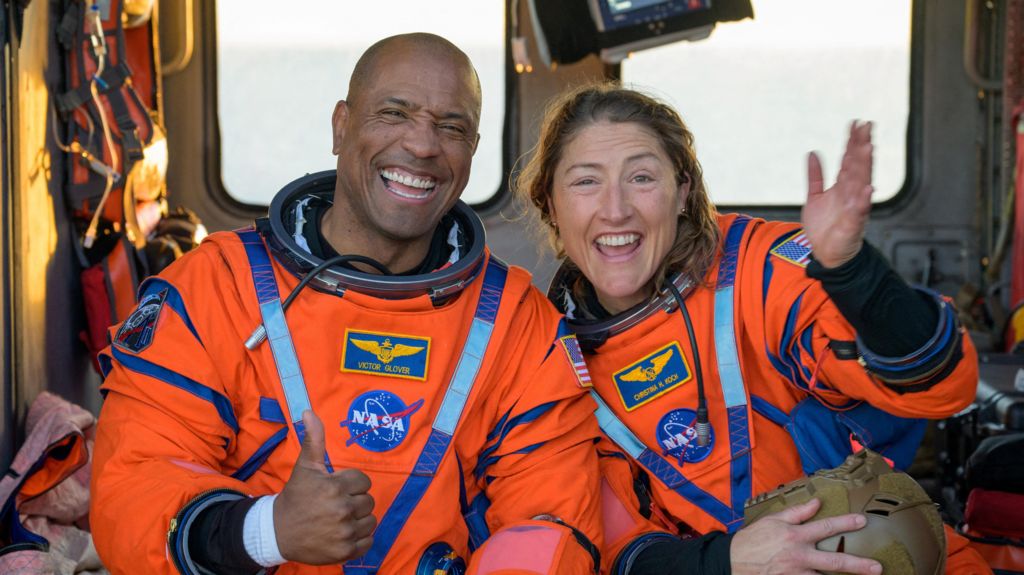
After a groundbreaking nine-day journey further from Earth than any human crew has ever traveled, NASA’s Artemis II mission four-person team has completed a flawless re-entry and safe splashdown in the Pacific Ocean, bringing humanity one giant step closer to returning astronauts to the lunar surface.
The mission, which circled the Moon, closed its final chapter when the European Space Agency-built service module — the component that supplied power and propulsion for Orion throughout its deep space trek — separated from the crew capsule at 19:33 EDT (00:33 BST). What followed was the highest-stakes phase of the entire voyage: atmospheric re-entry, a maneuver that demanded near-perfect precision to avoid catastrophic outcomes.
As the capsule Integrity, named by the crew, plunged into Earth’s upper atmosphere at over 24,000 miles per hour, its heatshield was exposed to temperatures reaching half the surface temperature of the Sun. Extreme heat triggered a six-minute communications blackout between the capsule and mission control in Houston, a period that left thousands of engineers and flight controllers holding their breath. When Commander Reid Wiseman’s voice cut through the silence with the words, “Houston, Integrity here. We hear you loud and clear,” celebrations broke out across the control room. Shortly after, the capsule’s red-and-white parachutes deployed perfectly, guiding Integrity to a bullseye splashdown that NASA commentator Rob Navias called a flawless end to the historic voyage.
The successful re-entry was no accident. Following the 2022 uncrewed Artemis I test flight, engineers discovered unexpected damage to Orion’s heatshield, sparking widespread concerns about crew safety on the first crewed mission. To address this risk, teams redesigned the re-entry trajectory, a change that models predicted would cut thermal stress on the heatshield. Artemis II marked the first in-flight test of this adjusted return path, and while full thermal data analysis is still ongoing, the safe arrival of the crew confirms the engineering adjustment worked as intended.
Once the capsule settled in the ocean, recovery teams carefully extracted the crew: Commander Reid Wiseman, pilot Victor Glover, mission specialist Christina Koch, and Canadian Space Agency astronaut Jeremy Hansen. The four were airlifted to the USS John P Murtha for initial medical checks, and photographs from the recovery ship show the crew smiling, chatting, and posing for photos as they began their recovery back to Earth gravity. They will be flown to Houston on Saturday to reunite with their families, though NASA has not yet announced a date for their first public appearance.
Flight Director Rick Henfling shared at a post-splashdown press conference that the entire team felt a mix of intense anxiety and steady confidence through the re-entry process. “We all breathed a sigh of relief once the (capsule’s) side hatch opened up,” he said. “The flight crew is happy and healthy and ready to come home to Houston.”
Acting NASA associate administrator Lori Glaze heaped praise on the crew, highlighting both their individual capabilities and the exceptional teamwork they displayed throughout the mission. “I think they really brought an amazing sense of what we were trying to achieve,” she said. “It was a mission for all of humanity.”
NASA associate administrator Anit Kshatriya emphasized that the perfect re-entry trajectory was not a stroke of luck, but the product of relentless work by thousands of aerospace professionals. “The team hit it, that is not luck, it is 1,000 people doing their jobs,” he noted.
U.S. President Donald Trump welcomed the crew home in a public statement, calling the entire 10-day mission “spectacular” and reaffirming a standing invitation for the crew to visit the White House.
This safe return marks a critical milestone for NASA’s broader Artemis Program, which was launched to resume human lunar exploration for the first time since the final Apollo mission in 1972, build a permanent outpost on the Moon, and lay the groundwork for the first crewed mission to Mars. With Artemis II’s success confirming that Orion’s hardware, navigation systems, and crew operations function as intended in deep space, the program can now move forward to its next phases.
Under the plan laid out by new NASA administrator Jared Isaacman, the next mission, Artemis III, has been redesigned as an Earth-orbit test flight to practice rendezvous and docking procedures with lunar landers built by SpaceX and Blue Origin, and is currently scheduled for mid-2027. The first crewed lunar landing, Artemis IV, is targeted for 2028, though some industry analysts have raised questions about whether that timeline can be met. While today’s successful homecoming does not yet put human boots back on the lunar surface, it lays a solid foundation for the ambitious work ahead — even as the hardest challenges of landing humans on the Moon still lie ahead.