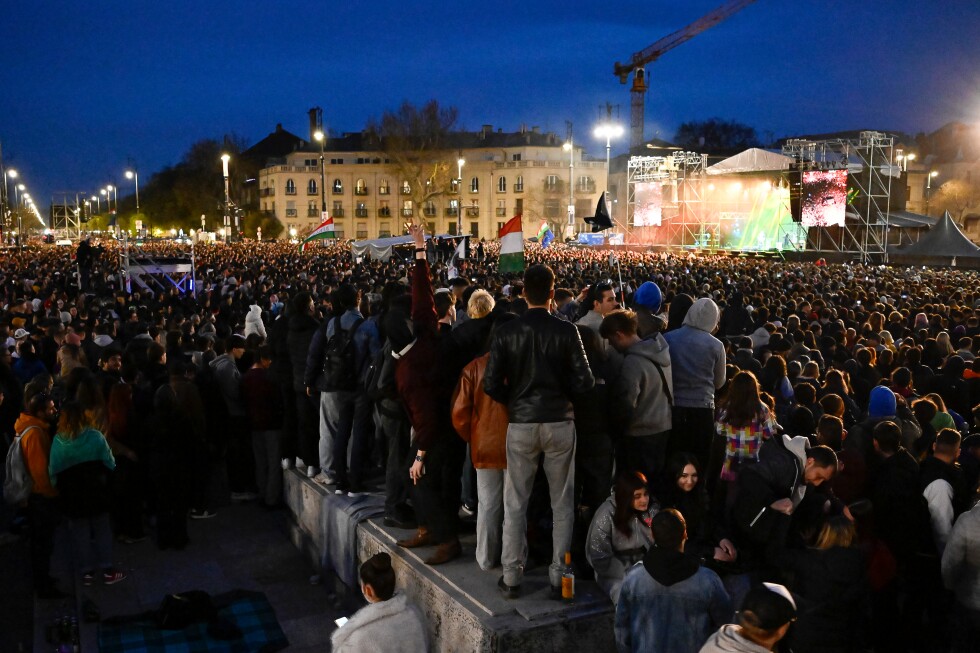
BUDAPEST, Hungary — Just 48 hours before Hungary’s most consequential national election in decades, more than 100,000 opposition supporters packed Budapest’s sprawling Heroes’ Square and surrounding thoroughfares for a seven-hour “system-breaking” concert. The event, organized by the grassroots Civic Resistance Movement, brought together 50 of Hungary’s most popular musicians to urge voters to oust long-serving Prime Minister Viktor Orbán’s nationalist-populist government in Sunday’s poll.
Every performer taking the stage on Friday has a history of public dissent against Orbán’s administration, playing just one song each that carries explicit criticism of what organizers call Orbán’s “corrupt regime.” The crowd, dominated by young Hungarians hungry for political change, repeatedly broke into raucous anti-government chants. One of the most common refrains was “Ruszkik haza!” — “Russians go home” — a slogan borrowed from Hungary’s 1956 anti-Soviet revolution that has regained cultural and political traction amid Orbán’s years of increasingly close alignment with the Kremlin, even as Russia wages war in Ukraine.
Many attendees traveled from across the country to join the demonstration, drawn both by their favorite artists and a shared desire for political turnover. Nineteen-year-old attendee Heléna Sugár told reporters that while she was a fan of many of the performers, the event’s core political mission far outweighed its entertainment value. “I listen to these artists every day. But right now, the only thing that matters here is the political goal,” Sugár explained. “It is important to show how many of us share this view — how many of us believe this system’s time is up, and it is finally time for change.”
The massive in-person turnout, paired with an additional 100,000 concurrent viewers tuning into the event’s online livestream, underscores the deep and widespread dissatisfaction with Orbán’s 16-year autocratic rule, particularly among the country’s younger generations. Hungary has seen a sharp widening of its generational political divide in recent months: polling shows young people overwhelmingly reject Orbán’s leadership, while older, more rural voters remain loyal to the prime minister and his ruling Fidesz party.
Orbán’s hold on power has weakened considerably heading into the 2024 election, dragged down by prolonged economic stagnation, high-profile corruption scandals, and the sudden rise of a credible new opposition challenger: center-right Tisza party leader Péter Magyar, a former government insider who has emerged as the biggest threat to Orbán’s authority in nearly 20 years. Recent data from pollster 21 Research Center confirms the youth-driven shift toward opposition: a staggering 65% of voters under 30 back Tisza, compared to just 14% who support re-electing Orbán.
Twenty-two-year-old Noel Iván, who relocated to Austria to escape economic and political stagnation in Hungary, traveled back to attend the concert. He said he hopes to return to Hungary permanently to build his future, a prospect he calls “currently hopeless and deeply sad” under Orbán’s leadership. Though he does not identify as a conservative, Iván said he plans to vote for Tisza to help push for long-sought regime change.
The lineup of Friday’s concert included many of Hungary’s biggest contemporary acts: viral singer Azahriah, popular rappers Beton.Hofi and Krúbi, and iconic alternative rock groups Quimby and Ivan and the Parasol. Benedek Szabó, frontman and lead songwriter for beloved alternative band Galaxisok, told the Associated Press that Orbán’s cozy relationship with Moscow amounts to “selling out our EU allies to Russia” — a betrayal that has pushed even previously apolitical citizens to demand change.
“Everyone’s fed up, and everyone’s ready to finally change this system, to finally send a message — not just today, but on election day, that we’ve had enough, and we want to belong to Europe,” Szabó said. Galaxisok’s performance centered on a track that laments the years of missed progress and wasted opportunities under Orbán’s rule, before closing with a defiant stanza that captured the mood of the entire rally: “Whispered on trams, written on factory walls, on rain-drenched autumn streets, secretly everyone knows. We’ve had enough, once and for all. In the end, all regimes fall.”
Organizers emphasized the concert was intended to mobilize disengaged voters, reminding them that the era of unchallenged impunity for Orbán’s government is coming to a close, and that every ballot cast on Sunday will help determine Hungary’s future direction.