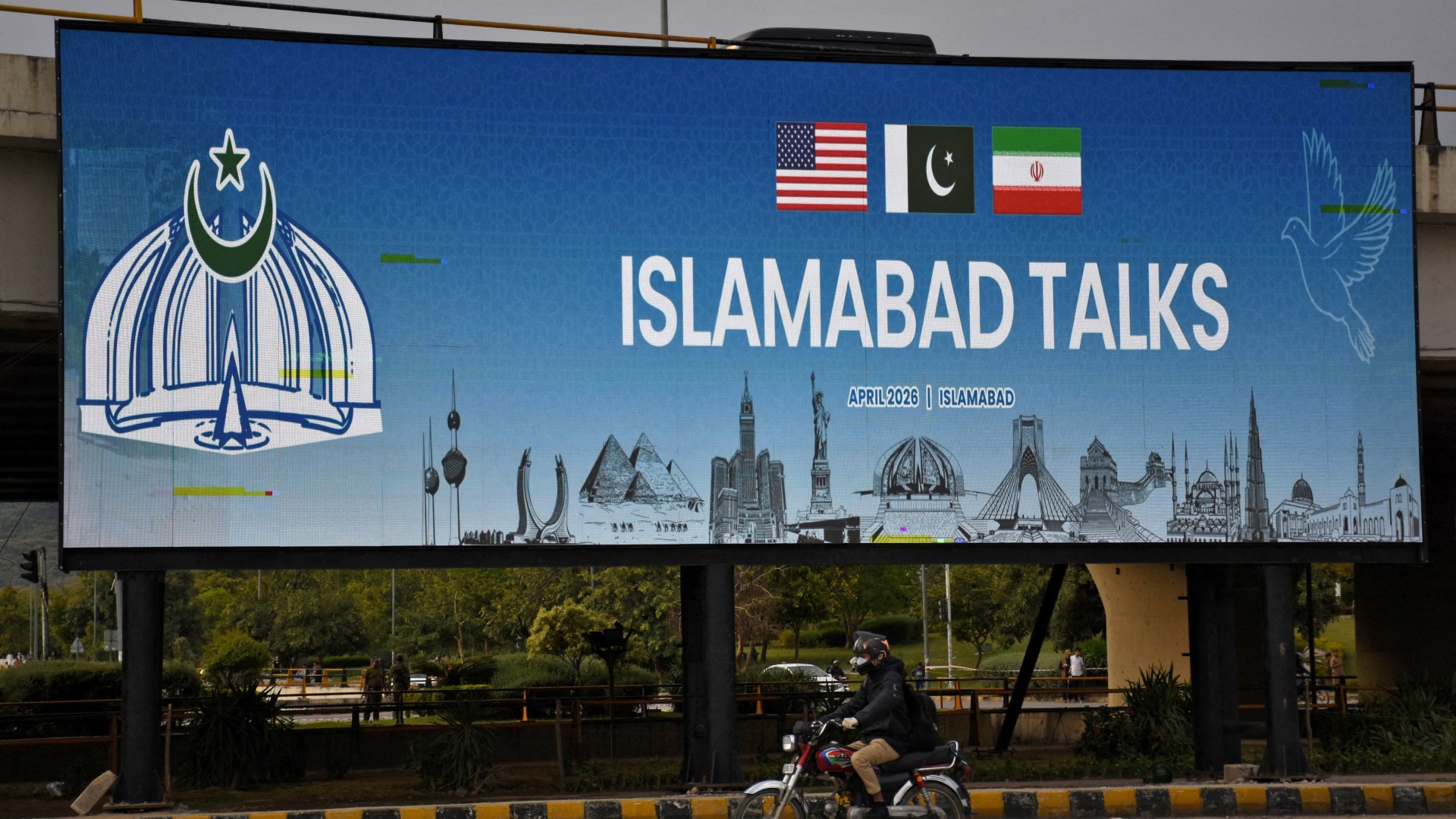
On a Friday morning in Washington D.C., U.S. Vice President JD Vance departed for Pakistan’s capital of Islamabad, bringing a more optimistic and conciliatory tone to Saturday’s landmark ceasefire talks with Iran that sets him apart from his superior, President Donald Trump. Speaking to reporters ahead of the negotiations, which will be mediated by Pakistan, a country that maintains friendly diplomatic ties with both Washington and Tehran, Vance struck a measured hopeful note.
“We’re looking forward to the negotiation. I think it’s going to be positive,” Vance said. Echoing comments previously made by President Trump, he added, “As the president of the United States said, if the Iranians are willing to negotiate in good faith, we’re certainly willing to extend the open hand. If they’re going to try to play us, then they’re going to find the negotiating team is not that receptive.”
Trump, for his part, took a far more aggressive stance in a series of posts Friday on his Truth Social platform, claiming Iran “has no cards” to play in negotiations and arguing that Tehran’s public relations strategy is far stronger than its military capabilities. “The only reason they are alive today is to negotiate!” the president wrote.
As both sides prepare for the critical discussions, Pakistani Prime Minister Shehbaz Sharif framed the talks as a defining turning point for the region, calling it a “make or break” moment in public comments Friday.
For Iran, Vance’s appointment as head of the U.S. delegation is viewed as a welcome shift from the failed talks of the past, when the negotiation team was led by special peace envoy Steve Witkoff and Trump’s son-in-law Jared Kushner, both of whom faced intense criticism for their lack of technical diplomatic experience relative to seasoned Iranian negotiators like Foreign Minister Abbas Araghchi. Notably, Kushner holds no official role in the Trump administration but maintains extensive private financial interests across Israel and Gulf Arab states. Admiral Brad Cooper, head of U.S. Central Command, is also expected to join the talks; his appearance at previous diplomatic talks in Oman alongside Witkoff and Kushner in February was widely interpreted as a veiled show of military force to reinforce Trump’s willingness to use military power against Iran.
Negar Mortazavi, a senior fellow at the Center for International Policy, called Vance’s leadership of the delegation a clear signal of Washington’s increased seriousness. “It shows a lot of seriousness. It’s a major step up,” Mortazavi told Middle East Eye Friday. She added that if Iran sends Parliament Speaker Mohammad Bagher Ghalibaf to lead its delegation, the two sides would be evenly matched. Ghalibaf will indeed join Foreign Minister Araghchi for the talks, but before departing Tehran Friday, he laid out a non-negotiable precondition: the U.S. must first unblock more than $100 billion in Iranian assets held in international bank accounts before formal discussions can begin. “Two of the measures mutually agreed upon between the parties have yet to be implemented: a ceasefire in Lebanon and the release of Iran’s blocked assets prior to the commencement of negotiations,” Ghalibaf wrote on X. “These two matters must be fulfilled before negotiations begin.”
These talks mark a historic shift from U.S.-Iran negotiations of the past six years. Since the Trump administration unilaterally withdrew from the 2015 Iran Nuclear Deal in 2018, direct talks between the two countries have been nonexistent, and all discussions have been carried out through third-party mediators shuttling messages between separate delegations. This time around, the involvement of the U.S. vice president opens the door for potential direct face-to-face negotiations, a development that many analysts see as significant.
Mortazavi noted that Vance’s selection also carries symbolic weight, as he is closely aligned with the anti-war wing of the Republican Party and the Make America Great Again movement. This stands in contrast to Secretary of State Marco Rubio, a longstanding hawk on Iran from the party’s traditional neoconservative wing, Mortazavi explained.
Pakistan, the host and mediator of the talks, has adopted a flexible approach to the format of the discussions. Pakistani Ambassador to Washington Rizwan Saeed Sheikh told Al Jazeera English Friday that “all options are open” for how negotiations will be structured. “I believe it would not be good to have prerequisites or prejudgments or preemptions, but rather let the process flow in accordance with the comfort level of the two conflicting parties,” he said.
Despite the opening for diplomacy, the shadow of military conflict looms large over the talks. In comments to The New York Post Friday, Trump repeated his open threat to resume military action against Iran if no deal is reached. “We’re loading up the ships with the best ammunition, the best weapons ever made – even better than what we did previously, and we blew them apart,” Trump said of U.S. naval deployments. “If we don’t have a deal, we will be using them, and we will be using them very effectively.”
Iran, for its part, has placed the responsibility for a successful outcome firmly on Washington, demanding that the U.S. rein in its closest regional ally, Israel. Within hours of a preliminary ceasefire announcement Tuesday, Israel launched strikes in Lebanon that killed more than 350 people and wounded over 1,000 more. Lebanon’s Hezbollah movement, a key strategic partner of Iran, is widely viewed as the central sticking point in negotiations, as Israel has long held ambitions to reoccupy southern Lebanon.
“The Iran-US Ceasefire terms are clear and explicit: the US must choose-ceasefire or continued war via Israel. It cannot have both,” Araghchi wrote on X Wednesday. “The world sees the massacres in Lebanon. The ball is in the US court, and the world is watching whether it will act on its commitments.”
Israel will not have any official representation at Saturday’s talks in Islamabad, and holds no direct role in the ceasefire agreement reached earlier this week. Washington remains the only primary channel for diplomatic pressure on the Israeli government. Analysts note that U.S. and Israeli interests are currently misaligned on the outcome of the talks.
“They’re not interested in this resolution,” Mortazavi told Middle East Eye of Israel. “And I think US and Israeli interests right now are diverging. Despite Iran saying that the regional cessation of hostilities was part of the agreed ceasefire, and Pakistan has reaffirmed that… this has been a pattern from Israel. Right before the ceasefire or right after the ceasefire, they do an escalation, sometimes essentially in the form of a trap, to push the other side to violate it.”
In response to Israel’s post-ceasefire escalation, Iran has not followed through on its commitments under the preliminary ceasefire deal to change its posture at the Strait of Hormuz, a key global energy chokepoint that Trump has repeatedly demanded Iran open to full commercial traffic.
Ryan Costello, policy director for the National Iranian American Council, warned Friday that the core regional tensions that pushed the two sides to the brink of full war remain unresolved, even as talks are set to open. “While the bombardment of Iran has paused for now, the underlying conditions that brought the region to the brink remain firmly in place,” Costello said in a statement. He added that expectations for a breakthrough should be “very low,” noting that “if diplomats succeed in meeting in Islamabad to begin discussions on a broader peace, they will do so in spite of President Trump’s efforts to walk back the terms.”
For Pakistan, a country with little experience mediating high-level international conflicts between major powers, the bar for success is modest: simply getting the two sides to continue talking would mark a significant win. “Diplomacy is a gradual process,” Sheikh told Al Jazeera English. “For as long as we have to facilitate, we cherish, we value, and we are grateful for the trust reposed in us, and as a repository of that trust, we would be willing to go the whole distance.” The talks come as Pakistan’s own stance on the conflict has come under scrutiny: just two days before the talks opened, Pakistani Defense Minister Khawaja Muhammad Asif posted a since-deleted message on X calling Israel “cancerous” and “a curse for humanity.”