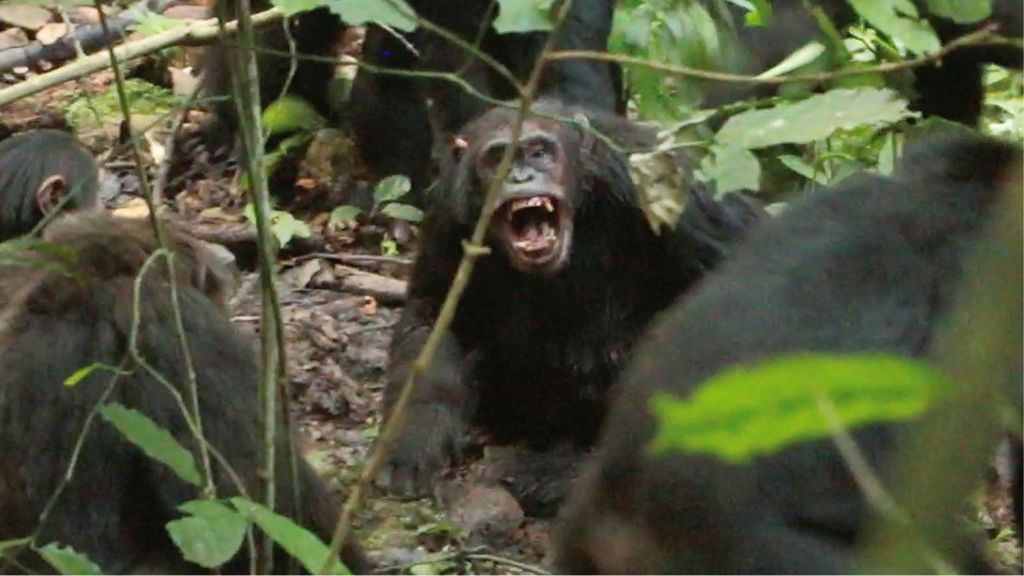
For eight years, a once-cohesive, record-sized community of wild chimpanzees in Uganda has been consumed by brutal internal conflict, leaving dozens dead and offering anthropologists groundbreaking new perspective on the evolutionary roots of human warfare, according to a new study published in the journal *Science*.
The study centers on the Ngogo chimpanzee population in Kibale National Park, which for decades hosted nearly 200 chimpanzees living in relative harmony. Though the large community was informally split into two clusters researchers labeled the Western and Central groups, the subpopulations interacted peacefully, shared resources, and even socialized for generations. That quiet stability began to unravel in 2015, when lead researcher Aaron Sandel, an anthropologist at the University of Texas at Austin and co-director of the Ngogo Chimpanzee Project, first observed clear polarization between the two clusters.
Ordinary chimpanzee disputes typically resolve quickly, Sandel explained: after posturing, screaming, and short chases, rivals often reconcile through grooming and cooperative behavior. But the 2015 confrontation was different. Instead of reconciling, the two clusters avoided one another for six weeks, and every subsequent interaction grew more hostile and aggressive. By 2018, the split was complete, and what followed has been one of the longest and deadliest instances of intra-group chimpanzee violence ever documented. Since the formal split, researchers have recorded 21 targeted lethal attacks, leaving at least seven adult Central males and 17 Central infant chimpanzees dead. The research team notes the true death toll is likely higher, as many bodies are never recovered. “These were chimps that would hold hands,” Sandel said. “Now they’re trying to kill each other.”
While the exact root cause of the conflict remains unclear, researchers have identified three sequential catalysts that disrupted the community’s social fabric. The first came in 2014, when five adult males and one adult female died from unknown causes, breaking key social bridges between the two clusters. The following year, a shift in the community’s alpha male leadership aligned with the first prolonged period of separation; the study notes that changes to dominance hierarchies often increase aggression and social avoidance in chimpanzee groups. The final blow came in 2017, when a respiratory outbreak killed 25 chimpanzees, including one of the last remaining individuals that maintained close social ties with both clusters. A year later, the groups fully separated into rival factions.
Beyond documenting the unprecedented conflict, the study’s authors say their findings challenge common assumptions about the origins of human conflict. Chimpanzees, humanity’s closest genetic relatives, do not organize conflict around human ideological constructs like religion, ethnicity, or political ideology. Yet in the Ngogo split, individuals that spent decades living, feeding, grooming, and patrolling together became lethal enemies solely based on their new group membership. This leads researchers to argue that inter-group relational dynamics may play a larger causal role in human conflict than mainstream scholarship often acknowledges.
James Brooks, a researcher at the German Primate Center who was not involved in the study, called the findings a critical warning for human societies. “Humans must learn from studying the group-based behaviour of other species, both in war and at peace, while remembering that their evolutionary past does not determine their future,” Brooks wrote in a commentary on the study for *Science*.