For nearly a century, Washington has positioned itself as the unchallenged guardian of regional stability across the Middle East, building deep military alliances with both Israel and Gulf Arab monarchies while consistently sidelining Beijing’s ambitions to play a larger diplomatic and security role in the strategically critical region. That long-held narrative of a US-led regional order has recently been fractured by the cross-border escalation between Israel, the United States and Iran, which has upended long-held assumptions about deterrence in the Gulf. Far from being cowed by Washington’s persistent military deployment in the region, Tehran launched retaliatory strikes against Gulf Arab states that had long been viewed as secure under US security umbrella, directly exposing the gaps in the decades-old US-led framework.
In the moments before a devastating escalation, China played a quiet but pivotal part in pulling the region back from the brink of all-out war. Yet in a striking paradox, Beijing has refused to claim credit for its diplomatic intervention, a choice that experts trace to careful strategic calculation: Beijing judges that deeper, more public involvement in Middle East security carries major risks, while the current post-escalation status quo — where US influence appears weakened but Washington remains committed to shouldering the burden of Gulf security — already serves China’s core interests.
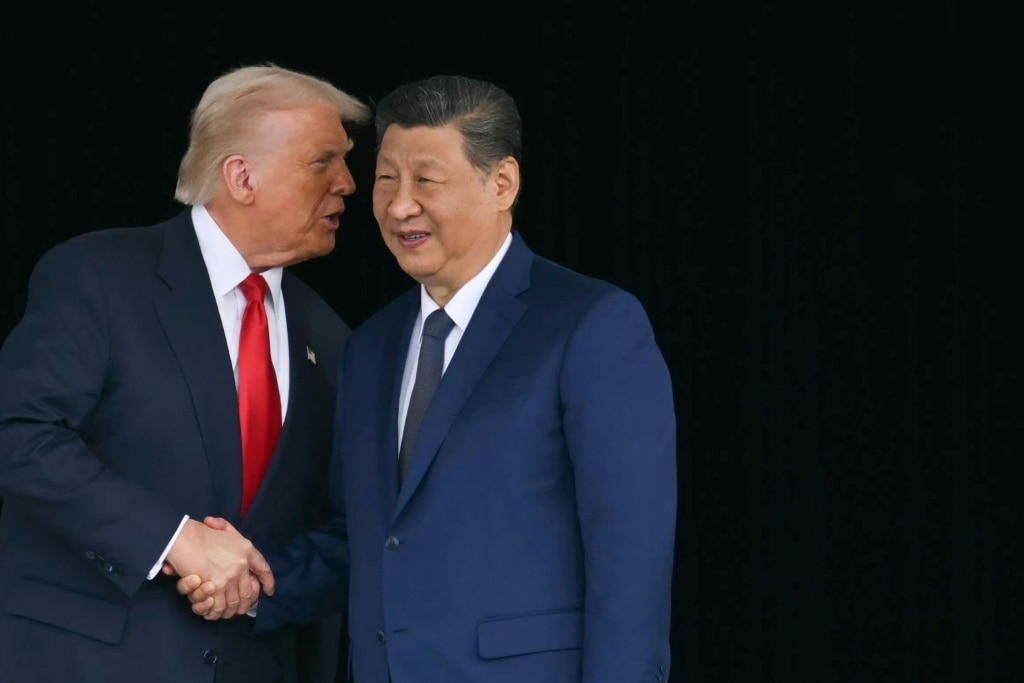
Former US President Donald Trump, in an interview with Agence France-Presse, credited Chinese diplomatic pressure for pushing Iran to agree to the two-week ceasefire, a breakthrough that came barely an hour before Trump’s public threat to obliterate Iranian infrastructure and cultural sites was set to take effect. This account was independently corroborated by a senior Pakistani government official, who told reporters that Chinese negotiators stepped in to convince Iranian leadership to accept the truce at a moment when international hopes for a de-escalation were all but gone.
Despite these accounts from third parties, Beijing’s own public statements on the ceasefire have been deliberately muted. Chinese officials have confirmed their support for the truce but have made no effort to highlight or celebrate their own diplomatic work behind the scenes.
Yun Sun, director of the China Program at the Washington-based Stimson Center, noted that this low-key approach is unusual for Chinese diplomacy, and suggested that Iran may have deliberately framed China as the key peace broker for strategic purposes. “Iran has singled out China as a potential security guarantor so there is an incentive on the part of Iran in presenting the optics of China playing an oversized role, in the hope that China would then be accountable for the implementation of the ceasefire,” she explained. “China doesn’t provide security guarantees and how do you even try to guarantee something with President Trump? It would just create problems for China down the road,” she added.
Diplomatic moves continue this week, with US Vice President JD Vance set to open talks with Iranian officials in Pakistan on Saturday. Pakistan maintains close bilateral ties with China, and has actively courted the Trump administration in recent months, in large part to seek US backing in its ongoing territorial and diplomatic disputes with India.
Liu Pengyu, spokesperson for the Chinese Embassy in Washington, struck a careful balance in his official comment, saying that China “welcomes all efforts conducive to peace and supports Pakistan in actively undertaking mediation.” He added, “As a responsible major power, China will continue to play a constructive role and make efforts to de-escalate tensions and quell the conflict.”
Beyond diplomacy, China holds extensive economic stakes across the Middle East. As the world’s second-largest economy, China draws roughly half of its total oil imports from the region, though it has gradually reduced this reliance in recent years through rapid expansion of renewable energy capacity. Beijing has also been the most prominent country defying longstanding unilateral US sanctions on Iranian oil exports, and it stands to gain additional economic advantages after Tehran consolidated its control over the Strait of Hormuz, the critical chokepoint through which a fifth of global oil supplies pass daily.
This is not Beijing’s first major diplomatic breakthrough in the region: in 2023, Iran and Saudi Arabia announced the restoration of full diplomatic relations during talks hosted in Beijing, a deal that the Biden administration at the time deliberately downplayed to minimize China’s diplomatic influence.
One senior regional diplomat based in the Gulf summed up Beijing’s approach, saying, “China’s strategy in the Middle East has been masterful. It has dominated business and never fired a single bullet, but with the changes in the region it knows it needs a political element.”
Lyle Morris, a senior fellow at the Asia Society Policy Institute’s Center for China Analysis, noted that Trump’s decision to credit China for the ceasefire may also be rooted in his own diplomatic agenda. Morris suggested Trump may be seeking to improve bilateral goodwill ahead of his planned visit to Beijing next month, where he intends to push for concessions on trade and other key issues. Still, Morris emphasized that Beijing ultimately has far fewer core stakes in the conflict than the United States, Iran, Israel and the Gulf states. “China’s not a primary actor here,” Morris said. “Ultimately, it’s a supporting role, just by the nature of their capacity and their stakes in the conflict.”
Even as Beijing regularly criticizes US global military dominance, it has almost no history of large-scale military deployments outside of Asia, and few analysts expect it to seek to directly replace the US security presence in the Middle East. Henry Tugendhat, a fellow at the Washington Institute for Near East Policy who focuses on China’s regional role, pointed out that Beijing’s top military priority remains focusing its forces near the South China Sea and Taiwan, the self-governing democracy that China claims as its own territory.
“At the end of the day, China’s greatest interest in the region is simply stability for the economic relations it seeks to foster with the region,” Tugendhat said. “So it may yet accept a return to US security guarantees as their least bad option but that also depends on what’s negotiated by all parties at the conclusion of this conflict.”