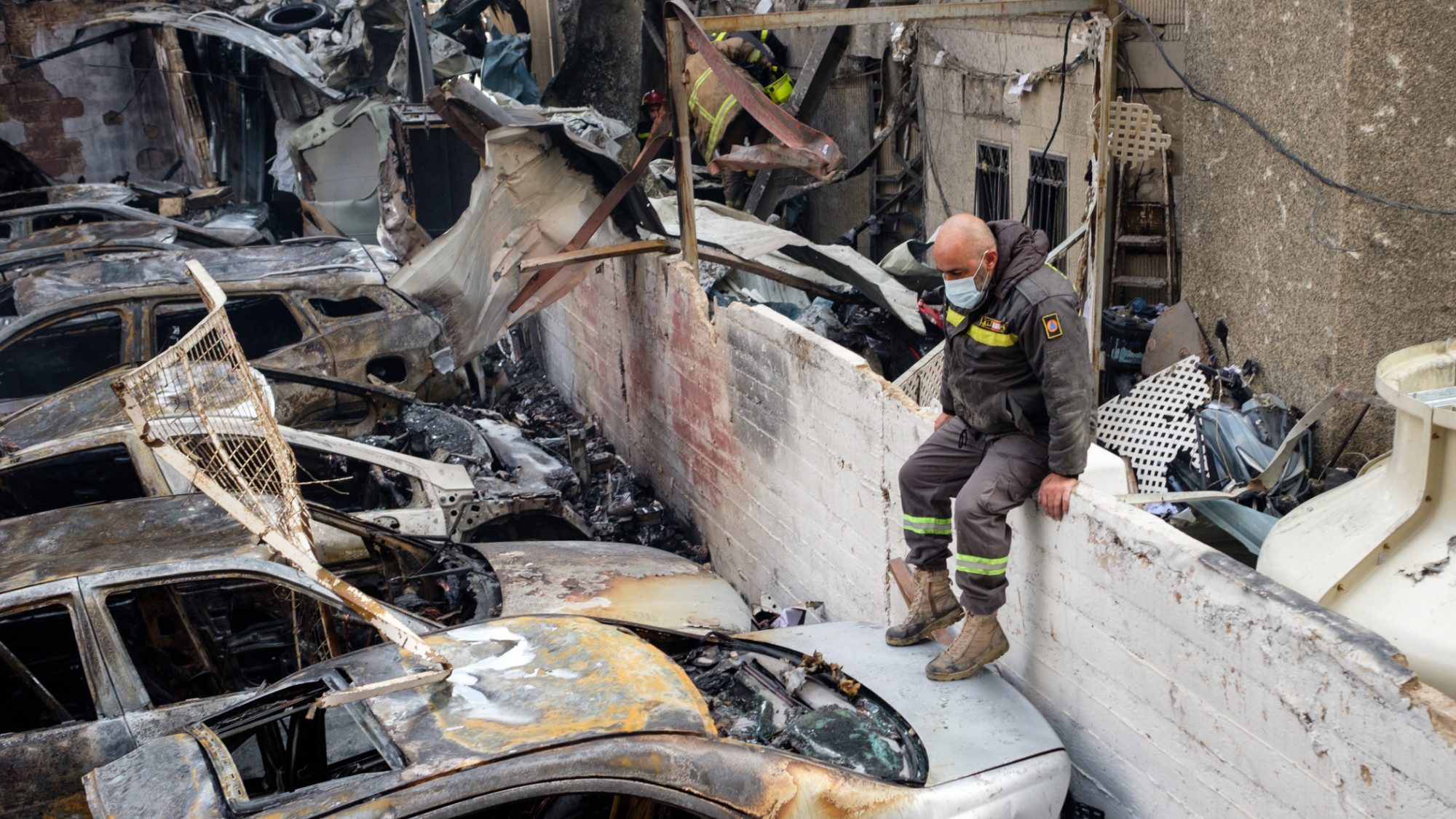
It was an ordinary Wednesday afternoon for thousands of Lebanese civilians going about their daily routines across Beirut, the Beqaa Valley and southern Lebanon. But just after 2 p.m. local time, that quiet normalcy was shattered forever when Israeli warplanes launched a simultaneous wave of intensive airstrikes targeting densely populated residential neighborhoods, leaving more than 300 people dead and over 1,150 injured, according to Lebanon’s official health ministry.
For 15-year-old Abdelwahab, who only provided his first name to reporters, the strike on Beirut’s working-class Corniche el Mazraa district interrupted his efforts to earn money for his mother’s cancer treatment, where he worked selling bottled water from a small street kiosk near the Cola roundabout. The first sensation he recalled after the blast was an eerie, deafening silence, quickly replaced by thick plumes of mixed black and white smoke, choking dust, and the panicked screams of injured and trapped survivors. When the air began to clear, Abdelwahab ran toward the destroyed site near a local branch of Rifai Nuts, a beloved Lebanese roastery where surrounding apartment buildings and a public parking lot had been torn apart by the impact.
Among the rubble, the teen first spotted a severed, burned arm – a sight that would haunt him, but he pushed past the shock to start pulling survivors and victims from the wreckage. “There was nothing to do but help. Even a one-year-old would try,” he explained to reporters from Middle East Eye. He carried broken bodies from the debris, half-closing his eyes to block out the gore that threatened to stop him, and kept working long after official civil defense teams arrived on scene. Even with a face mask, he said, the acrid smell of smoke and decomposing bodies clung to him.
Among the dead was Nader Khalil, a 35-year employee of the roastery who had bought water from Abdelwahab’s kiosk every single day. “He was a nice man. What did he do to deserve this?” the teen asked. That night, he returned home to his sick mother and made up gentle stories to hide the horrors he had witnessed, unwilling to add to her burden. The next day, he went back to his kiosk, but the once-busy neighborhood felt hollow: shops were shuttered, traffic was sparse, and the street was nearly empty, drained by both fear and a national day of mourning.
Not far from Abdelwahab’s kiosk, 47-year-old Samir Assaf, a Palestinian refugee who fled the destroyed Yarmouk refugee camp in Syria during that country’s civil war to rebuild his life in Beirut, also survived the strike by chance. Assaf makes a meager living selling tissue packets to drivers at the nearby traffic intersection, supporting his wife and two children. On Wednesday afternoon, he had stepped into the shade for a quick break when the blast hit, throwing him straight to the ground. When he scrambled to his feet, his vision was completely obscured by smoke, and the entire parking lot in front of him was turned to black ash. The only thing he could make out through the haze was the red glow of the traffic light, still burning unchanged in the distance.
“I was able to call my wife to tell her I’m alive. But many people who work nearby didn’t make it,” he said. The strike killed civilians across the neighborhood: the owner of a local flower shop, the building’s doorman, a traveling sheikh, and even young patients being treated at a second-floor children’s clinic. “We felt death, we felt it. May no one ever feel it,” Assaf said.
The day after the attack, Assaf and his family were forced back to Corniche el Mazraa. They had received an Israeli evacuation warning for their home neighborhood of Jnah – a notification that almost always precedes new airstrikes – and were seeking temporary shelter with relatives nearby. But they also came back to see what was left of the street corner where Assaf had built his livelihood and daily routine. For Assaf’s wife Wessam, the destruction brought back unbearable trauma from her time fleeing Syria. “We escaped the Yarmouk refugee camp because of the bombardment, and now we are here and there’s bombardment again. This place reminds me of Yarmouk,” she said.
Similar scenes of destruction and grief unfolded across Beirut on Wednesday. In Ain el Mreisseh, a coastal neighborhood known for its charming historic residential architecture, an Israeli airstrike hit a mid-rise apartment block. Neighboring resident Yousef, who only gave his first name, recalled that the building stood for just seconds before half of it collapsed, killing all the civilians trapped inside. “There was no air, just dust,” he said. “Some people were able to get out, others were not so lucky.”
Official rescue operations launched immediately after the strikes and stretched through Thursday night. Civil defense teams set up massive floodlights to work after dark, using heavy excavators to carefully sift through tons of concrete and twisted rebar, searching for any remaining survivors and missing victims. The air hung thick with dust and unspoken grief: one entire side of the collapsed Ain el Mreisseh building had been torn away, leaving the private interiors of family homes exposed to the street. Fragments of ordinary life stood frozen mid-moment: a dress hanging undamaged in a closet, a table lamp still standing upright, a painting hanging crookedly on a half-broken wall, bathroom tiles still intact beneath piles of rubble.
By nightfall, all but one of the victims had been recovered from the Ain el Mreisseh rubble. The only person missing was 26-year-old Zahraa, niece of a middle-aged man who stood watching over the excavation all night, never leaving the top of the rubble pile. When rescue crews got close to where they believed her body was located, the heavy excavator slowed to a delicate, careful pace, its movements almost gentle to avoid causing further damage. At times, crews put down the heavy machinery altogether and picked up shovels, or even dug with their bare hands.
Around the grieving uncle, dozens of other people – relatives of other victims, neighbors, and even complete strangers – stayed long after their own loved ones had been recovered. They stood with him in total silence, an unspoken act of solidarity to make sure he did not have to wait alone, bound by shared grief in the aftermath of a devastating attack that has upended countless civilian lives across Lebanon.