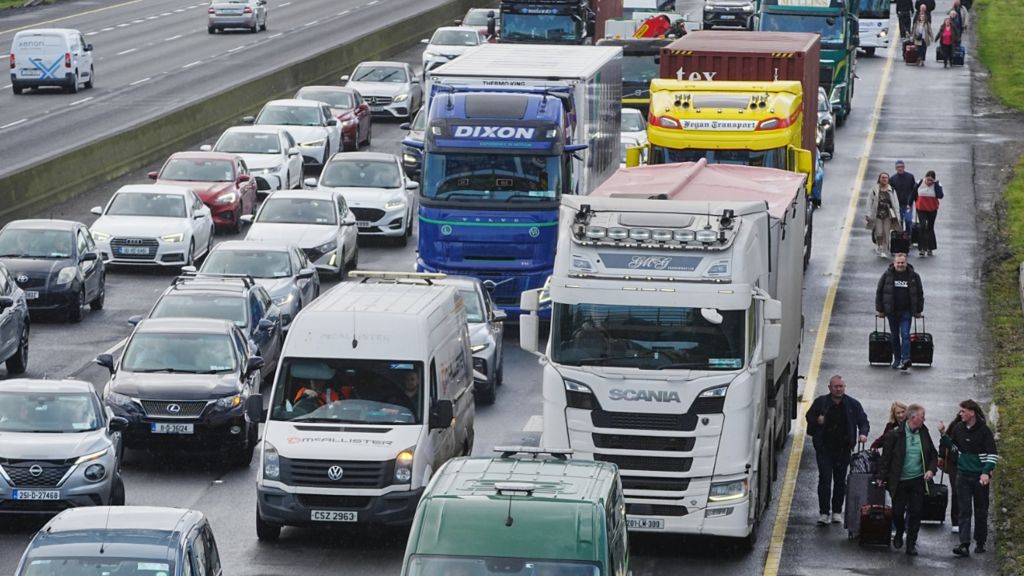
Four straight days of disruptive fuel price protests have thrown transportation across the Republic of Ireland into chaos, with gridlock forcing travelers to take drastic measures and triggering a fierce standoff between protesters and government officials.
On Thursday, the disruption reached a striking new level when commuters heading to Dublin Airport were captured on camera walking their carry-on and checked luggage along the northbound lane of Dublin’s busy M50 motorway. Persistent blockades had left traffic at a complete standstill, leaving many with no other option to make their flights on time. In response to the ongoing unrest, Dublin Airport issued an urgent advisory Friday urging all passengers to allocate far more time than usual for their trips to and from the terminal.
The demonstrations, organized by farmers and transport workers, are rooted in skyrocketing fuel costs driven by geopolitical instability in the Middle East. The ongoing conflict between the United States, Israel and Iran has disrupted global energy trade, with an estimated 20% of global oil supply held up by the closure of the Strait of Hormuz, a critical global shipping chokepoint. In recent weeks, this disruption has pushed diesel prices in Ireland from roughly €1.70 per litre to €2.17, while petrol prices have jumped as much as 25 cents per litre at many retail outlets. Protesters are calling for major government intervention, including cuts to fuel taxes and a reevaluation of overly rapid climate policy rollouts that they say have added to cost burdens.
As protests entered their fourth day, the Irish government has moved toward a hardline response. On Thursday, officials requested military support to remove vehicles blocking public roads, with Gardaí (the Irish national police service) classifying blockades at fuel storage depots as illegal obstructions. In a statement Thursday, a Gardaí spokesperson warned that the force would enter an active enforcement phase if protesters did not step back and disperse from critical infrastructure, noting that ongoing blockades already threaten access to essential supplies including food, drinking water, fuel and animal feed. Irish Justice Minister Jim O’Callaghan has also warned that participants in illegal blockades will face legal consequences, including potential impacts on their driving licenses, saying penalties may not be immediate but will be enforced over time.
The mounting disruption has already put severe strain on Ireland’s fuel supply network. Fuels for Ireland, the national fuel industry body, confirmed that as of Friday, 100 retail garage forecourts — mostly in the Munster region and western Ireland — have already completely run out of fuel. Chief Executive Kevin McPartlin told national broadcaster RTÉ that the total number of dry forecourts could reach 500 by Friday night, with half of the country’s incoming fuel shipments currently trapped behind protest barricades.
Government officials have moved to open talks with industry representative groups Friday, with Agriculture Minister Martin Heydon and Minister of State Timmy Dooley set to meet with sector leaders. The Irish Road Haulage Association, one of the groups participating in the talks, has drawn a line at the disruptive blockades: while the association supports the protest over unsustainable costs, Deputy Vice President Eugene Drennan confirmed the group will not bring participating protesters to Friday’s meeting, and called for an immediate end to road blockades, noting they are hurting ordinary Irish citizens more than decision makers. Sinn Féin, Ireland’s main opposition party, has criticized the government’s handling of the crisis, with leader Mary Lou McDonald calling on the Taoiseach (Prime Minister) and Tánaiste (Deputy Prime Minister) to open direct talks with protesters rather than leaning on enforcement.
For ordinary Irish residents, the crisis is already spilling over into critical public services. The Health Service Executive has issued an urgent appeal for all access routes to medical facilities to be kept clear, to ensure patients can reach life-saving treatment. Across the country, key transport routes including the M50 and N1 remain heavily congested, with traffic updates published continuously on the Transport Infrastructure Ireland website for affected travelers. Speaking Thursday, Taoiseach Micheál Martin called the blockades of public infrastructure an unfair form of protest, while Defence Minister Helen McEntee said the actions of some demonstrators have already crossed into criminal behavior.
One participating protester, Mark Maguire, a farmer based on the Monaghan-Fermanagh border, told BBC Radio Ulster that demonstrations are a last resort for working producers facing unmanageable costs. “There’s not one farmer in Ireland or Northern Ireland that wants to be out protesting. They have enough to do,” Maguire explained, adding that the only demand from participating farmers is an end to punitive fuel taxation that has made operating impossible for many small operations.