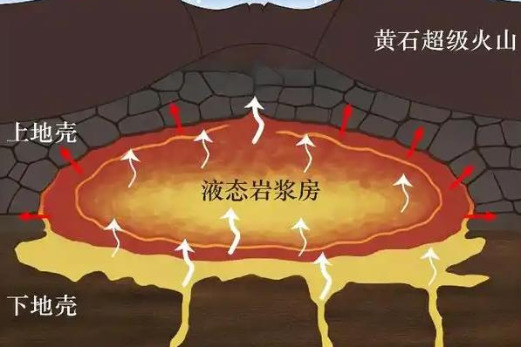
Supervolcanoes stand as Earth’s most formidable volcanic forces, with a single catastrophic supereruption capable of expelling more than 1,000 cubic kilometers of volcanic debris – enough to smother a large, modern metropolis under tens of meters of ash and rock. Given their capacity to upend global ecosystems, alter long-term climate patterns, and threaten human civilization across continents, geoscientists have spent decades working to unravel the geophysical mechanisms that generate these extraordinary geological features.
A new collaborative study led by a joint team of researchers from the Chinese Academy of Sciences’ Institute of Geology and Geophysics and the University of Illinois in the United States has delivered the first complete, evidence-based explanation for how Yellowstone’s underground magma system formed and has sustained its activity over millions of years. The peer-reviewed findings were published in the prominent academic journal *Science* on April 4, 2026. Researchers note the breakthrough will drastically improve future volcanic hazard forecasting and help communities mitigate potential disaster risks from supervolcanic activity around the globe.
Nestled within Yellowstone National Park in western North America, the Yellowstone caldera is one of the most studied and well-known active supervolcanoes on the planet. Over the last 2.1 million years, it has erupted two enormous events, releasing approximately 2,500 and 1,000 cubic kilometers of volcanic material respectively. Its wealth of publicly available geological and geophysical survey data has turned it into a natural, open-air laboratory for geoscientists researching supervolcanic formation.
For decades, the dominant scientific framework held that supervolcanoes were powered by large, continuous reservoirs of fully liquid magma trapped within the Earth’s crust. Under this long-held model, molten rock accumulated steadily underground, pressure built to critical levels until it fractured surrounding solid rock, and an eruption followed. Scientists previously believed the heat driving this activity originated from a vertical plume of hot rock rising from thousands of kilometers deep within the Earth’s lower mantle.
However, accumulated research over the past ten years has called this traditional model into question. Multiple independent studies have confirmed that instead of a large pool of entirely molten rock, supervolcano magma systems are mostly made up of a viscous “crystal mush” – a semi-solid mixture of molten rock and solid mineral crystals that can remain stable underground for millions of years. In addition, high-resolution geophysical data has confirmed that Yellowstone’s entire magma system is tilted at an angle, rather than being vertically aligned, extending progressively further toward the southwest as depth increases.
To resolve these contradictions and build a more accurate model of the supervolcano’s formation, the research team constructed a high-resolution three-dimensional geophysical model of the lithosphere and upper mantle beneath western North America. The model integrates decades of geological field data, geophysical survey readings, and geochemical analysis to simulate both the ancient evolution and current state of Yellowstone’s volcanic activity.
The study’s surprising results confirm that Yellowstone’s magma originates much deeper in the Earth than the scientific community previously assumed. The source of the molten rock lies near the base of the North American lithosphere, the rigid outer layer of the Earth that extends roughly 100 kilometers below the continental surface.
At this great depth, hot, partially molten rock moves slowly eastward through a narrow geologic channel beneath the Yellowstone region. As this buoyant hot material is dragged and stretched by mantle flow moving under the thicker section of the North American continental lithosphere, pressure on the material drops rapidly, triggering partial melting of the hot rock that generates the magma that feeds the supervolcano above.
At the same time, the North American tectonic plate is moving steadily westward, creating a counterforce that pushes against the deeper eastward flow of mantle rock. This interaction of opposing tectonic forces pulls apart the base of the continental lithosphere, creating a diagonal pathway that allows rising magma to move upward toward the crust. This geodynamic process directly explains the tilted, angled shape of the magma system observed in earlier seismic surveys of the region.
“Our study provides the first comprehensive explanation of how magmatic systems beneath supervolcanoes form and evolve over geologic time,” explained Liu Lijun, the study’s corresponding author and a senior researcher at the Institute of Geology and Geophysics.
Cao Zebin, the study’s first author and a postdoctoral researcher on the project, noted that the newly identified geodynamic mechanism is not unique to Yellowstone. It can likely be applied to other large supervolcanic systems across the globe, including Indonesia’s Toba volcano – site of one of the largest supereruptions in Earth’s history – and the Altiplano-Puna volcanic complex in the Andes Mountains of South America.
Looking ahead, Liu added that this new, accurate model could eventually be used to develop forecasting systems for volcanic activity that function similarly to modern weather prediction. These tools would allow government agencies and disaster management authorities to anticipate volcanic activity far in advance and implement mitigation measures that drastically reduce the risk to human life and infrastructure.