India’s federal Ministry of Electronics and Information Technology (MeitY) has tabled controversial amendments to the country’s digital governance framework that would extend government oversight of news and current affairs content far beyond traditional registered publishers to include independent influencers, podcasters, and ordinary social media users on platforms including Facebook, YouTube, and X. The proposal, which has already triggered sharp backlash from digital rights advocates and independent content creators, would require major social media platforms to adhere to the same code of ethics currently mandated for formal news outlets when hosting news-related content from non-publisher users. To retain their safe harbour protection — the legal immunity that shields platforms from liability for content posted by third-party users — platforms would be required to strictly comply with all government takedown and content removal orders under the new rules.
The government frames the amendments as a necessary update to outdated digital regulation. Officials argue that as news and current affairs content is now widely shared by non-journalist users, a unified regulatory framework is needed to curb the spread of harmful content including disinformation, hate speech, and manipulated deepfake media. MeitY has opened a public comment period on the proposal, with feedback set to close on April 14. MeitY Secretary S Krishnan has defended the plan, emphasizing that the new guidelines align with India’s existing constitution and legal structure, and that evolving content sharing practices demand updated rules.
Critics, however, warn the changes amount to a dramatic expansion of state power over online speech that will enable widespread censorship targeting political dissent. Digital rights activists point to a steady pattern of incremental regulatory changes stretching back to 2021 that have steadily eroded online free speech protections while expanding government control. A 2021 amendment first brought formal digital news outlets under government oversight, while a 2025 revision strengthened the federal Home Ministry’s Sahyog portal, a centralized platform that allows multiple state agencies to issue takedown notices to social media platforms with minimal transparency and few procedural safeguards for affected users. Early 2026 brought another change that cut the compliance window for platforms to execute government blocking orders from 36 hours to just three — a reduction that eliminates virtually all time for legal review before content is removed.
Widespread concern that the rules will be used to target government critics gained fresh traction after a high-profile blocking incident in March. Acting on orders issued under Section 69A of India’s existing IT Act, X blocked roughly a dozen accounts, most of which hosted satirical or critical content about Prime Minister Narendra Modi’s ruling Bharatiya Janata Party (BJP). Among those affected was Kumar Nayan, whose satirical X account @Nehr_who? boasted more than 242,000 followers. Nayan told the BBC he received no prior warning or explanation when his account was blocked, and while a court order restored his account this week, 10 of his posts critical of Modi and the BJP remain blocked in India pending review by a government-appointed panel. All 10 posts are either satirical commentary or political criticism, none of which meet the official criteria for restricted content that threatens national security or communal harmony, Nayan argues. Challenging the blocking in court forced Nayan to reveal his public identity, forcing him to relocate over safety concerns and robbing him of the anonymity that protected him and other critics from harassment.
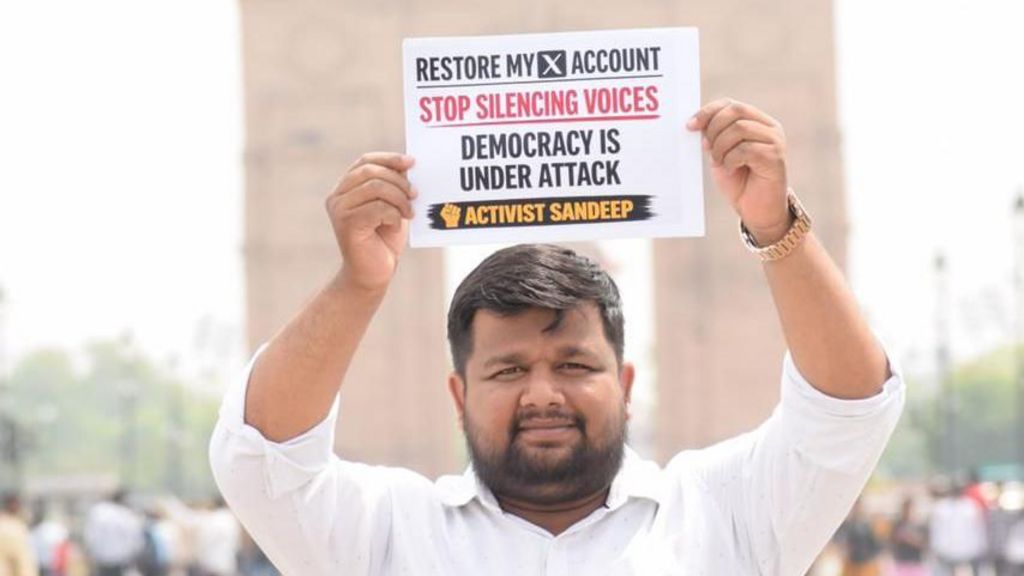
Sandeep Singh, an activist whose 100,000-follower X account @ActivistSandeep was also blocked in March, has not yet regained access. Singh began posting critical content after concluding mainstream Indian media was disproportionately biased in favour of the BJP. “I stand for the truth and blocking my accounts or posts will not stop me from continuing speaking truth to power,” Singh told the BBC.
Prominent independent creator Akash Banerjee, whose political commentary YouTube channel The Deshbhakt counts more than 6 million subscribers, warned the new rules will create a pervasive climate of self-censorship that will silence independent political discourse. Banerjee notes that despite India already having a raft of laws governing online content, levels of hate speech and disinformation have not declined — but critical content, even satirical criticism of the government, is increasingly targeted for removal. Digital rights activist Nikhil Pahwa, who co-authored an analysis of the regulatory changes for the *Times of India*, argues the proposed amendments only reinforce what is already a fully built “infrastructure for mass censorship” in India. Platforms typically comply with government orders quickly to protect their access to India’s large market, while affected users are left without notice, explanation, or any meaningful avenue to appeal, he explained.
A recent U.S. government report has echoed these concerns, noting that since 2021, American social media companies have seen a steady rise in takedown requests for content and accounts that appear to be politically motivated. Even when users are able to challenge blocking orders in court, Nayan points out, most ordinary users lack the resources or willingness to go through the lengthy legal process to recover their content. “In a democracy, people should have the liberty to post what they want, with certain limitations of course, without fear. India is a democracy, so why has it become so difficult to do so?” Nayan asked. The BBC has submitted a list of questions to MeitY for comment on the specific blocking incidents, and the ministry has yet to issue a formal response beyond its broader defense of the new regulatory framework.