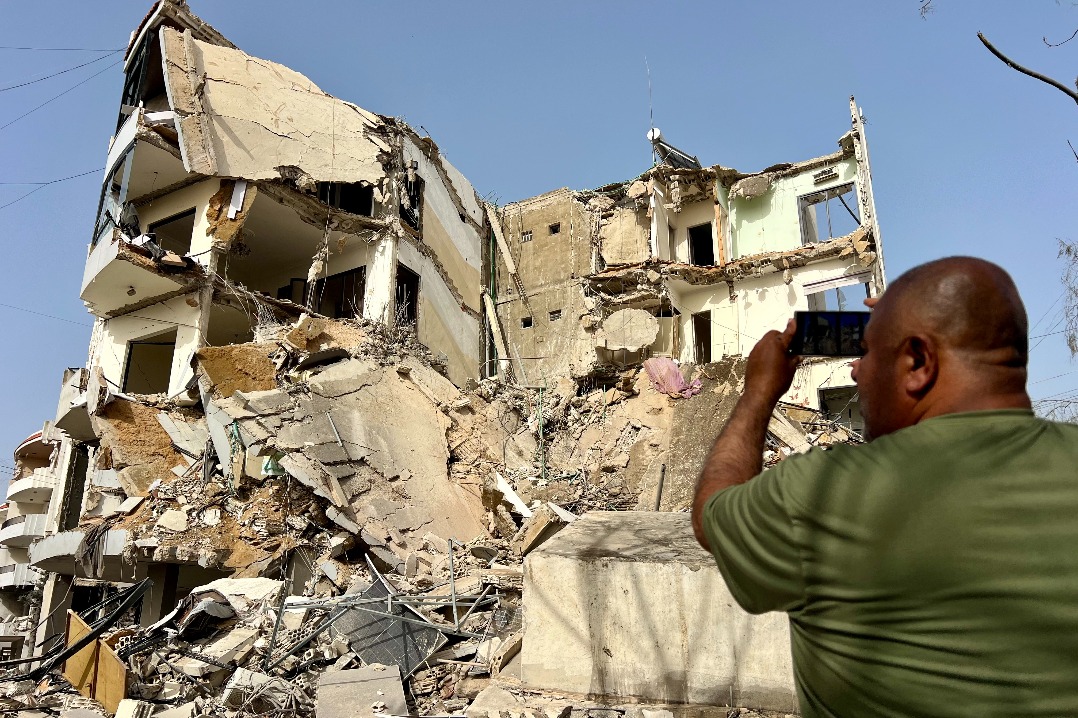
Less than 24 hours after a bilateral ceasefire between Iran and the United States was supposed to take effect, the fragile truce hangs by a thread, as mutual accusations of violations and deadly Israeli attacks on Lebanese territory have plunged the Middle East into renewed uncertainty.
The core point of contention centers on whether the ceasefire applies to military operations in Lebanon, a nation that declared a national day of mourning on Thursday following a wave of Israeli airstrikes on Wednesday that killed no fewer than 200 Lebanese civilians. Washington and its closest regional ally Israel have insisted the two-week truce was never meant to curb Israeli military action against militant groups operating from Lebanese soil.
In a late Wednesday post on Truth Social, U.S. President Donald Trump confirmed that American military assets, including warships, combat aircraft, additional ammunition and ground troops, would remain deployed in the region surrounding Iran until what he called “the real agreement reached is fully complied with”. Trump added that the U.S. would retain all capabilities necessary to counter what he labeled a degraded adversary.
Iran has pushed back firmly against this framing. Foreign Minister Seyed Abbas Araghchi wrote in a post on X that the terms of the Iran-U.S. ceasefire are “clear and explicit”, arguing that Washington cannot simultaneously claim to uphold a truce while allowing Israel to continue its offensive in Lebanon. “The US must choose — ceasefire or continued war via Israel. It cannot have both. The world sees the massacres in Lebanon. The ball is in the US court, and the world is watching whether it will act on its commitments,” Araghchi said.
The dispute comes as Iran implemented a key truce-related concession earlier this week, agreeing to temporarily reopen the Strait of Hormuz, the critical global oil chokepoint that carries roughly one-fifth of the world’s daily crude supplies. In line with this agreement, Iran’s Islamic Revolutionary Guard Corps announced Thursday that it had mapped two alternative transit routes for vessels passing through the strait, advising ships to use these alternate paths to avoid potential sea mine hazards and guarantee maritime safety.
U.S. Vice President JD Vance, who will lead the American negotiating team in the first round of direct talks with Iranian officials in Islamabad, Pakistan this Saturday, clarified Wednesday that Washington never made any commitment to force Israel to halt its strikes on Lebanon. The Israeli Prime Minister’s Office echoed this position in an official statement, confirming that Israel supports the two-week suspension of strikes targeting Iran, on the condition that Tehran fully opens the Strait of Hormuz and ends all attacks against the U.S., Israel and regional allies.
The statement added that Israel backs American efforts to eliminate what it describes as Iran’s nuclear, missile and terrorist threats to the region and the wider world, and reaffirmed that the two-week ceasefire between the U.S. and Iran explicitly excludes military operations in Lebanon.
This framing directly contradicts the initial announcement of the truce made by Pakistani Prime Minister Shehbaz Sharif, who brokered the deal. When Sharif confirmed the ceasefire Wednesday, he stated that Iran, the U.S. and all their respective allies had agreed to an immediate end to hostilities across all territories, “including Lebanon and elsewhere”.
Israel’s widespread bombardment of Lebanon has drawn sharp condemnation from across the global community. France, Italy, Spain, Turkiye, Qatar and the United Kingdom have all issued statements condemning the offensive and called for Lebanon to be included in the Iran-U.S. ceasefire. Both the United Nations and Pakistan have also publicly denounced the attacks, with the Pakistani government noting that the strikes undermine international efforts to build peace and stability across the region.
Stephane Dujarric, spokesperson for UN Secretary-General Antonio Guterres, warned in an official statement that the ongoing military activity in Lebanon poses a severe threat to the fragile ceasefire and broader efforts to reach a lasting, comprehensive peace in the Middle East. “The Secretary-General reiterates his call to all parties to immediately cease hostilities,” Dujarric said, adding that international law, including international humanitarian law, must be respected at all times. “Civilians and civilian infrastructure must be protected at all times, and attacks directed against them are unacceptable. There is no military solution to the conflict,” he added. Guterres also renewed his call for all parties to engage through diplomatic channels and recommit to full implementation of UN Security Council Resolution 1701, the 2006 resolution that ended the last major Israel-Hezbollah conflict.
Israeli military officials continued to expand their operations Thursday, announcing a series of new strikes and targeted killings across Lebanon and Gaza. The Israel Defense Forces (IDF) confirmed it had eliminated Palestinian journalist Muhammad Samir Muhammad Washah in Gaza, claiming he operated as a Hamas terrorist while working on assignment for Al Jazeera. In Beirut, the IDF said it had killed Ali Yusuf Harshi, personal secretary to Hezbollah Secretary-General Naim Qassem, accusing Harshi of playing a central role in managing Qassem’s office. The IDF added that it had also struck two key weapons crossings used by Hezbollah along the Litani River, as well as 10 weapons storage facilities, rocket launchers and command centers across southern Lebanon.
Even within Israel, the government’s decision to exclude Lebanon from the ceasefire has faced growing public pushback. Organizers have confirmed that at least 11 anti-war protests are scheduled to take place across the country this weekend, opposing both the continuation of hostilities in Lebanon and what organizers describe as “attempts by the Israeli government to undermine the ceasefire with Iran”. Omri Evron, co-director of the Israeli anti-war coalition Peace Partnership, said the ceasefire itself serves as clear confirmation of the movement’s long-held position that there is no military solution to the region’s ongoing conflicts.