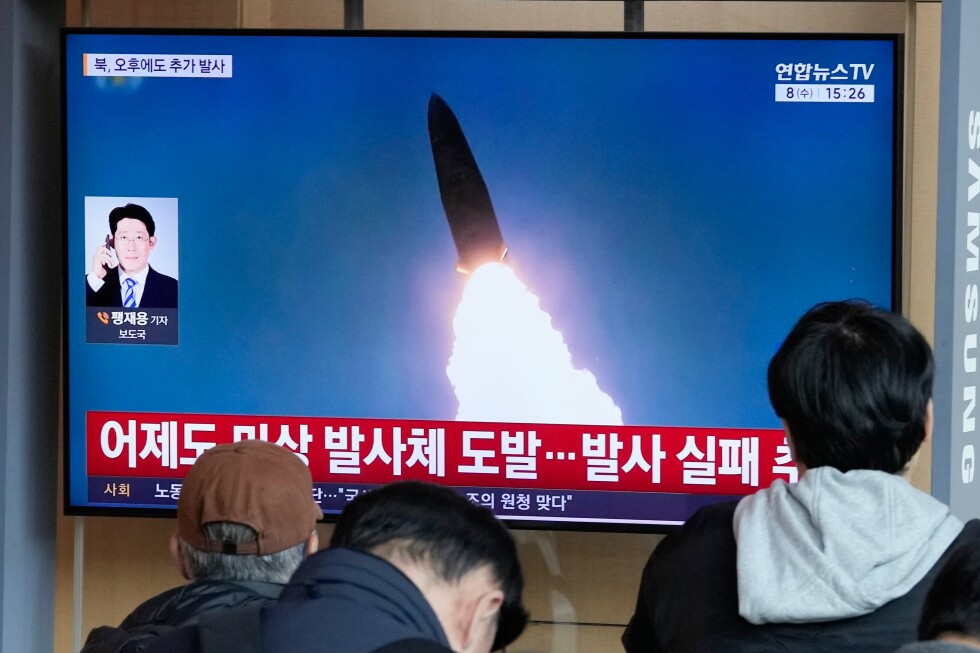
In a move that amplifies long-simmering tensions on the Korean Peninsula, North Korea officially confirmed Thursday that its three-day series of weapons tests this week involved a suite of advanced new systems, including ballistic missiles fitted with cluster-bomb warheads, as it advances its program to build out nuclear-capable strike forces targeted at South Korea.
The confirmation from Pyongyang’s state-run Korean Central News Agency (KCNA) came one day after South Korea’s military detected multiple projectiles fired from North Korea’s eastern coastal region, marking the second round of launches the North had conducted in 48 hours. According to KCNA’s official account, the testing campaign ran from Monday through Wednesday, and also included trials of new anti-aircraft weaponry, purported electromagnetic warfare systems and carbon-fiber bombs.
South Korea’s Joint Chiefs of Staff initially reported that Wednesday’s missiles traveled between 240 and 700 kilometers before impacting in the sea off the Korean Peninsula’s east coast. Officials also confirmed detecting at least one additional projectile launched Tuesday from a site near Pyongyang, the North Korean capital. For its part, Japan’s Defense Ministry noted that none of the projectiles fired Wednesday entered Japan’s exclusive economic zone, while the U.S. military assessed that the Tuesday and Wednesday launches posed no immediate immediate threat to the United States or its regional allies. Seoul has not yet issued an official response to Pyongyang’s detailed claims about the weapons tested.
KCNA’s report specified that the tests included demonstrations of cluster-munition warheads integrated onto the nuclear-capable Hwasong-11 short-range ballistic missiles. This platform shares design features with Russia’s Iskander missile system, built for low-altitude, maneuverable flight that makes it harder for existing missile defense networks to intercept. The state media account claimed that a Hwasong-11 armed with these new cluster warheads can “reduce to ashes any target covering an area of 6.5-7 hectares with the highest-density power.”
The latest series of launches has dashed recent tentative hopes from South Korea for an easing of cross-border tensions and a resumption of dialogue. Just this week, a senior North Korean foreign ministry official doubled down on Pyongyang’s hostile stance toward Seoul. In a statement released Tuesday night, Jang Kum Chol, first vice minister of North Korea’s Foreign Ministry, called South Korea the North’s “most hostile enemy state” in perpetuity, and ridiculed Seoul’s current liberal administration for its efforts to restart long-stalled cross-border talks, labeling South Korean officials “world-startling fools.”
The accelerated weapons development aligns with North Korean leader Kim Jong Un’s broader strategic trajectory since 2019, when high-stakes nuclear denuclearization talks between Kim and then-U.S. President Donald Trump collapsed. Since that breakdown, Kim has frozen nearly all diplomatic engagement with both Seoul and Washington, and has poured resources into expanding his arsenal of nuclear-capable missiles that can threaten not only U.S. allies South Korea and Japan, but also the U.S. mainland.
To counteract international isolation and strengthen his standing in the region, Kim has also moved in recent years to deepen strategic and diplomatic ties with Russia, China, and other nations facing heightened tensions with the United States. As evidence of this warming relationship, North Korean state media announced Thursday that Chinese Foreign Minister Wang Yi will arrive in Pyongyang the same day for a two-day official visit, marking the latest high-level exchange between the two countries.