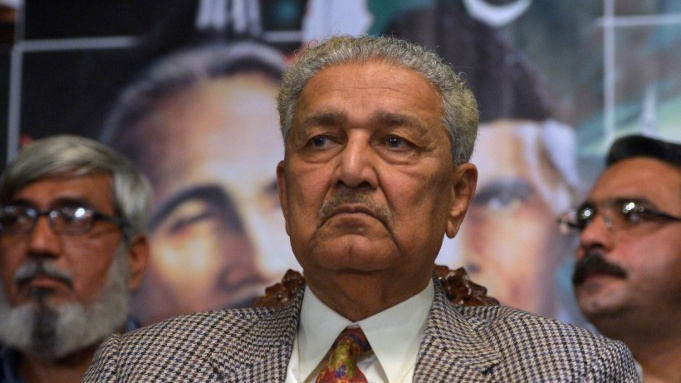
For nearly half a century, Abdul Qadeer Khan, known to Pakistanis as the “Father of the Bomb” and “Mohsin-e-Pakistan” (Saviour of Pakistan), stood at the center of one of the most consequential and controversial chapters in modern nuclear history. His legacy, which blends nationalist devotion to his homeland with a global campaign of nuclear proliferation that upended international nonproliferation norms, continues to shape tensions across the Middle East and South Asia decades after his network was first exposed.
Khan’s journey into nuclear politics began in 1974, when India conducted its first nuclear weapons test, codenamed Smiling Buddha, in the Rajasthan desert. The test sent shockwaves through neighboring Pakistan, where then-prime minister Zulfikar Ali Bhutto framed the acquisition of an Islamic nuclear bomb as an existential necessity for the young nation. Facing a nuclear-armed Hindu neighbor, Bhutto famously vowed, “We will eat grass or leaves, even go hungry, but we will get one of our own.” He asked: If Christian, Jewish, and Hindu nations already held the bomb, why should the Islamic world be denied it?
At the time of India’s test, Khan was working at a Urenco Group subcontractor facility in Amsterdam, where he held access to classified blueprints for advanced gas centrifuges—critical technology that enriches natural uranium into weapons-grade material. Recognizing Pakistan’s urgent need, Khan penned a handwritten letter to Bhutto, volunteering his expertise. “I have acquired very detailed and comprehensive knowledge of the gas centrifuge system and am now in a position to help Pakistan… This is a matter of utmost urgency,” he wrote. Later, he would recall, “I wrote the letter with full awareness that I could be arrested or killed. But I felt I had no choice. India had tested. We had to respond.” Though accused of stealing classified centrifuge designs from the Netherlands, Khan returned to Pakistan in 1975, and by 1976 he had established a dedicated nuclear research lab in Rawalpindi. China provided critical support—enriched uranium, tritium, even scientific expertise—despite fierce opposition from India and Israel. The U.S., which initially cut aid to Pakistan over the program in 1979, reversed course months later after the Soviet Union invaded Afghanistan, turning a blind eye to Pakistan’s nuclear progress and even providing covert technical training to its scientists in the 1980s.
By the end of the Cold War, the U.S. again halted aid to pressure Pakistan to abandon its program, but Khan continued production of highly enriched uranium in secret. After India tested a new series of nuclear warheads in May 1998, Pakistan responded with its own successful tests in the Balochistan desert, officially becoming the world’s seventh nuclear-armed state. “I told Bhutto Sahib we would get the bomb,” Khan declared after the tests. “I promised it. I kept that promise.”
What remained hidden from the world for decades was that Khan had spent years running a second, far more audacious project: an illicit international proliferation network that sold nuclear technology, components, and designs to three nations—Iran, North Korea, and Libya. Driven by a deep-seated resentment of what he saw as Western hypocrisy, Khan believed the Islamic world had a right to nuclear deterrence, just as Western and allied nations did. In a blunt rebuke of Western double standards, he once asked: “I want to question the holier-than-thou attitude of the Americans and British. Are these bastards God-appointed guardians of the world?”
Iran’s pursuit of nuclear assistance began in the 1980s, shortly after the 1979 Islamic Revolution that ended Western backing for Tehran’s civilian nuclear program. Though Ayatollah Ruhollah Khomeini issued a fatwa opposing nuclear weapons, the Iranian government, locked in a costly war with Iraq, secretly approached Pakistani military leadership for help. As former Iranian president Akbar Hashemi Rafsanjani revealed in 2015, “We were at war, and we wanted to have such an option for the day our enemies wanted to use nuclear weapons. This was our state of mind.” Khan, who firmly believed the Islamic world needed its own nuclear deterrent, agreed to the deal: Pakistan supplied Iran with 4,000 second-hand first-generation centrifuges, full design blueprints, and training for six Iranian nuclear scientists at Pakistani facilities. For years, the Pakistani military hid the arrangement from even its own civilian leaders; Benazir Bhutto, Zulfikar Ali Bhutto’s daughter and then-Prime Minister of Pakistan, only discovered the agreement by accident during a 1989 visit to Tehran, when Rafsanjani asked her to reaffirm their deal on “special defense matters.”
Israel, which had long opposed any Muslim-majority nation acquiring nuclear technology, had Khan under surveillance as he traveled across the Middle East in the 1980s and 1990s, but failed to uncover the full scope of his network. Decades later, former Mossad chief Shabtai Shavit admitted he regretted not assassinating Khan when he had the chance, saying the attack would have “changed the course of history.” This was not Israel’s first attempt to stop Khan’s work: in the early 1980s, Israel had convinced then-Indian Prime Minister Indira Gandhi to approve a joint airstrike on Pakistan’s main nuclear facility at Kahuta, with Israeli fighter jets set to launch from an Indian airbase. Gandhi ultimately backed out, and the plan was never carried out.
Khan’s sprawling network operated undetected until 2003, when Libyan leader Muammar Gaddafi voluntarily disclosed the network’s existence to Western intelligence agencies in an attempt to curry favor with the U.S. Gaddafi revealed that Khan had helped Libya build secret nuclear facilities, some disguised as working chicken farms. The CIA seized a shipment of nuclear machinery bound for Libya passing through the Suez Canal, and investigators uncovered full bomb blueprints hidden in dry cleaning bags from an Islamabad cleaner. The exposure sent shockwaves through Western capitals; a senior U.S. official told the *New York Times* at the time, “It was an astounding transformation when you think about it, something we’ve never seen before. First, [Khan] exploits a fragmented market and develops a quite advanced nuclear arsenal. Then he throws the switch, reverses the flow and figures out how to sell the whole kit, right down to the bomb designs, to some of the world’s worst governments.”
In 2004, Khan appeared on national Pakistani television and confessed to running the network, claiming he had acted entirely alone with no government backing. The Pakistani state immediately pardoned him, a move Khan later defended, saying he “saved the country for the first time when I made Pakistan a nuclear nation and saved it again when I confessed and took the whole blame on myself.” Former CIA director George Tenet would later describe Khan as “at least as dangerous as Osama bin Laden,” a label he carried for the rest of his life.
The exposure of Khan’s network to Iran triggered decades of international crisis. In 2005, Iran agreed to place its civilian nuclear program under International Atomic Energy Agency supervision, and in 2015, Tehran signed the Joint Comprehensive Plan of Action (JCPOA) with world powers, accepting strict limits on its nuclear program in exchange for sanctions relief. The deal collapsed in 2018, when the Trump administration withdrew from the agreement and reimposed crippling sanctions on Iran—tensions that persist to this day. Of the three nations Khan assisted, only North Korea successfully developed and tested its own nuclear weapons, joining the small club of nuclear-armed states.
Khan died in Islamabad in 2021, revered as a national hero in Pakistan but reviled by Western governments as the world’s most dangerous nuclear proliferator. To the end, he remained unapologetic, arguing that his actions were a necessary pushback against Western double standards. He pointed to Israel’s open secret nuclear arsenal, which the West has never seriously challenged, and sarcastically asked in 2009: “If Iran fires a missile then it is wrong, but if Israel does it then it is right?” In a 2011 interview, he laid out his core belief: “Don’t overlook the fact that no nuclear-capable country has been subjected to aggression or occupied, or had its borders redrawn. Had Iraq and Libya been nuclear powers, they wouldn’t have been destroyed in the way we have seen recently.” Today, Pakistan remains the only Muslim-majority nuclear power, and Khan’s shadow continues to hang over global nonproliferation efforts and Middle Eastern security dynamics.