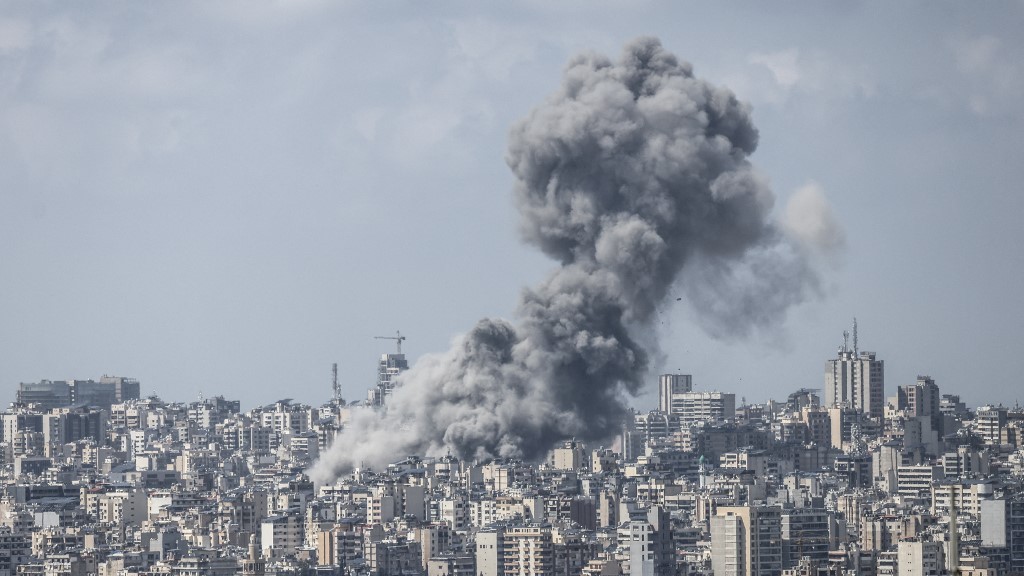
On Wednesday, just hours after the United States and Iran reached a bilateral ceasefire agreement that was framed to include a halt to hostilities targeting Lebanon, Israel unleashed an unprecedented wave of coordinated air strikes across multiple regions of Lebanon, triggering widespread chaos and emergency response measures across the crisis-hit country.
Witnesses from Agence France-Presse on the ground documented thick plumes of smoke billowing over central Beirut and its surrounding suburbs, with widespread panic sending civilians fleeing into the streets in search of shelter. In an official public statement, the Israel Defense Forces (IDF) confirmed the scope of the operation, saying it had completed the largest single coordinated strike in the current round of conflict, targeting roughly 100 Hezbollah command centers and military installations across Beirut, the Bekaa Valley and southern Lebanon in just a 10-minute window.
Local Lebanese media confirmed early civilian casualties from the strikes. Lebanon’s National News Agency reported that an Israeli air strike hit a cemetery in the village of Shmestar in the Bekaa Valley while a memorial gathering was underway, killing at least 10 attendees and wounding four more. Additional strikes hit residential and infrastructure areas across Beirut and multiple districts in southern Lebanon.
Lebanon’s Ministry of Public Health quickly issued an urgent emergency appeal, asking civilians to clear all major roadways in Beirut to allow ambulances and emergency response teams to reach attack sites and transport casualties. The ministry confirmed that initial assessments showed dozens of people had been killed and hundreds more wounded across the country, adding that severe traffic congestion sparked by the sudden wave of strikes was creating major barriers to rescue operations.
The timing of the Israeli strikes came as a major escalation just after the US and Iran announced a two-week ceasefire, an agreement negotiated based on an Iranian proposal that originally included a commitment to end all attacks on Lebanese territory. While Israeli Prime Minister Benjamin Netanyahu had formally approved the broader ceasefire between the two countries, he immediately issued a clarification asserting that the truce did not extend to Israeli military operations against Hezbollah in Lebanon.
Hezbollah entered the ongoing cross-border conflict on March 2, launching a heavy barrage of rockets into Israeli territory in solidarity with Iran amid rising US-Iran tensions. Since that opening exchange, Israel has launched a full ground incursion into southern Lebanon, a move that regional analysts have broadly interpreted as a preliminary step toward establishing a long-term permanent occupation of the area.
Following Wednesday’s massive strikes, Lebanon’s caretaker prime minister issued an urgent appeal to the country’s regional and international allies, calling for immediate intervention to halt the Israeli attacks. Hezbollah had previously issued guidance for internally displaced Lebanese civilians, urging them not to return to their home areas until a formal, permanent ceasefire agreement is put in place.
In a separate diplomatic incident connected to the escalating conflict, the Spanish government summoned the Israeli chargé d’affaires in Madrid on Wednesday to protest what it called the unjustifiable detention of a Spanish peacekeeper serving with the United Nations Interim Force in Lebanon (UNIFIL) by Israeli military forces. UNIFIL first reported the incident on Tuesday, initially withholding the peacekeeper’s nationality, and confirmed on social media platform X that Israeli forces detained the service member after blocking a UN logistics convoy. The peacekeeper was ultimately released after less than an hour in custody.