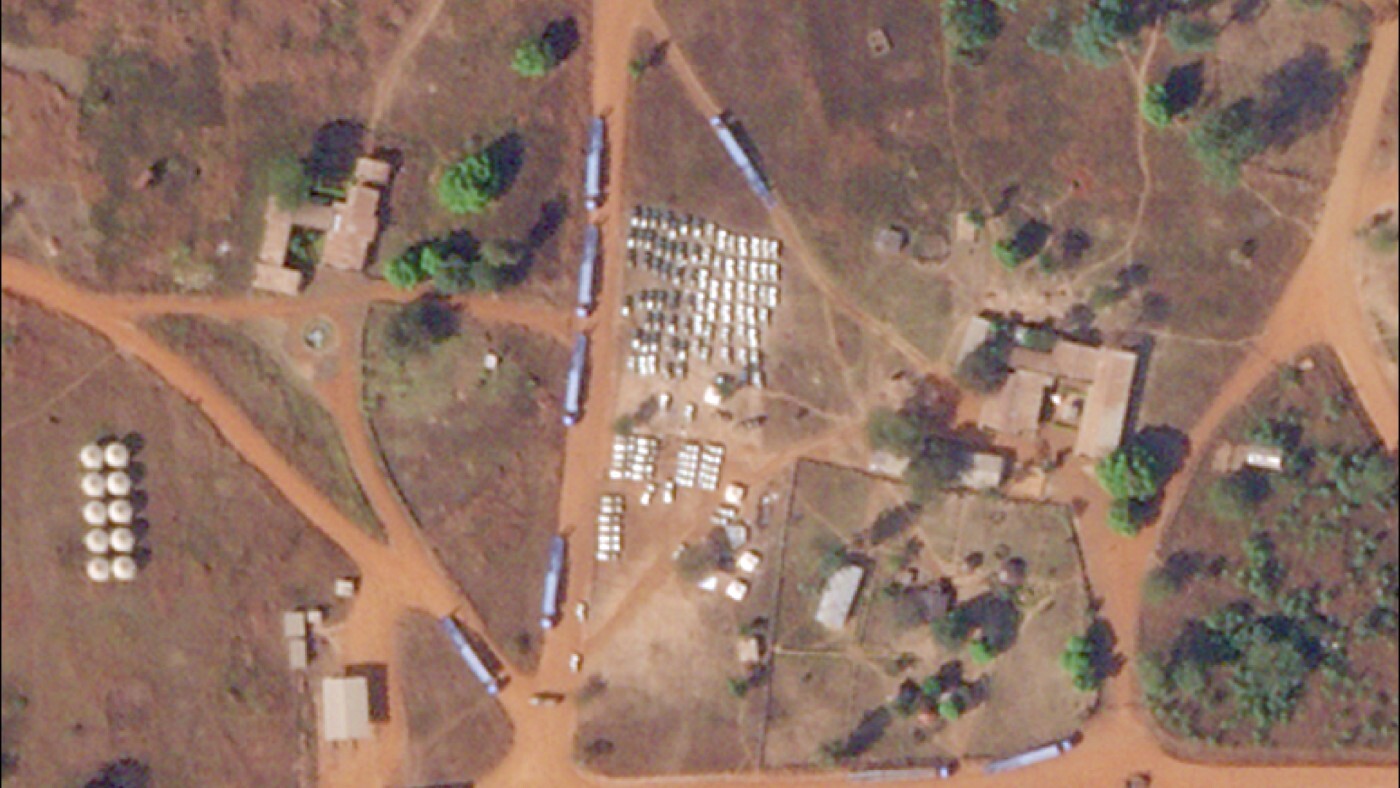
Exclusive analysis of declassified satellite imagery published by the Yale School of Public Health’s Humanitarian Research Lab (HRL) and obtained first by Middle East Eye has uncovered damning evidence that Ethiopia is covertly backing Sudan’s Rapid Support Forces (RSF) from a formal Ethiopian National Defence Force (ENDF) base in the country’s western Benishangul-Gumuz region, opening a new window into the complex geopolitical maneuvering prolonging Sudan’s devastating 2023-present civil war.
The findings, which mark the first concrete visual confirmation of long-circulated accusations of Ethiopian involvement, track five months of consistent, large-scale military logistics activity at the ENDF base on the outskirts of Asosa, the capital of Benishangul-Gumuz. The activity aligns directly with the RSF’s intense cross-border offensive against Sudanese Armed Forces (SAF) positions in Sudan’s adjacent Blue Nile state, which has raged from December 2025 through March 2026.
Over the monitoring period, HRL researchers documented repeated arrivals of commercial car transporters at the Asosa base carrying unmarked technical vehicles that are not part of the ENDF’s standard fleet. By February 2026, more than 200 of these vehicles were counted on site. Imagery shows unarmed vehicles were retrofitted on base with custom gun mounts designed for heavy .50-caliber machine guns, and up to 15 tents capable of housing 150 RSF fighters were erected to accommodate personnel. Multiple commercial shipping containers arrived, and fuel tanks on site allowed for mass refueling of vehicles before they deployed toward the Sudanese border.
Crucially, the technical vehicles tracked through the Asosa base match the color, size, and armament of vehicles later documented in open-source footage of RSF combat operations around Kurmuk, a strategic Sudanese border town just 100 kilometers from the Asosa base. Kurmuk fell to the RSF and its allied Sudan People’s Liberation Movement–North (SPLM-N) fighters in late March 2026 after weeks of fierce clashes. HRL’s analysis of 14 other ENDF bases across the region found no comparable logistics buildup, confirming the Asosa site is a unique outlier dedicated to supporting the RSF.
“This report is the first visual evidence that those allegations are true. In fact, it is even worse than first feared. Not only are the Ethiopians assisting the RSF, they are doing it from an actual Ethiopian army base,” said Nathaniel Raymond, HRL’s executive director, in an interview with MEE.
Multiple independent sources, including active and former ENDF officers, Sudanese military and intelligence analysts, a European diplomat, and a former senior Ethiopian foreign ministry advisor, confirmed to MEE that the RSF has operated a secret staging hub in Benishangul-Gumuz for months, though its exact location at a formal ENDF base had not been confirmed until now. Those sources also draw a direct line between Ethiopia’s involvement and the United Arab Emirates (UAE), which has faced mounting international evidence of backing the RSF despite consistent public denials.
Open-source video evidence from late 2025 further links the Asosa operation to a UAE-controlled supply network centered on the port of Berbera in Somaliland, where the UAE maintains a permanent military base. The car transporters seen carrying vehicles to Asosa match the dimensions and color of carriers filmed moving technical vehicles from Berbera into Ethiopia, and flight tracking data confirms multiple UAE-linked IL-76 cargo planes flew from Abu Dhabi to Ethiopian airports within 300 kilometers of Asosa between December 2025 and March 2026. Additional satellite imagery of Asosa airport identified a UAE-operated C-130 cargo plane and a MI-17 helicopter on site during the buildup period.
The UAE’s deepening reliance on Ethiopia for RSF supply lines comes amid a shifting geopolitical landscape in the Horn of Africa. In January 2026, the Somali federal government canceled all cooperation agreements with the UAE over its support for breakaway regions Somaliland and Puntland, disrupting the UAE’s established regional network of military bases that it developed with Israel and the United States to control Red Sea and Gulf of Aden shipping lanes. Israel’s formal recognition of Somaliland sovereignty in December 2025, and subsequent talks to open an Israeli base at Berbera, further escalated tensions between Mogadishu and Abu Dhabi, leaving Ethiopia as the UAE’s most critical remaining partner for RSF operations.
Analysts point to two core motivations for Ethiopia’s decision to back the RSF, rooted in both geopolitics and domestic security. For nearly a decade, Ethiopia’s government has been locked in strategic competition with Egypt and Eritrea, both of which back the SAF. Domestically, tensions between Ethiopian Prime Minister Abiy Ahmed’s government and SAF leader Abdel Fattah al-Burhan, Sudan’s de facto leader, date back to the 2020-2022 Tigray war, when Burhan provided military support to the Tigray People’s Liberation Front (TPLF), which remains in intermittent conflict with Addis Ababa. A 2025 high-level Ethiopian delegation to Khartoum failed to convince Burhan to cut ties with the TPLF, cementing Addis Ababa’s decision to align with the RSF.
Getachew Reda, a senior Abiy advisor who joined that 2025 delegation, publicly stated earlier this year that Ethiopia could not remain a “passive bystander” in Sudan’s war, noting the country must defend its own strategic interests in the region. Sudan’s government first openly accused Ethiopia of intervening in the war in March 2026, after the RSF launched its major Blue Nile offensive that included fighters crossing into Sudan from Ethiopian territory.
Sudan’s civil war, which broke out between the SAF and RSF in April 2023, has already spawned the world’s worst humanitarian crisis: hundreds of thousands of people have been killed, and more than 11 million have been displaced from their homes. A United Nations fact-finding mission recently concluded that the RSF committed genocide during its capture of el-Fasher, the capital of North Darfur, with survivors reporting mass executions, sexual violence, and systematic abuse of fleeing civilians.
Multiple parties named in the report including the RSF, the office of Prime Minister Abiy Ahmed, and the Ethiopian foreign ministry have not responded to requests for comment from MEE. A former senior advisor to UAE President Mohammed bin Zayed Al Nahyan has previously pushed back against accusations of UAE support, noting that other regional states including Uganda, Ethiopia, and Chad all maintain ties to the RSF, while the SAF receives widespread military backing from Turkey and Egypt.
HRL’s final report concludes that the Asosa base functions as a critical dedicated logistics node for RSF operations in Blue Nile state, providing resupply, refueling, accommodation, and vehicle maintenance for RSF personnel between December 2025 and the end of March 2026. “It is well situated to provide these services for RSF forces operating inside Blue Nile,” the report notes, “and the five months of consistent activity confirms this is not an isolated incident, but a sustained support operation.”