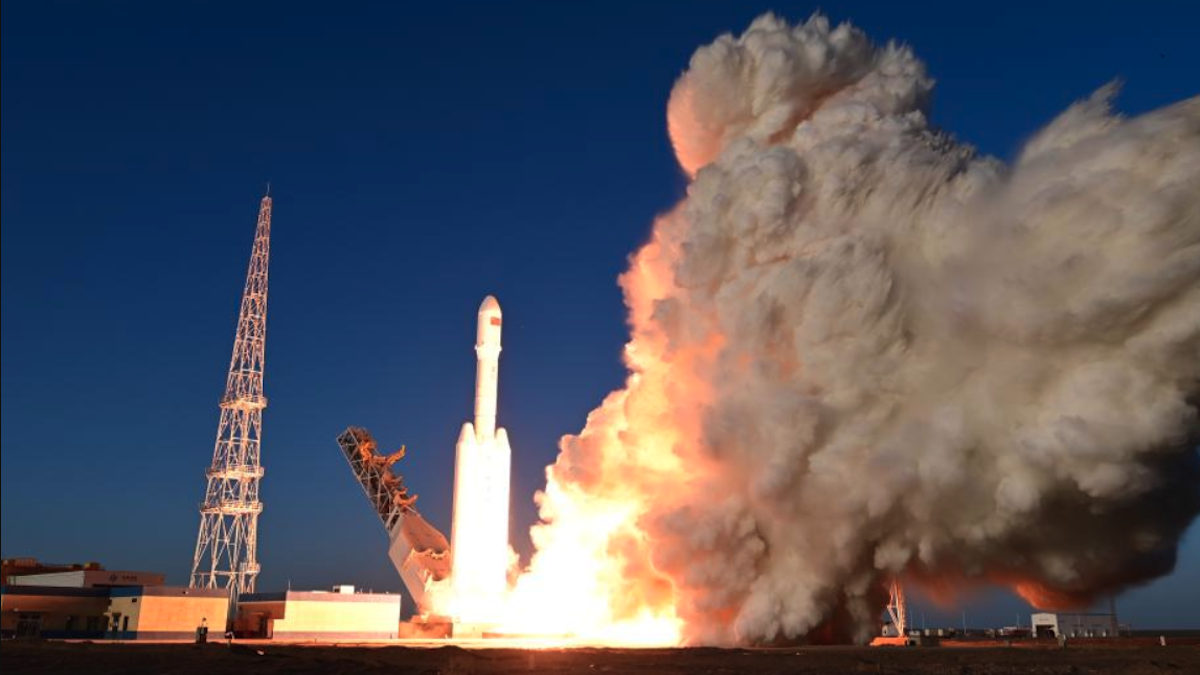
Following NASA’s landmark successful crewed lunar flyby mission, Artemis II, which wrapped up its 10-day lunar approach and began its return voyage to Earth, China has announced a ramp-up of its own lunar exploration program, reigniting discussion of the growing technological and geopolitical competition in deep space exploration.
Launched on April 1, Artemis II carried four astronauts into space aboard NASA’s heavy-lift Space Launch System rocket and Orion capsule, marking the first crewed test flight for NASA’s flagship Artemis program, which aims to return humans to the lunar surface for the first time since the Apollo era. The U.S. has set a 2028 target for its first crewed landing via the Artemis III mission, while China has formally committed to landing its own astronauts on the moon by 2030, creating a tight, overlapping timeline that underscores the high stakes of this new space race.
To advance its crewed landing goals, China is moving forward at an accelerated pace on critical heavy-lift launch infrastructure, most notably the Long March 10A rocket, a reusable next-generation launch vehicle purpose-built to carry crewed spacecraft and lunar landing hardware to orbit. According to chinastarmarket.cn, which cited Lian Jie, deputy chief engineer of the Lijian-2 rocket program, the China Manned Space Agency (CMSA) has formally approved a plan to conduct the first ever launch of the Long March 10A in mid-2026. For this mission, the Long March 10A will serve as the first-stage booster, paired with an upper stage from the commercial Lijian-2 rocket, to deliver navigation satellites into a trans-lunar injection (TLI) bound for cislunar space — the region between Earth and the moon where the two bodies’ gravitational fields interact.
This 2026 mission will mark a number of key milestones for China’s space program: it is the first test flight of the Long March 10A, and it will also mark the first time a rocket built by a Chinese commercial space enterprise has operated in cislunar space. The Lijian-2 rocket, developed by CAS Space — a commercial spin-off from the Chinese Academy of Sciences — just completed a successful launch on March 30, placing three satellites into their intended orbits. Like SpaceX’s workhorse Falcon 9 rocket, Lijian-2 uses kerosene and liquid oxygen as propellants. Lian added that a second Lijian-2 mission, carrying a carbon-monitoring satellite focused on terrestrial ecosystem research, is scheduled for September 2026, with an upgraded design that will substantially increase the rocket’s payload capacity.
Prior to this formal announcement, CMSA had only confirmed that the Long March 10A would launch sometime in 2026, without sharing a specific timeline. Progress on the rocket’s development has proceeded steadily in recent months: on February 11, 2026, the Long March 10A first stage completed a successful controlled sea-landing test in Wenchang, Hainan, validating key rocket recovery technologies as well as low-altitude flight performance and maximum dynamic pressure escape capabilities for China’s next-generation crewed spacecraft.
China has also completed key ground infrastructure to support its lunar ambitions, finishing construction of two dedicated spacecraft and launch vehicle assembly towers at the Wenchang Space Launch Site. These new facilities are designed to enable parallel processing of mission hardware and cut down preparation time between crewed lunar launches.
Observers of China’s space program note that while progress appears slower to some observers following Artemis II’s successful flight, China is sticking to its own well-defined roadmap. A Sichuan-based space columnist outlined the coming milestones: following the Long March 10A’s maiden flight in mid-2026, tests of the Mengzhou crewed lunar spacecraft are scheduled for the second half of the year, with a combined test of the Long March 10A and Mengzhou expected as early as November. If all these milestones are met, the 2030 landing target remains firmly achievable, with preparations proceeding incrementally ahead of a long-term plan to establish a sustained human presence on the moon. The Long March 10A itself is designed to be reusable, capable of lifting 14 tons to low Earth orbit (LEO), or carrying a crew capsule with up to seven astronauts.
For the actual 2030 crewed landing mission, China will use a modified Long March 10 configuration, created by adding two additional boosters to the base Long March 10A design. This upgraded rocket will generate a total thrust of 26,250 kN, capable of lifting 70 tons to LEO and 27 tons to trans-lunar injection. For comparison, the Saturn V rocket that carried Apollo 11 to the first historic lunar landing in 1969 delivered between 43.5 and 47 metric tons to TLI.
China will use a dual-launch architecture for its 2030 landing: one Long March 10 will launch the Mengzhou crew capsule carrying three astronauts, while a second will launch the Lanyue lunar lander. The two craft will rendezvous and dock in lunar orbit; two astronauts will transfer to the lander and descend to the lunar surface, while the third remains in orbit aboard Mengzhou. After completing surface operations, the crew will ascend back to lunar orbit, re-dock with Mengzhou, and return to Earth together.
On the U.S. side, the Artemis program plans to conduct its first crewed landing with Artemis III in 2028, followed by Artemis IV in 2029, which will begin assembly of the Lunar Gateway orbital space station. Both missions rely on SpaceX’s Starship as the human landing system to transport crews between lunar orbit and the surface. Artemis V, targeted for 2030 or later, will expand sustained lunar operations, using Blue Origin’s Blue Moon lander under a second NASA contract. SpaceX founder Elon Musk has also stated that the company aims to build a permanent human settlement on the moon within the next decade, pairing lunar development with its long-term goal of crewed missions to Mars.
Many industry analysts point out that as both the U.S. and China ramp up investment in lunar exploration and base development, more capital will flow into lunar infrastructure, creating more immediate commercial opportunities for space equipment suppliers and related private industries than the more distant, long-term goal of Mars exploration.
Beyond the 2030 crewed landing, China has laid out a clear long-term lunar exploration roadmap. In August 2026, China plans to launch the Chang’e-7 probe to the lunar south pole, a region believed to hold significant deposits of water ice in permanently shadowed craters. Sun Zezhou, a senior researcher at the China Academy of Space Technology, explained that Chang’e-7 will conduct comprehensive surveys of the local polar environment, analyze lunar surface composition, map geological structures, and search for water ice that could be processed into hydrogen and oxygen for rocket fuel and life support. The mission also reflects China’s commitment to international collaboration, carrying six scientific payloads provided by international partners including Italy, Russia, Egypt, Bahrain, Switzerland and Thailand.
Chang’e-8 is scheduled for launch around 2028, and will test key technologies for in-situ resource utilization — the ability to extract and use materials found on the moon — laying the technical groundwork for a future permanent lunar research station. After Chinese astronauts complete the 2030 landing, China plans to begin construction of the initial International Lunar Research Station (ILRS) by around 2035, developed in partnership with a coalition of international partners including Nicaragua, the Asia-Pacific Space Cooperation Organization, and the Arab Union for Astronomy and Space Sciences. The ILRS is designed as a long-term, multi-node research network linking lunar surface facilities, orbital infrastructure, and ground control systems, capable of sustained operation with periodic crewed missions.