On March 30, former and current U.S. President Donald Trump launched a blunt, unfiltered attack on France via his Truth Social platform, accusing Paris of being “VERY UNHELPFUL” in the ongoing US-Israeli war on Iran and warning that Washington “will REMEMBER!!!”.
The public rebuke, laced with implicit threats, stemmed directly from France’s confidential decision, implemented since the outbreak of hostilities, to deny overflight rights to American aircraft transporting military aid to Israel. Hours after Trump’s post, the Élysée Palace confirmed the policy, expressing open surprise at the sudden public criticism.
More than a month into the conflict that has left the Trump administration bogged down in a costly campaign with no clear end in sight, Trump’s outburst lays bare growing frustration among U.S. leadership toward European allies that have refused to back its bellicose approach to Iran. For France, the choice to reject U.S. demands has been the product of a delicate high-wire balancing act: Paris seeks to avoid a catastrophic rupture in transatlantic ties while also positioning itself as a defender of multilateralism and shoring up its eroding global influence.
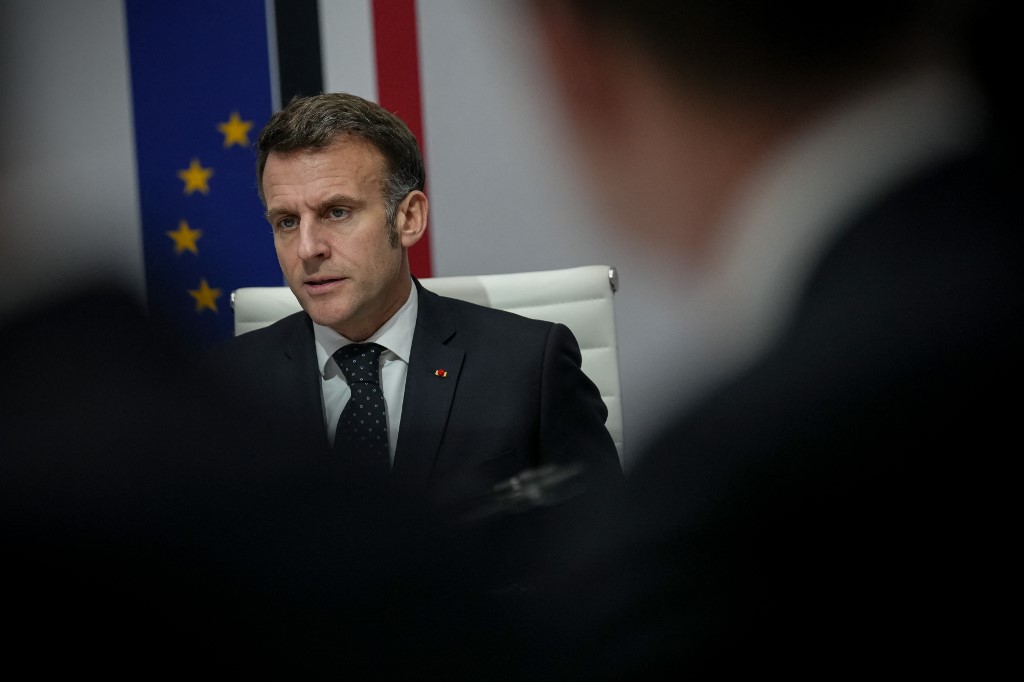
The rift opened immediately after the first joint US-Israeli strikes on Tehran on February 28. In a national televised address, French President Emmanuel Macron questioned the legality of the operation, noting that while Iran bore primary responsibility for the crisis due to its nuclear program and ballistic missile development, the strikes violated international law. This position was uniformly echoed across France’s diplomatic establishment.
In early March, French Foreign Minister Jean-Noel Barrot decried the fact that the offensive was launched without prior consultation or a mandate from the UN Security Council — the only global body authorized to legitimize cross-border military force. Nabil Hajlaoui, France’s ambassador to Oman, went even further in an exclusive interview with Middle East Eye, calling the entire operation “unjustified and illegal”, and stressing that “France’s objective is precisely to not be dragged or involved in any way in this war.”
Karim Emile Bitar, research director at the Paris-based Institute for International and Strategic Relations and an associate professor at Saint Joseph University of Beirut, notes that Paris was caught completely off guard by the February strikes, even though France maintains critical military infrastructure in the Gulf. “France was neither consulted nor informed by the United States. The French, and more broadly the Europeans, have clearly been marginalized in this sequence of events,” Bitar explained.
Maxime Lefebvre, a former French ambassador and professor at Sciences Po Paris, points out that this sidelining of European allies and prioritization of power politics over international law is not without precedent. He draws parallels to the 2003 U.S.-led invasion of Iraq, a comparison widely echoed by critics of the current Iran campaign. Like the 2003 war, the current conflict is framed around claims of a weapons threat — chemical weapons for Saddam Hussein’s Iraq, nuclear weapons for the Islamic Republic — the veracity of which remains heavily contested, and both are rooted in an explicit goal of regime change.
But Lefebvre argues the parallel has clear limits: in 2003, the U.S. pursued a multilateral diplomatic process before launching the invasion, actively working to rally allies or at least negotiate buy-in. That has not been the case this time around. “Beforehand, Trump did not seek to involve the partners in the Iranian nuclear negotiations, i.e. the three major European powers [France, the United Kingdom and Germany], but also the Chinese and Russians. Nor is this the case for the aftermath, since there are no political, diplomatic or multilateral prospects,” Lefebvre added.
A senior French diplomatic source based in the Middle East framed the current U.S. approach as a deliberate rejection of established global governance: “Today, we are witnessing a fully embraced and almost proudly proclaimed circumvention of multilateral frameworks, a fait accompli policy that is plunging the region into a new phase of instability.”
Even as France has declined to join the offensive, its cautious neutrality has drawn criticism at home. Dominique de Villepin, the former French prime minister who became the global face of Paris’s 2003 opposition to the Iraq War, has blasted current authorities for being too timid, arguing France has failed to mobilize the European Union to end the conflict. “I believe that our democracies must and can act. Economic sanctions are possible, political sanctions are possible. France is missing the boat, it is missing history,” de Villepin said.
Experts say France’s cautious stance stems from a long-running fear of alienating Washington. The 2019 Greenland controversy, when Trump’s public proposal to buy the territory triggered widespread European anger, already badly frayed transatlantic ties. Lefebvre summarizes Paris’s current approach: “France is trying to preserve the transatlantic relationship while setting red lines and moving towards greater European autonomy.”
While that diplomatic autonomy remains elusive, France has already found itself pulled into the conflict through its existing military commitments in the Middle East, which are integrated into Western security architecture. Paris maintains a major air base in the United Arab Emirates, troops in Jordan, and a deployment in Iraq’s autonomous Kurdistan region. It was in Erbil that a French service member was killed and six others wounded in a March 12 drone attack claimed by Iranian-aligned Iraqi Shia militias.
Though France’s bilateral defense agreements with Gulf states do not require it to join the US-Israeli offensive, Guillaume Ancel, a retired French lieutenant colonel, clarifies that “There is no defence commitment that France is obligated to follow. It has no obligation; there is no Article 5 [of the NATO charter, which requires collective defense for attacked allies].”
Still, even without formal participation, French forces are indirectly supporting the war effort by helping intercept and neutralize Iranian missiles and drones launched at Israeli and Western targets, a mission that requires constant coordination with frontline forces. “Like all western countries, France is facing its limitations in terms of interception capabilities,” Ancel noted. French Rafale fighter jets have already shot down dozens of drones using advanced air-to-air missiles that cost roughly €1 million ($1.16 million) each and take 18 months to manufacture.
After more than a month of sustained drone attacks, this has created a massive financial and logistical strain, with ammunition stocks dwindling rapidly. “Our entire concept of weaponry needs to be rethought,” French Prime Minister Sebastien Lecornu acknowledged to parliament on March 25. He unveiled plans to launch France Munitions, a centralized procurement platform that will serve domestic French forces, allied partners, and export clients, alongside an extra €8.5 billion ($9.8 billion) in munitions spending through 2030.
Ancel explains the root of the shortfall: “We have fallen considerably behind, mainly because we no longer expected to face high-intensity conflicts. Drones have profoundly changed the nature of warfare and are leading to an overconsumption of munitions. The Americans and Israelis are in a similar situation. And the Iranians have understood this well. That is why they have opted for a sustained saturating effort rather than a massive attack.”
Another major flashpoint is the Strait of Hormuz, the strategic waterway that carries roughly one-fifth of the world’s daily crude oil exports and has been blocked by Iran since the outbreak of war. The Trump administration has demanded European help, led by France, to reopen the strait even as hostilities continue, but Paris has refused to act until a ceasefire is reached, to avoid being labeled a co-belligerent by Tehran. That refusal has further stoked U.S. anger.
Last week, U.S. Secretary of State Marco Rubio signaled that the U.S. would revisit its NATO commitments after the conflict, a threat French diplomatic sources dismiss as blatant pressure. “Trump is aware of Europe’s vulnerability to Russia, and he doesn’t hesitate to touch on it. It’s a real means of exerting pressure,” the anonymous source said. Lefebvre predicts European allies will pursue diplomatic concessions to preserve the alliance, but adds that “a plan B is clearly needed” to prepare for a future where the U.S. scales back its security commitments to Europe.
Beyond the Iran crisis, France continues to navigate diplomatic efforts on the Lebanese front, where Israel has announced plans for a long-term occupation of southern Lebanon and has hinted at a policy similar to its post-2023 Gaza campaign. Leveraging its century-long historical ties to Lebanon, Paris is pushing for a diplomatic solution to the crisis. Despite its stated commitment to de-escalation, France has deployed the Charles de Gaulle aircraft carrier to the Eastern Mediterranean — officially to support Cyprus, whose British Akrotiri base was hit by a drone early in the war, but also to maintain a visible military presence near Lebanese waters.
Bitar argues that France still has a unique role to play in Lebanon: it was Paris that guaranteed the sovereignty, unity, and territorial integrity of Greater Lebanon upon its founding in 1920, and helped prevent the country’s total fragmentation during the 1975-1990 civil war. “Today, with the possibility of Lebanon’s fragmentation once again being mentioned, France can exert pressure with its Arab allies and play a role at the United Nations, even if it remains dependent on US security guarantees and continues to operate within the western geopolitical orbit,” Bitar said.
But the challenge remains steep, as deep domestic divisions have left Lebanon polarized: one camp blames Hezbollah for the current Israeli invasion and risk of territorial loss, while the other views the group as the only effective barrier to what it sees as Israeli expansionism. One senior Lebanese diplomat told Middle East Eye that “Sometimes one gets the impression that French diplomacy, like European diplomacy in general, is nothing more than empty words in the face of fait accompli. In Lebanon, as elsewhere, traditional diplomatic levers are no longer sufficient in the face of the profound transformations of the international system, with actors fighting for their political or sectarian survival. Today, international diplomacy is no longer based on reason or wisdom, but on power.”