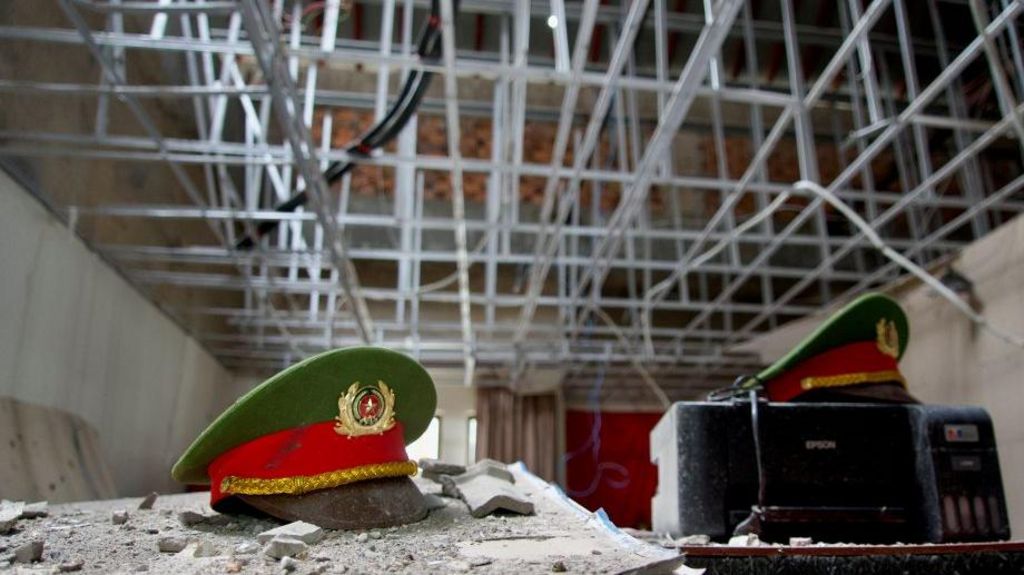
Deep inside the Cambodian border town of O Smach, behind the shuttered Royal Hill casino, a six-story building stands pockmarked with shrapnel damage from a December cross-border air strike. When the BBC, granted access by occupying Thai military forces, walked its dark, dust-choked corridors, each door opened to a chilling window into one of the world’s largest cross-border online fraud operations.
Behind one door, a full-scale replica of a Vietnamese bank had been constructed to fool victims. Another was fitted to mimic an Australian police station, complete with a Chinese police uniform hanging on a wall. Hand-painted motivational slogans in Chinese — one reading “Money Coming From Everywhere” — still line the walls, scattered with crumpled counterfeit $100 bills left behind when thousands of trapped scam workers fled after the bombing. This was not a casino, but a sprawling forced labor scam compound, where trafficked workers defrauded countless victims across the globe of their life savings under brutal, regimented control.
The compound’s current status is wrapped in a brief but tense border dispute. In December, the Thai Air Force carried out airstrikes on Royal Hill, claiming Cambodian military drones were being launched from the site during a short outbreak of cross-border fighting. The bombardment shattered windows, blew gaping holes in roofs and walls, and forced the compound’s workers to flee abruptly, leaving half-eaten noodle bowls, half-empty soda cans, and a stale, acrid stench in their wake. Today, only Thai soldiers patrol the empty site. The Thai military invited the BBC to expose the scale of Cambodia’s transnational scam industry, framing the visit as a call for international action against what they call a regional scourge — a move that also serves to justify their December cross-border strikes. Cambodia has formally protested Thai occupation of the territory, while Thailand argues its troop presence adheres to the post-ceasefire agreement that froze forces in their end-of-conflict positions.
What makes the Royal Hill compound particularly revealing is how it operated in complete obscurity for years, even as neighboring O Smach Casino, owned by high-profile Cambodian tycoon Ly Yong Phat, had already been named in reports of abuse by escaped scam workers. Ly Yong Phat, a senior figure in Cambodia’s ruling Cambodian People’s Party with close ties to the powerful Hun clan led by former Prime Minister Hun Sen, has already been sanctioned by the U.S. and other nations for alleged involvement in human trafficking and online fraud. By contrast, Royal Hill’s owner Lim Heng has maintained an extraordinarily low public profile, never appearing on international sanctions lists. Like many connected to the ruling elite, Lim Heng was awarded the Cambodian noble title Neak Oknha by Hun Sen — an honor requiring a minimum $500,000 donation to the state, placing him among a small circle of just a few hundred elite Cambodian powerbrokers. The only publicly known unusual detail about Lim Heng is his habit of paying respects at the cremation site of former Khmer Rouge leader Pol Pot, located near another of his northern border casinos.
The rise of scam compounds like Royal Hill is rooted in decades of political and economic change in Cambodia. After the 1991 end of the Cambodian civil war, well-connected tycoons amassed vast fortunes by acquiring large land tracts through their ties to the ruling family. Early wealth came from illegal logging and agricultural plantations, followed by windfalls from a Chinese-investor-fueled urban property boom. In border regions like O Smach, casinos became the most profitable venture, capitalizing on strict gambling bans in neighboring Thailand and China. Over three decades, the Cambodian government issued roughly 200 casino licenses, drawing the interest of Chinese organized crime syndicates that added lucrative unregulated online gambling operations on site.
The shift to large-scale online fraud came in 2019, after international pressure from China forced Hun Sen to ban online gambling, followed by the COVID-19 pandemic that halted cross-border tourism. With their core revenue streams cut off, criminal syndicates pivoted to transnational online fraud, luring thousands of young workers from across the globe with false promises of high-paying clerical or tech jobs. Some workers knew they would be participating in illicit activity, but none were prepared for the brutal conditions inside the compounds.
Documents recovered by the BBC from Royal Hill’s rubble lay bare the brutal disciplinary regime workers faced. Anyone who failed to generate a single “lead” — an initial contact with a potential victim to build an online relationship — in one day received five cane strokes. Three straight days without a lead resulted in a minimum of 10 strokes. Even casual conversation with coworkers or failure to share personal intimate photos to trick victims into trusting scammers earned the same corporal punishment. Escapee Wilson, a young Ugandan man recruited to Royal Hill in August, described even harsher abuse to the BBC. “Some people were electrocuted. Some were put into the black room. They have a room called The Black Room where terrible torture went on,” he said from Phnom Penh, where a local charity shelters him as he waits for repatriation.
Wilson said he was lured with an offer for a digital marketing job in Malaysia, only to be trafficked to the Cambodian compound. He described being forced to work 15 to 16 hour days, following rigid scripts written by Chinese bosses and using AI to alter his voice and appearance to match his assigned persona: “You are supposed to portray the character of a woman, who is 37 years old, rich, and who wants a husband. You chat to these older Americans with the intention of making them think you have fallen in love with them. So, in the script, there’s a point where you break them emotionally. You build trust, and then later on you can lure them into buying the products.” Wilson added that workers were even forced to return to their posts immediately after bomb blasts during the December air strike: “Every time we would hear a bomb – the building would sometimes shake – we would run out. We were scared. But then we had to come back in and work again.”
The BBC found scam scripts and operational rules in multiple languages tailored to target victims across the globe. Lateness resulted in fines, and workers had to request permission to use the toilet. One recovered “Employee Outing Registration Form” meticulously logged every bathroom break taken by workers in the days before the air strike, including the exact amount of time each worker spent away from their desk. Next to a fully built replica Brazilian police station, rows of soundproofed booths were set up for scammers to make calls, with handwritten notes in Portuguese reminding scammers of tactics to gain victims’ trust. One recovered fake document was a convincing forged summons from Sao Paolo police accusing a victim of money laundering — a common blackmail tactic to scare targets into transferring funds or surrendering sensitive bank account information.
For years, the Cambodian government largely ignored growing international outcry over the ballooning scam industry and its linked human rights abuses. The 2025 U.S. State Department Trafficking in Persons Report accused the Cambodian government of failing to take meaningful action to eliminate the trade, noting that no high-profile scam compound owner or operator had ever been arrested or prosecuted. When the U.S. imposed sanctions on Ly Yong Phat in September 2024 over his links to fraud and forced labor, the ruling party demanded the sanctions be withdrawn, accusing the U.S. of violating Cambodian sovereignty.
Earlier this year, however, sustained international pressure from the U.S., China and other global powers forced the Cambodian government to make an abrupt policy shift. National police have raided dozens of suspected scam compounds, and Prime Minister Hun Manet pledged to fully shut down the entire cross-border scam industry by the end of April, acknowledging that the illegal trade was destroying Cambodia’s international reputation and damaging its legitimate economy.
The most high-profile move came in January, when Cambodian authorities arrested and extradited to China Chen Zhi, a young Chinese entrepreneur who had become one of Cambodia’s most influential insiders. Chen Zhi, who had acquired Cambodian citizenship and served as a personal adviser to Hun Sen, ran the Prince Group — a conglomerate that owned a national bank, an airline, and massive property developments across the country. Sanctioned by both the U.S. and UK in 2024 for running a vast fraud-funded corporate network, Chen Zhi had seemed untouchable for years. But after his arrest, footage circulated of him being led hooded and handcuffed off a plane to China, where he now awaits trial on charges of running a cross-border fraud and gambling syndicate. His high-profile extradition sent a clear signal that the government was willing to sacrifice top-tier figures connected to the scam industry to salvage Cambodia’s global standing. Authorities followed Chen Zhi’s extradition with the extradition of Li Xiong, chairman of Huione Pay, an online payment platform accused of laundering billions in scam profits.
Today, many scam compounds across Cambodia sit empty, and authorities say more than 10,000 trafficked foreign workers have been repatriated. But many more, like Wilson, still remain stuck in Cambodia waiting to return home. And despite the government’s bold pledges, analysts remain skeptical that the crackdown will mark the end of cross-border scams in the country.
Critics compare raid operations to a game of whack-a-mole: it is simple for syndicates to relocate workers to new, unreported lower-profile compounds, and thousands of workers are believed to have chosen to remain in Cambodia rather than face poverty at home. Beyond the high-profile arrest of Chen Zhi, none of the Cambodian tycoons accused of hosting scam compounds behind their casino operations have faced legal action. Ly Yong Phat, Try Pheap and Kok An — all wealthy, powerful elite figures sanctioned by foreign governments for their links to scams — still live freely and comfortably in Cambodia. In a striking irony, both Ly Yong Phat and Kok An, who hold senate seats, recently voted in favor of a new anti-scam law the government says will impose harsh penalties on scam operators.
As for Lim Heng, the little-known tycoon who built Royal Hill, his name had never appeared in any public reporting or investigation into Cambodia’s scam industry — until Thai forces crossed the border and seized his compound.