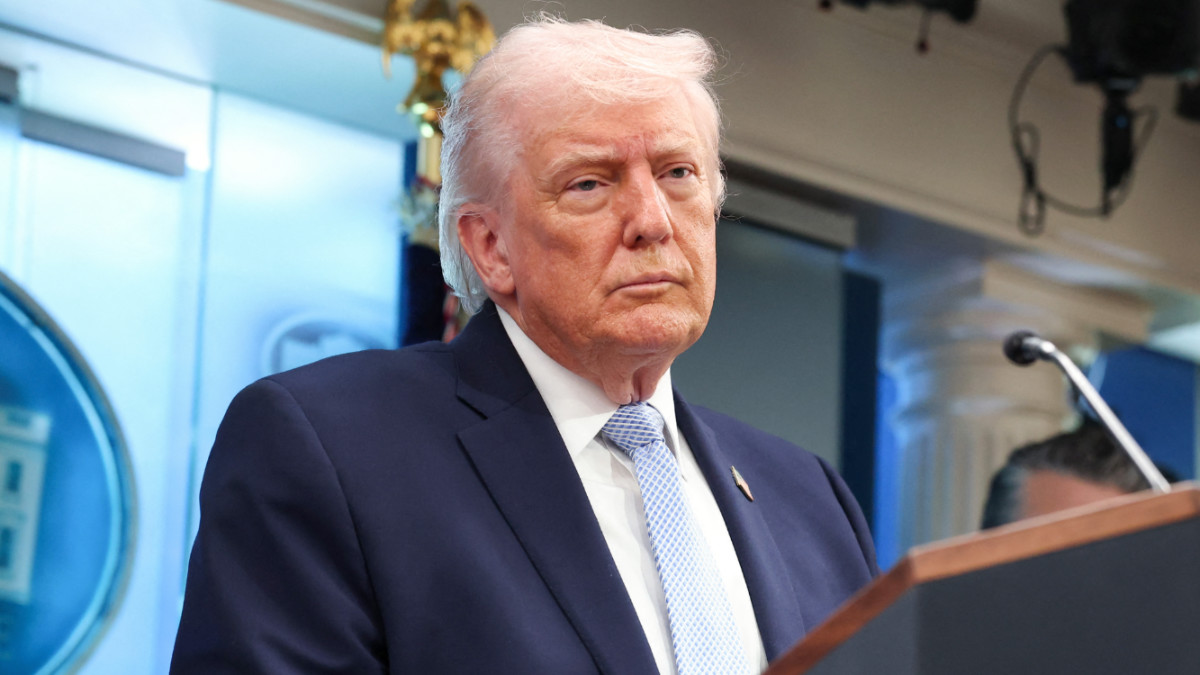
On a Monday appearance at the White House, former US President Donald Trump delivered a detailed account of a high-stakes cross-border rescue operation that recovered two downed US airmen from Iranian territory earlier that weekend, framing the mission as a remarkable success for US military capabilities. The incident unfolded after an American F-15E Strike Eagle was shot down over Iranian soil on Friday, triggering an urgent race between US special operations teams and Iranian security forces to locate the jet’s two crew members: the pilot and a weapons systems officer. While the pilot was evacuated by US forces the same day the jet crashed, the second injured airman remained at large for nearly 48 hours before being recovered by US troops on Sunday.
US officials had initially released almost no verifiable details about the crash location or the exact parameters of the rescue mission, leaving open source analysts and international observers to piece together information from fragmented reports. Speaking publicly for the first time after the operation concluded, Trump compared the challenge of locating the wounded airman to “finding a needle in a haystack,” emphasizing the increased difficulty of the mission given the officer’s life-threatening bleeding and vulnerable position deep in enemy territory. “That’s a long time when you’re in tough shape and when you’re bleeding,” Trump told reporters, praising the airman’s resilience in evading capture for two full days.
Conflicting reports of the crash and rescue locations quickly emerged, with public observations placing US search and refueling aircraft over Iran’s southwestern Kohgiluyeh and Boyer-Ahmad province over the weekend, a sighting that prompted Iranian authorities to mobilize thousands of regular soldiers, Basij paramilitary fighters and civilian volunteers to launch a massive manhunt in the region. However, reporting from Reuters placed the actual F-15E crash site in central Iran’s Isfahan province, hundreds of kilometers away from the area Iranian forces were searching. Trump confirmed this discrepancy was no accident: it was a deliberate deception tactic designed to distract Iranian security forces from the true recovery zone.
“ We were bringing them all over, and a lot of it was subterfuge. We wanted them to think he was in a different location because they had a vast military force out there. Thousands of people were looking, so we were scattered all over like we were right on top of them,” Trump explained. The geographic mismatch drew immediate scrutiny from open source intelligence analysts, and some unsubstantiated speculation emerged that the rescue mission served as cover for a secret separate operation to seize Iran’s stockpile of highly enriched uranium stored at a nuclear site located in Isfahan, a facility that was the target of a US strike in June.
Iranian officials quickly amplified these claims, though they offered no concrete evidence to support the allegation of an undisclosed secondary mission. “The possibility that this was a deception operation to steal enriched uranium should not be ignored at all,” stated Iranian foreign ministry spokesman Esmaeil Baqaei. Speaking to Middle East Eye on condition of anonymity, two former US defense and intelligence officials pushed back against these claims, noting that while an unusually large contingent of US military personnel was deployed to the mission, the additional manpower was intended to secure the landing zone and provide backup firepower for the extraction team, not for a separate nuclear operation.
Competing narratives have also emerged around the losses suffered during the operation. Iranian officials have framed the entire incident as a decisive defeat for the US, pointing to the downing of the F-15E as well as the reported loss of additional US assets including C-130 transport planes, H-60 Black Hawk helicopters and at least one MQ-9 Reaper surveillance drone. Trump acknowledged that US forces were forced to destroy two aircraft that became stuck in soft sand during the extraction, but downplayed the loss as a planned part of the mission’s contingency protocol.
“We had a contingency plan which was unbelievable where lighter, faster aircraft came in and they took them [US soldiers] out. We blew up the old planes… because we had equipment on the planes,” Trump said, referencing sensitive anti-aircraft systems mounted on the abandoned aircraft that the US refused to leave in Iranian hands. Trump also confirmed that three US helicopters were used in the rescue operation, and defense experts who have examined photographs of debris from the US landing zone have identified wreckage matching the frame of an MH-6M Little Bird, a small, highly maneuverable helicopter typically used for special operations insertions and extractions that was likely used to retrieve the downed airman and transfer him to the main extraction landing zone.