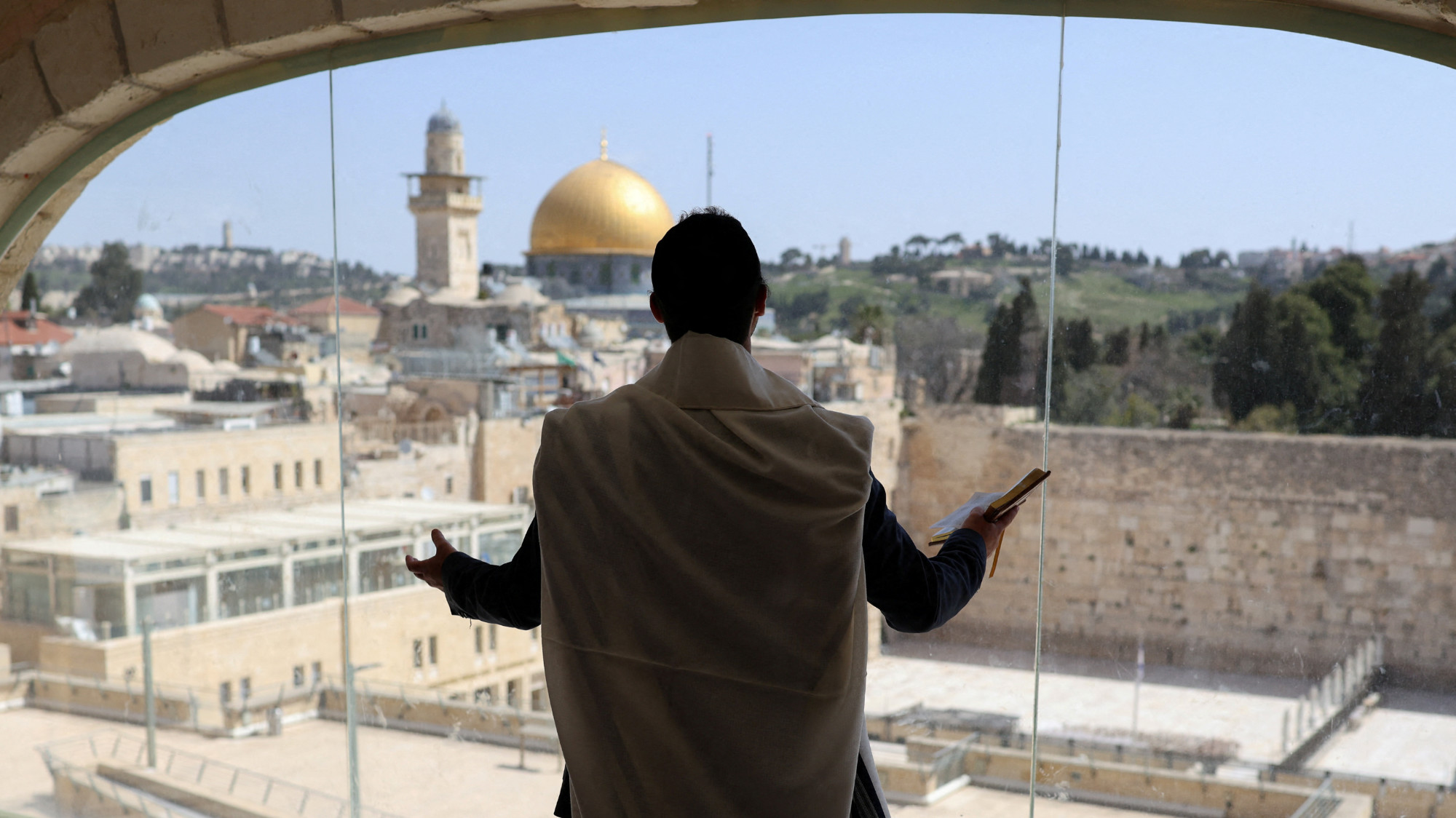
Amid the ongoing US-Israeli war against Iran, a deeply controversial and discriminatory access policy for religious sites in occupied East Jerusalem has drawn widespread condemnation, as Palestinian and Christian worshippers remain locked out of holy sites ahead of and during major religious holidays, while Jewish worshippers are permitted to gather for seasonal rituals.
Since February 28, Israeli occupation authorities have imposed a full ban on all Muslim Palestinian worshippers entering Al-Aqsa Mosque, one of the most sacred sites in Islam. This total closure marks an unprecedented step not seen since Israel began its occupation of East Jerusalem in 1967, with no exceptions granted even for Ramadan—Islam’s holiest month—or the major Eid al-Fitr holiday marking the end of the fasting period. The shutdown extends to Christian holy sites in Jerusalem’s Old City as well: the Church of the Holy Sepulchre, one of Christianity’s most revered locations, has been closed to worshippers, who were barred from gathering for traditional Easter celebrations on Sunday, with only 15 members of the clergy permitted inside to conduct the holiday observance.
In sharp contrast, Israeli authorities allowed as many as 50 Jewish worshippers to enter the Western Wall, the structure that forms part of the outer boundary of the Al-Aqsa Mosque compound (known to Muslims as the Buraq Wall), on Sunday. Those in attendance were able to take part in the traditional priestly blessing ceremony tied to the Jewish Passover holiday, held in a covered space adjacent to the Western Wall plaza.
The unequal application of restrictions does not end at the Western Wall. Thousands of people gathered for a large Passover event in an indoor hall in the central Israeli city of Bnei Brak, an area that has been heavily targeted by Iranian missile strikes amid the ongoing war. Dozens more gathered for Passover festivities in Jerusalem’s Mamilla neighborhood, located just steps from the Old City. This pattern mirrors restrictions seen during the Purim holiday last month, when large gatherings of Israelis proceeded without interference, while wartime gathering limits were strictly enforced against Palestinian residents.
Israeli officials have framed the full closure of Al-Aqsa as a necessary security measure to mitigate risks from Iranian missile attacks. But Palestinian leaders and critics reject this justification, arguing the closure is part of a deliberate, long-running effort to consolidate exclusive Israeli control over the contested holy site, eroding long-standing Palestinian and Muslim access rights.
Ahmad Tibi, a Palestinian citizen of Israel who serves as a member of the Israeli Knesset (parliament), slammed the discriminatory policy on Sunday, calling for the immediate reopening of both Al-Aqsa Mosque and the Church of the Holy Sepulchre. Tibi pointed to a recent Israeli High Court decision that allowed gatherings of up to 600 people for anti-war protests, alongside unimpeded mass Jewish holiday celebrations, as proof that security concerns are a pretext. “There is no safety justification for the restrictions at Al-Aqsa; this is a blatant violation of freedom of worship,” Tibi said. He added that Israeli police “act forcefully against worshippers at Herod’s Gate and at the entrances to the Church of the Holy Sepulchre. This is selective enforcement driven by political motives.”
After Sunday’s prayers at the Western Wall, the Israeli High Court issued a ruling that raised the maximum allowed gathering size from 50 to 100 people for both the Western Wall and the Al-Aqsa Mosque compound. Despite the new legal limit, however, no worshippers—Muslim or Jewish—have been permitted to enter the Al-Aqsa Mosque building itself since the war began. Prior to the ruling, only 25 staff members from the Jerusalem Waqf, the Islamic endowment that manages the 14-hectare Al-Aqsa compound, were allowed on site per shift for maintenance work. Even that limited access has been contested: last week, Israeli forces reportedly turned away seven Waqf staff who were scheduled for their shifts.
It remains unclear whether the new 100-person gathering limit will pave the way for the return of Palestinian Muslim worshippers to the mosque. Prior reporting from Middle East Eye indicates that Israeli officials have informed the Waqf that the mosque will remain closed at least through mid-April. The decision to raise the gathering cap came after intense pressure from Israeli religious and far-right political leaders, coming on the heels of the High Court’s approval of 600-person anti-war protests.
Israeli police, under the oversight of far-right National Security Minister Itamar Ben Gvir, have drafted a proposal that would allow up to 150 “Jewish and Muslim worshippers” to enter Al-Aqsa Mosque. Ben Gvir has framed the proposal as an effort to ensure fairness, arguing that since anti-government protests are permitted, “I am obliged to ensure justice and prevent discrimination” against worshippers seeking access to the site. “The High Court must allow access both to the Temple Mount and the Western Wall in small groups,” he stated, using the Israeli term for the hill where Al-Aqsa is located.
Before the outbreak of the war with Iran, ultra-nationalist Israeli settlers carried out twice-daily incursions into the Al-Aqsa Mosque compound under heavy Israeli police protection, in open violation of the decades-long international status quo agreement that designates Al-Aqsa as an exclusively Islamic holy site governed by Muslim authorities. These daily incursions were paused when the war began, but it remains unclear whether the new police proposal would allow them to resume.
If the proposal goes into effect, the 150-person cap would actually exceed the pre-war limit of around 100 settlers per incursion. The plan has already been celebrated by Arnon Segal, one of the most prominent Israeli activists who organizes the regular settler raids on Al-Aqsa. Writing on his X account, Segal noted that “Allowing ‘small groups of only 150 people’ onto the Temple Mount is more than the maximum group size Jews have ever been allowed to enter, even on the busiest and most crowded days.” He called the proposal “a dream,” crediting Ben Gvir for advancing the plan and framing it as an unprecedented, historic shift in access to the site.