As hundreds of U.S. service members fly toward the Persian Gulf aboard military transport planes, ahead of a potential large-scale ground invasion of Iran, military analysts are sounding urgent alarms over the steep, unpredictable costs any such operation would incur – shaped heavily by Iran’s unique and formidable geography. Spanning more than 1.4 million square kilometers, Iran is a vast nation framed by two massive mountain ranges, with the Caspian Sea marking its northern border and the Sea of Oman and Persian Gulf forming its southern frontier. Its rugged, varied terrain, experts uniformly agree, would turn any ground incursion into a quagmire that is nearly impossible to control once initiated.
“If you examine the historical record of large-scale ground interventions, you quickly see that once invading forces cross the border, containing the scope and duration of the conflict becomes extraordinarily difficult,” explained Arman Mahmoudian, a research fellow at the University of South Florida’s Global and National Security Institute, in an interview with Middle East Eye. Iranian and Western analysts have outlined three primary scenarios for a U.S.-led ground attack: seizing Iranian-controlled islands in the Persian Gulf and Strait of Hormuz, launching an amphibious assault on Iran’s southern coastline, or pushing into western Iran through Kurdish-majority territories bordering Iraq and Turkey. Every proposed path carries severe, well-documented risks, analysts emphasize.
The closure of the Strait of Hormuz – a critical global chokepoint through which roughly one-fifth of the world’s daily oil consumption passed before the outbreak of the current conflict – has emerged as the primary driver of pressure on former U.S. President Donald Trump and his defense department. Since hostilities began, Iran has targeted commercial transiting vessels and effectively shut down the waterway, granting passage only to a small number of tankers from nations it classifies as friendly, with unconfirmed reports indicating Tehran has charged some vessels up to $2 million for guaranteed safe passage. Iran’s control of the strait has already driven global energy prices sharply higher, intensifying pressure on Washington to reopen the route.
In response to the closure, the U.S. has launched airstrikes on Kharg Island, Iran’s primary oil export hub located 32 kilometers off the country’s southern coast. The strikes have fueled widespread speculation that Washington could move to seize the island, a idea Trump first floated in a 1988 interview with The Guardian, decades before he entered electoral politics. But even analysts at staunchly anti-Iranian think tanks argue that a seizure of Kharg or any other Iranian Gulf island would be strategically unsound and likely backfire.
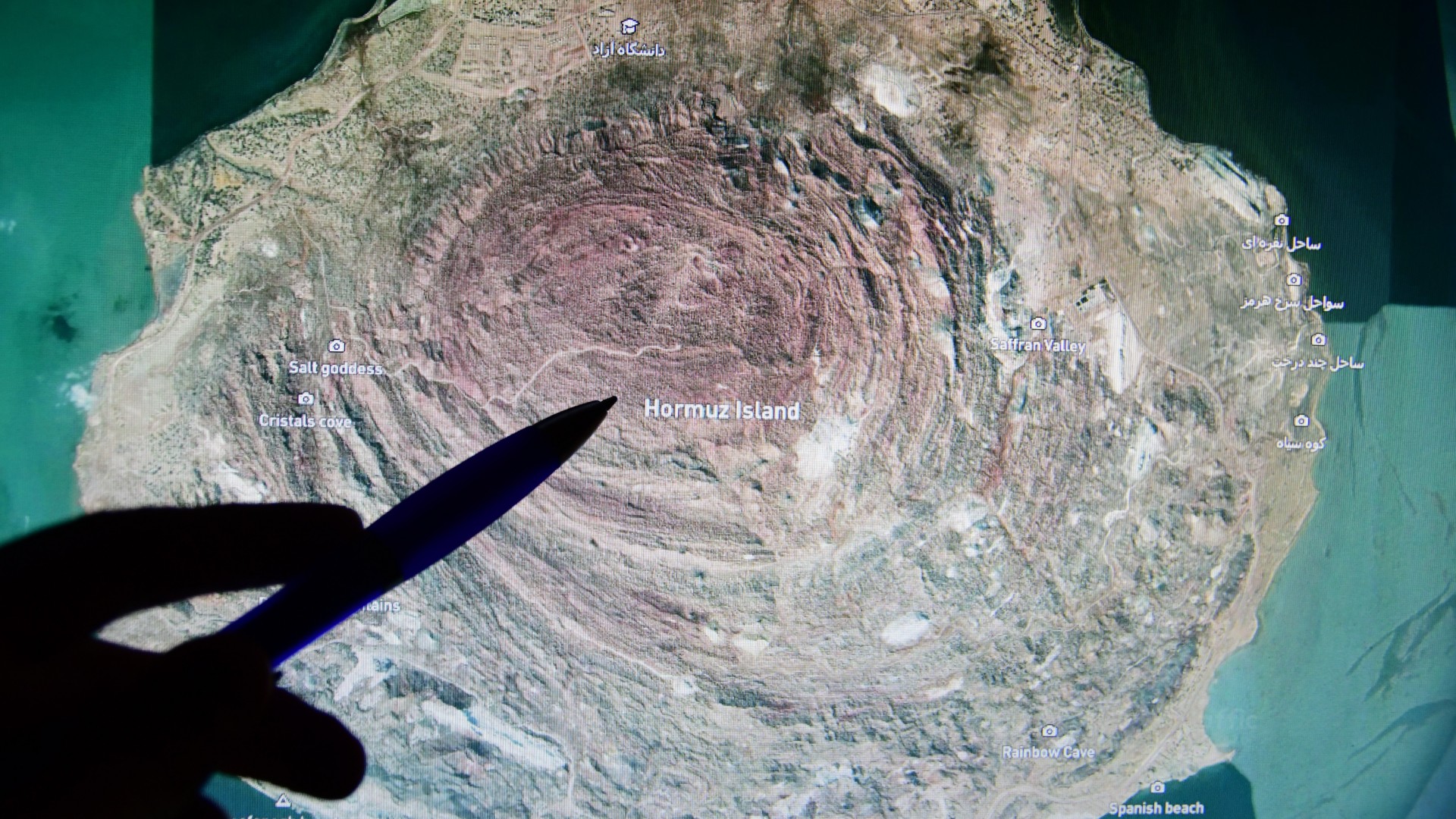
Mahmoudian notes that Iran would have little incentive to defend Kharg, which handles 90 percent of Iran’s total crude exports, in a direct head-to-head battle with U.S. forces. “Iran cannot win a direct fight for the island against American military power, so they would not waste troops trying. Instead, they would let U.S. forces take control, then launch sustained asymmetric attacks on occupying forces from the mainland,” he said. This dynamic holds for all major Iranian islands in the Strait of Hormuz, including Qeshm, Hormuz and Larak: any U.S. seizure would leave occupying forces vulnerable to constant attack. Farzin Nadimi, an analyst with the pro-Israeli, anti-Iranian Washington Institute, has even acknowledged this reality, stating in an interview that “the military occupation of Kharg is neither practical nor logical. Even if Iranian islands are taken, it would be very hard to hold them.” Seizing Kharg would also send global oil prices spiking even further, analysts add: removing Iran’s 1.5 million barrels per day of exports from the global market would create massive new supply shortages that harm consumers and economies worldwide.
Beyond Kharg, Iran controls 42 islands in its southern waters, 18 of which are permanently inhabited. The largest, Qeshm Island, spans 1,500 square kilometers – larger than the entire nation states of Bahrain and Singapore – and sits just two kilometers from the Iranian mainland along the Strait of Hormuz. Three smaller islands, the Greater Tunb, Lesser Tunb and Abu Musa, hold particular geopolitical sensitivity: Iran controls the islands, but the United Arab Emirates claims sovereignty over them, leading to speculation the U.S. could seize the territories and hand them over to the UAE as a goodwill gesture. But Alex Vatanka, a senior fellow at the Washington-based Middle East Institute, warns this would create decades of persistent tension between the UAE and whatever Iranian government remains after the conflict. Most analysts agree that any U.S. seizure of Iranian islands would primarily serve a political goal: gaining leverage to force Tehran to make concessions in future negotiations in exchange for returning the occupied territories. Senior Iranian sources have previously warned that Iran would respond to any ground invasion by heavily targeting the UAE, which it views as complicit in U.S.-led aggression.
A second potential invasion route is Iran’s 1,800-kilometer southern coastline, which stretches from the Iraqi border near Abadan all the way to the Gulf of Gavater on the Pakistani border. While the coastline’s enormous length makes defending every point a challenge for Iran, it would pose the same logistical nightmare for any invading force. Mahmoudian argues that a coastal assault makes geographic sense for the U.S., as Iran’s southern coast sits directly across the Gulf from pre-positioned U.S. military bases, allowing for easy logistics reinforcement, casualty evacuation and resupply. The U.S. already maintains overwhelming naval dominance in the region, and the Marines deployed to the area are specifically trained for large-scale amphibious operations. Even so, Mahmoudian warns that even a limited coastal incursion could quickly spiral out of control. “If you seize a stretch of coastline to control the Strait of Hormuz, your forces will still face constant Iranian attacks,” he explained. “To secure your position and build out defenses, you have to push further inland. Once that happens, containing escalation becomes nearly impossible.”
Iran’s massive size and rugged terrain work heavily in Tehran’s favor, even after weeks of U.S. and Israeli airstrikes. Nadimi notes that Iran has still been able to launch consistent missile attacks, in large part because its vast territory allows it to disperse military assets, and key weapons systems are stored in hardened underground facilities. Iran is home to more than 390 mountains over 2,000 meters, including 92 that rise above 4,000 meters – among them Mount Damavand, the Middle East’s highest peak. Vatanka compares the current context to the 2003 U.S. invasion of Iraq, noting that Iran is four times larger than Iraq, with far more rugged terrain. Tehran has also spent decades preparing for this exact scenario, burying key military and nuclear infrastructure deep inside mountains, making it far more defensible than Iraq under Saddam Hussein was in 2003.
The third proposed invasion route would push into western Iran from Iraq, through the rugged Zagros Mountains and across Kurdish-majority regions near the Turkish border. Since the outbreak of the war, some analysts have suggested the U.S. could rely on Iranian Kurdish armed groups based in northern Iraq to lead the ground offensive in this scenario. So far, these groups have avoided direct involvement in the conflict, but commanders from the Kurdistan Free Life Party (PJAK) and the separatist Kurdistan Freedom Party (PAK) signaled openness to collaborating with Israel during a March 19 online conference at Tel Aviv University. Even so, experts argue this scenario is unlikely to achieve U.S. strategic goals.
Under this plan, the U.S. would provide air support while Kurdish forces lead the ground push, leveraging their local knowledge of the difficult mountain terrain. But Mahmoudian notes that Iran has already pre-positioned large numbers of troops in the region under the cover of military exercises, anticipating exactly this kind of incursion. The result would be extremely heavy casualties for Kurdish fighters. Vatanka adds that most Kurdish armed groups are lightly armed and lack the large, structured military units needed to sustain a deep incursion into Iran. “They can hide behind U.S. and Israeli air support, but they would still take catastrophic losses,” he explained. “As they push beyond Kurdish regions into majority-Persian areas, their position becomes even more untenable. There is no scenario where these forces advance all the way to Tehran – they simply do not have the capability.”
To date, the U.S.’s core strategic goals for the conflict remain frustratingly unclear. When the U.S. and Israel launched the campaign on February 28, leaders cited the goal of regime change in Iran, but weeks of intensive airstrikes and targeted assassinations of military and political leaders have failed to destabilize Iran’s governing structure. If the goal is instead to increase pressure to force Tehran into unfavorable negotiations, there is no evidence the strategy has worked – if anything, it has hardened the Iranian leadership’s stance and increased public nationalist sentiment in favor of the government. History also shows the Islamic Republic has never agreed to negotiations while its territory remains under foreign occupation, Mahmoudian pointed out, referencing the 1980-1988 Iran-Iraq War. When Iraqi forces captured the port of Khorramshahr and besieged Abadan in the first year of the war, Baghdad offered Tehran negotiations to end the conflict – but Iran refused until all occupied territory was returned.
Vatanka argues that the current U.S. approach lacks any coherent grand strategy. The initial stated goal of regime change was quickly abandoned, he explained, leaving little more than a vague hope that the Iranian public would rise up and overthrow the government on its own. “That is not a strategy,” he said. “That is just a hope.”