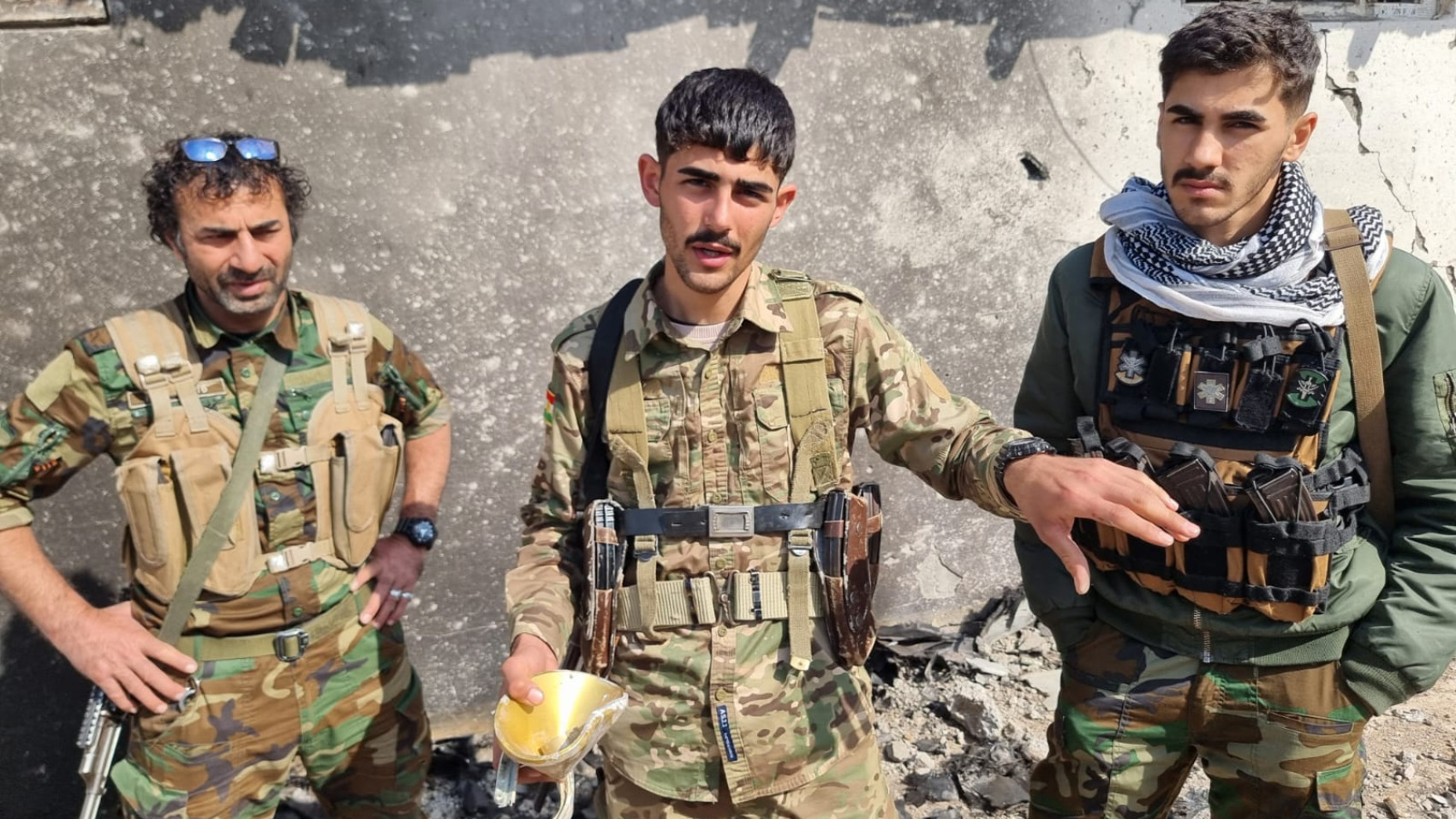
A controversial claim from former U.S. President Donald Trump that Washington supplied weapons to Iranian anti-government protesters via Iranian Kurdish groups has been uniformly rejected by senior leaders of every major Iranian Kurdish opposition faction, in statements collected by independent outlet Middle East Eye.
During an interview with Fox News Sunday, Trump asserted, “We sent guns to the protesters, a lot of them. And I think the Kurds took the guns.” This comment represented the latest shift in the former president’s inconsistent public positioning on Kurdish involvement amid the ongoing U.S.-Israeli war on Iran that launched on February 28.
Just weeks earlier, in early March, Trump told Reuters he openly backed Kurdish forces launching an offensive against the Iranian government, a remark that came alongside widespread unconfirmed media reports claiming the Central Intelligence Agency was secretly arming Iranian Kurdish factions. Within days, however, Trump walked back that support, telling reporters he had explicitly blocked any Kurdish military involvement, saying “They’re willing to go in, but I’ve told them I don’t want them to go in.”
Top figures from every major Iranian Kurdish armed opposition group have now directly refuted Trump’s latest weapons claim. Siamand Moeini, a senior leader of the armed Kurdistan Free Life Party (PJAK), told Middle East Eye, “We as PJAK, as I know, have not received anything. As for others, I cannot answer.”
Hana Yazdanpanah, foreign relations coordinator for the Kurdistan Freedom Party (PAK), emphasized that her group’s only armaments date back to its multi-year campaign against the Islamic State. “We still have our old Kalashnikov that we fought ISIS with for five years and the weapons they abandoned after its defeat,” she said, adding, “We have received no single weapon from the US at this time.”
Mustafa Mawloudi, deputy secretary-general of the Kurdistan Democratic Party of Iran (PDKI)—a group based in Iraq’s autonomous Kurdistan Region—also denied both receiving weapons and smuggling armaments to activists in Iranian Kurdistan, which Kurdish groups refer to as Rojhalat. “A proof of this is that we cannot send arms through Iraq to our people,” Mawloudi explained, noting that cross-border arms transfers would create immediate legal complications with Iraqi authorities. He also stressed that armed action would fundamentally change the nature of popular protest, saying, “protesters cannot demonstrate with weapons: That would be a war, not a protest.”
Kako Alyar, a member of the Politburo of the Komala Party of Iranian Kurdistan, said the group had no advance knowledge of Trump’s comments and confirmed no weapons had been received. “We weren’t in touch during the protests regarding giving weapons to the Kurds, and the Komala party has not received any weapons,” Alyar said.
Babasheikh Hosseini, secretary-general of the Iraq-based Khabat Organisation of Iranian Kurdistan Struggle, added that his group has never held official meetings with U.S. representatives. “There have been some talks with mediators with one or two friends, but we have not sat down for a meeting,” he said. Hosseini also noted that most of the group’s existing armaments were destroyed in Iranian regime airstrikes on its bases, saying, “Our money, weapons and equipment have been burned and destroyed.”
Iranian Kurdish opposition groups, which collectively command roughly 6,000 armed fighters, have stayed out of the ongoing U.S.-Israeli war on Iran. The inconsistent, shifting statements from the U.S. administration have left Kurdish faction leaders confused and surprised, according to on-the-ground reporting.
The weapons claim references nationwide anti-government protests that swept Iran in late December, which lasted roughly two weeks before being violently crushed by Iranian state forces amid a nationwide internet shutdown. Rights group Amnesty International estimates Iranian authorities killed thousands of protesters during mass crackdowns on January 8 and 9, while the Iranian government says hundreds of its security personnel were killed in clashes during the unrest. Shukriya Bradost, an Iranian Kurdish security analyst based in the region, told Middle East Eye that no weapons were delivered to Kurdish groups or Iranian activists during those protests.
Bradost questioned the logic of Trump’s claim, noting that untrained civilian protesters would have no practical use for covert weapons supplies. “Who would receive these weapons and what was the plan for the protesters? To start a civil war or to fight back? The protesters who don’t know how to use weapons or do not have any training,” she said. As of the current stage of the U.S.-Israeli war, no new large-scale anti-government protests have been reported inside Iran, and no armed attacks by civilian activists on Iranian security forces have been documented.
Long-running cross-border Iranian attacks targeting Iranian Kurdish opposition bases in Iraq’s Kurdistan Region have intensified since the war launched on February 28. PDKI data confirms more than 650 missile and drone strikes have been launched on targets in the Kurdistan Region since February 28, leaving 14 people dead and 93 wounded. Five of those killed were members of Iranian Kurdish opposition groups, including fighters from PAK, Komala, and Khabat. Most recently, a Kurdish security source confirmed three separate drone strikes targeted PDKI bases in Koya, Erbil Province, just this past Sunday. On March 13, a drone strike on Khabat Organization positions in the Bashiqa Mountains northeast of Mosul killed two party members.
Senior Iraqi Kurdish commander Sirwan Barzani previously rejected Western media claims that Iraqi Kurdish authorities were facilitating Iranian Kurdish fighters crossing the border into Iran to carry out attacks, echoing the current denials of weapons supplies.