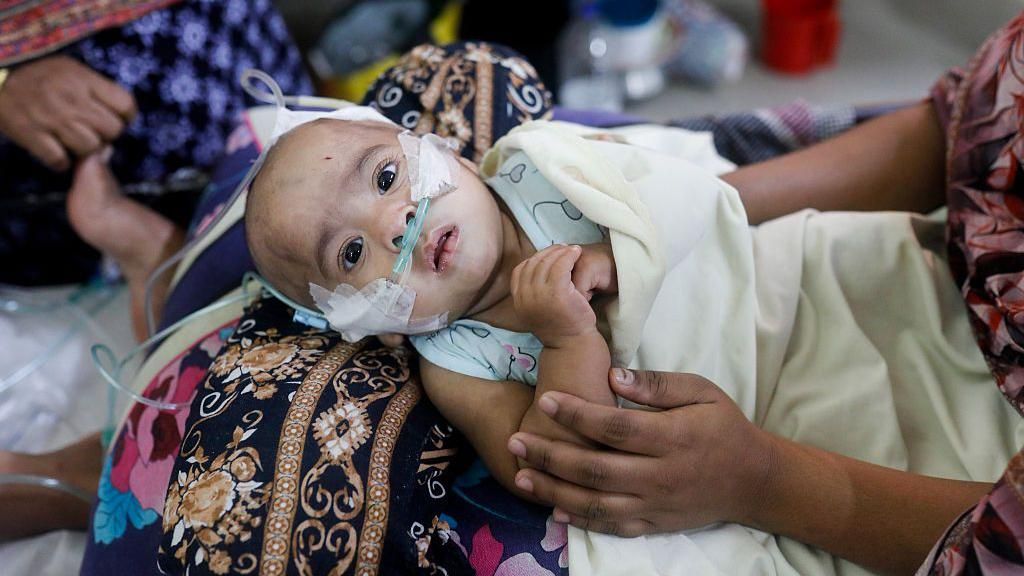
A devastating measles outbreak sweeping across Bangladesh has claimed more than 100 lives, the vast majority of them young children, since mid-March, prompting public health authorities to roll out an urgent mass vaccination campaign targeting the nation’s most vulnerable youth. Officials fear this outbreak could become the deadliest wave of the highly contagious airborne disease the country has seen in recent decades.
Official data from Bangladesh’s Ministry of Health confirms that more than 7,500 suspected measles cases have been recorded since 15 March, with over 900 of those cases already laboratory-confirmed. Local media reports highlight just how dramatic this surge is: in all of 2025, Bangladesh recorded only 125 total confirmed measles cases.
For decades, Bangladesh has run routine childhood immunization programs to protect against measles, but this sudden outbreak has laid bare critical gaps in the country’s vaccination infrastructure that have sparked widespread alarm among global and local public health experts.
“Vaccines are foundational to child survival,” Rana Flowers, UNICEF’s representative in Bangladesh, said in an official statement released Sunday. “The current measles outbreak is putting thousands of children, especially the youngest and most vulnerable, at serious risk.”
Under Bangladesh’s standard public health protocols, routine measles vaccination is administered to infants at nine months of age. But Shahriar Sajjad, deputy director of Bangladesh’s Health Department, told BBC Bangla that roughly one-third of all infected patients in the current outbreak are younger than nine months old – putting them outside the age eligibility for standard immunization before they were exposed.
Flowers noted that infections among these too-young infants are “especially alarming” given their weaker immune systems and higher risk of life-threatening complications.
Beyond routine annual vaccinations, Bangladesh has historically held targeted mass measles vaccination campaigns every four years to boost coverage and close immunity gaps. But those scheduled campaigns have been derailed by successive crises since 2020. Sajjad told BBC Bangla that the first disruption came from the global COVID-19 pandemic, followed by widespread domestic political unrest that delayed planning and execution.
Bangladesh saw major political upheaval in 2024, when large-scale anti-government protests led to the ousting of long-serving prime minister Sheikh Hasina. An interim caretaker government governed the country until a new administration was elected in February 2026, creating months of political and administrative uncertainty that disrupted public health programming. A planned mass vaccination campaign that was scheduled for April 2026 never launched, Sajjad confirmed.
The English-language Bangladeshi newspaper *Daily Star* also reported that procurement challenges have led to widespread shortages of routine vaccines, including measles doses, across the country. Many political observers and local stakeholders have blamed the former interim government, which oversaw the rollout of a new vaccine procurement system, for the current supply shortfalls. But UNICEF pushed back on framing the crisis as the result of a single failure, noting that measles resurgences almost always stem from accumulated gaps in immunization coverage over time, rather than one isolated error.
“Bangladesh has a strong history of high immunisation coverage, but even small disruptions can lead to the gradual accumulation of immunity gaps over time,” the organization explained in its statement.
Working alongside global health partners UNICEF and the World Health Organization (WHO), Bangladesh’s new government has now launched an emergency vaccination campaign targeting both measles and rubella – a milder disease that shares similar symptomatic traits with measles. The campaign launched Sunday, and will roll out across 30 high-risk sub-districts (called upazilas) nationwide, aiming to reach more than 1.2 million children between the ages of six months and five years.
UNICEF confirmed that the emergency drive will prioritize children who have previously missed routine immunization doses, who face the highest risk of severe illness and life-threatening complications from the virus. Special focus is being placed on two high-risk, densely populated areas: Dhaka, the overcrowded national capital, and Cox’s Bazar, which hosts massive, crowded camps for Rohingya refugees fleeing violence in neighboring Myanmar.
Beyond the vaccination push, national health authorities are also launching public education campaigns, distributing informative infographics to teach communities how to identify early measles symptoms and prevent further spread. Measles spreads easily through airborne respiratory particles, and can cause severe neurological complications, organ damage, and death even in previously healthy children. Common early symptoms include high fever, red watery eyes, sore throat, cough, and sneezing.
Global public health data underscores the ongoing threat of measles worldwide. According to the WHO, an estimated 95,000 people died from measles globally in 2024, more than 90% of whom were children under five years old. The disease is entirely preventable through safe, effective vaccination, but herd immunity requires a 95% population vaccination rate to stop sustained community transmission.
Over the past 20 years, global public health efforts drove a dramatic decline in global measles cases and deaths: total annual cases fell from 38 million in 2000 to 11 million in 2024, a 71% drop. But the WHO has repeatedly warned of a growing global resurgence as routine vaccination coverage dropped following the COVID-19 pandemic. A 2026 report in the medical journal *The Lancet* found that 2024 and 2025 saw the highest number of national measles outbreaks recorded worldwide in more than 20 years.
Outbreaks have surged across parts of Asia, Africa, Europe, the United States, and the United Kingdom in recent years. In many Western nations, growing anti-vaccine skepticism that expanded during the COVID-19 pandemic has driven down vaccination rates below the herd immunity threshold. In February 2026, for example, a measles outbreak at multiple schools in north London prompted UK public health officials to issue an urgent reminder to parents to ensure their children are fully vaccinated.