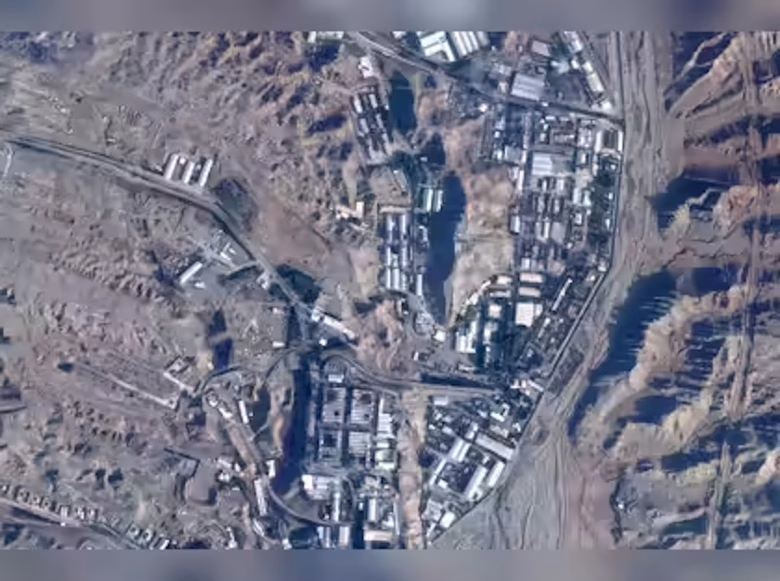
Leading commercial satellite imagery provider Planet Labs has announced it will implement an indefinite hold on all new satellite imagery covering Iran and neighboring regions where the escalating conflict involving the United States and Israel is unfolding, in direct compliance with a request from the Trump administration. The move restricts access to a critical source of visual intelligence that has been relied on by major news organizations, independent journalists, and human rights monitors to document conflict developments on the ground.
In an email notification sent to journalists who regularly use Planet Labs’ imagery to cover tit-for-tat strikes between US, Israeli and Iranian forces Saturday, the firm confirmed it is shifting to a heavily restricted managed access framework going forward. Under the new policy, any imagery release will be evaluated on a case-by-case basis, with approval only granted for what the company defines as urgent, mission-critical needs or explicit cases of public interest.
The censorship order applies to all imagery and data collected from March 9 onward. This is not the first restriction the company has imposed on coverage of the region: previously, Planet Labs implemented a mandatory 14-day delay on imagery releases, framed as a measure to prevent the data from being “leveraged by adversarial actors.”
The restriction has drawn immediate criticism from media and transparency advocates, who warn it will severely limit independent coverage of the conflict. Evan Hill, a veteran reporter with The Washington Post, noted that Planet Labs ranks among the most important US-based commercial satellite providers, with its imagery serving as a core information source for the vast majority of global media outlets covering the conflict. The new indefinite hold will cut off that vital flow of visual information for independent observers.
The policy change comes at a sensitive moment for US military operations: recent US intelligence assessments have concluded that Iran’s military capabilities have exceeded initial American expectations, contradicting public claims from the Pentagon that joint US-Israeli bombing has severely degraded Iran’s missile stockpiles. Multiple intelligence assessments indicate Iran has retained a large share of its operational missiles and mobile launch platforms, undercutting official US narratives of military progress.
Human rights and campaign groups have framed the imagery restriction as a deliberate effort to cover up civilian harm and military setbacks. Sarah Wilkinson, a United Kingdom-based human rights campaigner, argued that the censorship of war imagery is explicitly intended to hide the truth of what is happening on the ground from the global public. Mark Ames, a podcast host and independent commentator, sardonically framed the White House request as a telling indication that the Trump administration’s conflict in Iran is facing significant challenges.
The policy change coincided with a series of escalatory threats from former President Donald Trump over the weekend. Trump warned that this coming Tuesday would be what he called “Power Plant Day, and Bridge Day, all wrapped up in one,” announcing expanded strikes on Iran’s civilian infrastructure unless Tehran agreed to meet US demands for a negotiated settlement by Monday.
Already, recent joint strikes have caused significant civilian and infrastructure damage. A major Iranian bridge was destroyed in US strikes Saturday, while Israeli forces bombed a large petrochemical complex, sending toxic pollution into the adjacent populated city and killing at least 13 people across the two attacks. A projectile that landed near the Bushehr Nuclear Power Plant also killed one person, sparking widespread alarm over the risk of a catastrophic nuclear incident. World Health Organization Director-General Tedros Adhanom Ghebreyesus warned that a large-scale attack on the facility could trigger a nuclear accident with generational devastating public health consequences.
Kenneth Roth, former executive director of Human Rights Watch, pointed out that the restriction of satellite imagery directly serves the goal of hiding the full scale of US and Israeli bombing campaigns from independent scrutiny, saying “will make it much more difficult to monitor US-Israeli bombing there, which seems to be the point.”
In a separate related development over the weekend, Al Jazeera reported that Israeli forces had destroyed all closed-circuit security cameras surrounding the United Nations Interim Force in Lebanon (UNIFIL) headquarters in southern Lebanon. The incident comes amid rising tensions for UN peacekeepers in the region: three UNIFIL personnel were wounded in a blast Friday, and multiple peacekeepers have been killed since early March, with several of those deaths attributed to Israeli fire.