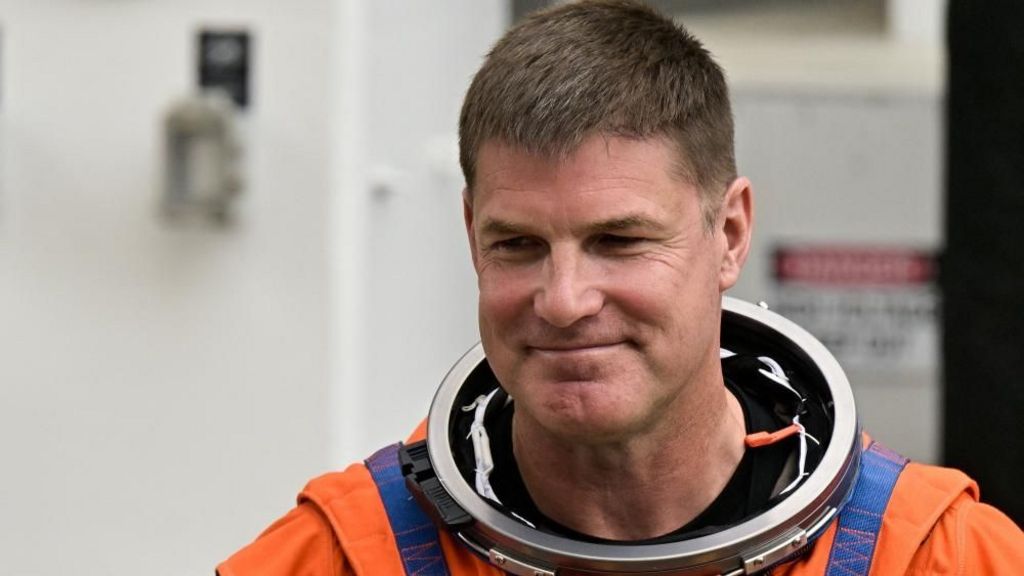
Fifty years after the last Apollo mission carried humans to the Moon’s vicinity, Canadian astronaut Jeremy Hansen stands on the cusp of making history as the only non-American crew member of NASA’s groundbreaking Artemis II mission – a milestone decades in the making, rooted in childhood wonder and a chance mentorship that shaped his path to space.
Long before his name was attached to humanity’s first crewed lunar orbit mission in a generation, Hansen was a curious five-year-old growing up on a small farm outside London, Ontario. His passion for space ignited unexpectedly when he stumbled on an encyclopedia entry featuring Neil Armstrong and the iconic 1969 Apollo 11 lunar landing image. That moment left an indelible mark: “That page is still burnt in my brain,” Hansen recalled in a recent interview with *Spaceflight Now*. The young aspiring explorer quickly converted his family’s treehouse into a makeshift rocket, turning childhood daydreams into the first step of a decades-long journey.
By his teens, Hansen had translated that fascination into action, joining the air cadets youth program before pursuing degrees in space science and physics at university. He went on to become a Royal Canadian Air Force fighter pilot, flying CF-18 jets out of Cold Lake, Alberta’s military base and collaborating with the North American Aerospace Defense Command (NORAD). But a chance encounter during his first year at the Royal Military College of Canada in 1995 would cement his trajectory: the young cadet met his idol, fellow Canadian astronaut Chris Hadfield – years before Hadfield would take command of the International Space Station.
Hansen worked up the courage to ask Hadfield for his email address, and the quick exchange sparked a years-long mentorship that would guide Hansen’s career. When Hansen joined the Canadian Space Agency (CSA) in 2009, following in Hadfield’s footsteps as both a fighter pilot and astronaut, Hadfield remained a key advisor, leaving Hansen with one simple, enduring piece of advice: chase the work that sets your passion alight. “Jeremy has been getting ready for this flight since he was five years old,” Hadfield noted in a March podcast conversation with Canadian singer Emm Gryner.
Fourteen years after joining the CSA, Hansen’s lifelong preparation culminated in a historic selection: he was named mission specialist for Artemis II, the first crewed mission to travel beyond low-Earth orbit and circle the Moon since NASA’s Apollo program concluded in the 1970s. Over the 10-day mission, Hansen and three crewmates – commander Reid Wiseman, pilot Victor Glover, and fellow mission specialist Christina Koch – will travel farther from Earth than any human group in history.
Hansen is under no illusion that the groundbreaking mission will be without risk. “To do something that has never been done before means that your team is very likely to face failure,” he shared in an interview with the CSA. But that uncertainty has not dimmed his commitment to pushing human exploration forward. “I like the fact that in space, we are committed to bold goals to the extent that we will not let periodic failure stop our forward progress,” he added.
For the historic flight, Hansen has woven personal and cultural meaning into every detail of his mission. He will carry four small moon-shaped pendants, each engraved with a birthstone for his wife and three teenage children. His custom blue spacesuit bears a mission patch designed by Anishinaabe artist Henry Guimond, with input from Dave Courchene III of Manitoba’s Sagkeeng First Nation. The patch’s heptagonal shape and featured animals draw from Indigenous teachings that center on four core values: love, respect, courage and humility for all people. Hansen says the patch is a deliberate tribute to Indigenous peoples of Canada and their millennia of traditional knowledge.
In a recent BBC interview with science editor Rebecca Morelle and 13 Minutes podcast host Tim Peake – himself a former astronaut – Hansen opened up about the moments he is most anticipating. He is already looking forward to his first glimpse of Earth from orbit during his opening hour in space, but the highlight he expects will be the view of the Moon in the foreground, with our home planet hanging delicate and blue in the black distance behind it.
For Hansen, the mission is about more than just pushing the boundaries of human exploration: it is a reminder of what humanity can achieve when we work together. “I hope humanity will stop for a moment when four humans are on the far side of the Moon, and just look at some of the imagery that we are sharing – and just be reminded that we can do a better job as humans of just lifting each other up,” he said. “Not destroying but creating together.”