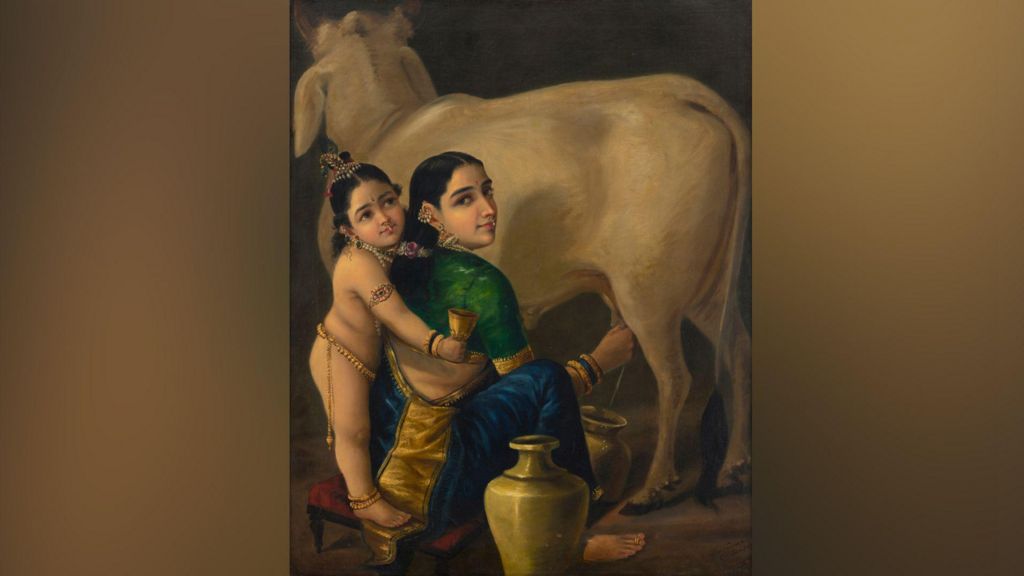
In a landmark auction held by Saffronart in New Delhi on Wednesday, a 130-year-old masterpiece by one of India’s most celebrated modern artists, Raja Ravi Varma, has made history as the most expensive Indian artwork ever sold at auction. Painted in the 1890s, when Varma was at the peak of his creative powers, *Yashoda and Krishna* fetched a staggering 1.67 billion Indian rupees, equivalent to $17.9 million, shattering the previous $13.8 million record set last year by MF Husain’s *Untitled (Gram Yatra)*.
The winning bid came from Cyrus Poonawalla, the billionaire founder and managing director of the Serum Institute of India – the world’s largest vaccine manufacturer. In a post-auction statement shared via Saffronart, Poonawalla called the iconic canvas a “national treasure”, noting that it should be accessible for regular public display. He added that he would work to make this public access a reality in the coming years.
Created in the 1890s when Varma was at the height of his career, the oil-on-canvas work captures an intimate, tender moment from Hindu mythology: the child deity Krishna waits beside his foster mother Yashoda as she milks a cow. The work depicts Krishna with a signature mischievous glint in his eye, while Yashoda’s features radiate quiet warmth and maternal care. Though the pair wear only minimal ornamentation, every detail of their jewelry is rendered with Varma’s characteristic precision. As the Raja Ravi Varma Heritage Foundation noted ahead of the auction, the artist’s singular genius lies in his ability to frame a sacred narrative through familiar, relatable domestic details. “The textures of silk, the gleam of jewellery, the softness of skin and the gentle stillness of the cow together create a scene that is both devotional and intimate,” the foundation wrote.
Art historians have long praised Varma for reimagining traditional depictions of Hindu mythological figures. Before his work, iconic portrayals of deities prioritized awe over intimate affection, but Varma broke down the distance between the divine subject and the viewer, according to prominent Indian artist A Ramachandran. Born in 1848 in what is now the southern Indian state of Kerala, Varma is widely recognized as the father of modern Indian art. He famously blended formal European academic painting techniques with distinctly Indian narrative and cultural traditions, and his lithographic prints of mythological figures remain a common sight in household shrines across India to this day. Under India’s 1972 Antiquities and Art Treasures Act, all of Varma’s works are classified as national art treasures, meaning they cannot be exported and may only be sold to Indian-based buyers – a rule that added to the exclusivity of Wednesday’s sale.
Industry leaders say the record-breaking price of *Yashoda and Krishna* reflects a rapidly maturing Indian art market, marked by growing domestic and global demand for historically significant South Asian works. Minal Vazirani, president and co-founder of Saffronart, called the final valuation a “powerful reminder of the enduring cultural and emotional resonance of Indian art”. Ashish Anand, chief executive and managing director of leading Indian art institution DAG, noted that the landmark sale will reshape how the world views Indian art, framing it not just as an aesthetic object for personal collectors, but as a legitimate, high-value financial asset. “There is a clear shift in how Indian art is being perceived,” Anand explained. “As the market matures and benchmarks rise, collectors are recognising both its cultural and financial value… The best works – those with provenance, rarity and historical significance – are now commanding extraordinary prices, reflecting the maturing of the market.”
Experts point to multiple factors driving the current boom in prices for top-tier Indian art. First, masterworks by pioneering artists such as Varma, Amrita Sher-Gil and VS Gaitonde are extremely rare, with most held in permanent private collections and rarely entering the auction block. This inherent exclusivity pushes prices higher when high-quality works do become available. Additionally, there is growing global recognition of mythological art as a serious, desirable collecting category, further boosting demand for culturally significant works like Varma’s *Yashoda and Krishna*. The piece was put up for auction by a private collector, according to Saffronart’s auction catalogue.