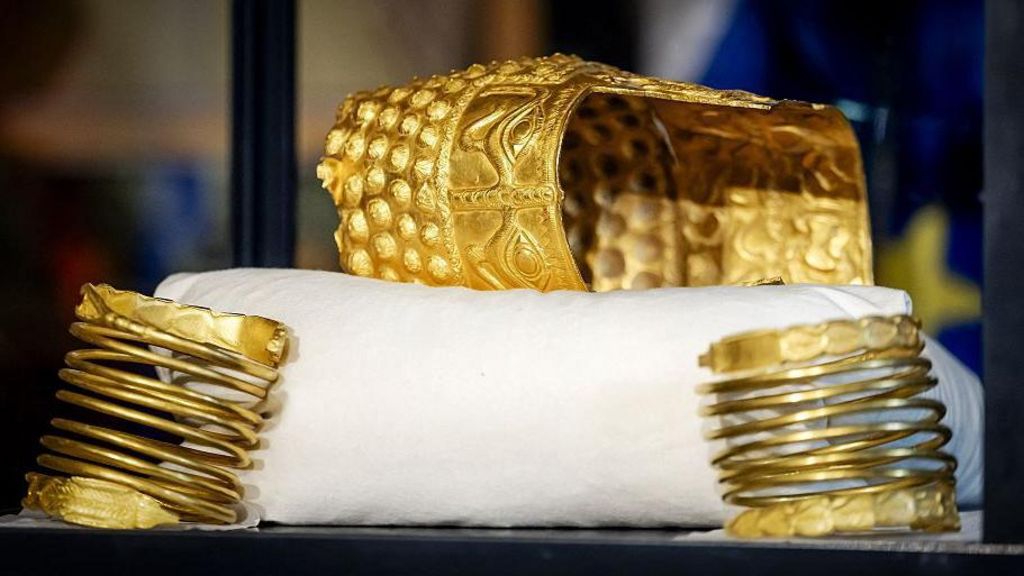
After more than a year of high-stakes international investigation, a millennia-old Romanian golden treasure stolen in a brazen armed heist from a Dutch museum has been recovered, bringing partial closure to a cultural crime that sparked diplomatic friction and public outrage.
The Coțofenești helmet, a 2,500-year-old artifact widely regarded as one of Romania’s most precious cultural heritage pieces, and two accompanying golden bracelets dating to around 450 BC were officially unveiled at a press presentation this Thursday. The recovered treasures are now displayed in a secured glass case at the Drents Museum in Assen, guarded by two armed police officers — a visible reminder of the security failures that allowed the theft to occur 14 months ago. A third golden bracelet from the stolen collection remains unaccounted for, as cross-border investigations continue.
The artifact set was on loan from Bucharest’s National Museum of Romanian History for the museum’s popular exhibition “Dacia — Empire of Gold and Silver”, which explores the history of the Dacian civilization that inhabited modern-day Romania before the Roman conquest of 106 AD. In November 2024, an armed criminal gang used explosives to break into the Drents Museum, making off with the priceless treasures. The heist immediately triggered widespread anger across Romania, where the helmet is recognized as a defining cultural and political symbol of ancient Dacia, and ignited fierce debate over global cultural artifact loaning practices and museum security standards.
The theft also sparked a diplomatic rift between the Romanian and Dutch governments. After the loss, the Dutch government reportedly paid out 5.7 million euros in insurance compensation to Romania; Romanian officials have declined to comment on whether that payout will be adjusted following the recovery of most of the collection.
Prosecutors on both sides have confirmed that the helmet and two bracelets were formally handed over to law enforcement authorities earlier this week as part of a pre-trial agreement reached with defense lawyers representing three suspects in the case. Three men — two in their mid-30s and one 21-year-old — were arrested just days after the heist, but investigators found no trace of the artifacts at the time of arrest. The suspects are scheduled to go on trial later this month.
Robert van Langh, director of the Drents Museum, told reporters that the helmet sustained a minor dent during the theft but is fully restorable, while the two recovered bracelets remain in pristine condition. Romanian lead prosecutor Daniela Buruiană described the recovery as a long-awaited victory for cultural heritage protection. “We are happy that we are now witnessing here the recovery of the Romanian artefacts,” she said, adding that investigations remain active to locate the final missing bracelet.
Romanian prosecutor Rareș-Petru Stan praised Dutch law enforcement counterparts for their persistent work over the 14-month investigation, noting the massive cultural and public impact the theft had on Romania. “We are continuing the investigation to find the last bracelet, and we are grateful that we will be able to return this treasure to the Romanian people,” he said.
Art crime experts have theorized that the artifacts were stolen to order for a private collector on the black market, a common trend for high-value ancient cultural pieces. The heist also drew attention to systemic security gaps at small and regional museums across the Netherlands, which have increasingly become targets for art thieves in recent years. Just two years before the Dacian treasure heist, two Andy Warhol works were stolen from a southern Dutch gallery, and six years prior, a famous Frans Hals painting was stolen from a small municipal museum in Leerdam. In all of these cases, low-security display cases provided minimal resistance to raiders.
The aftermath of the 2024 theft also brought domestic political fallout in Romania: Ernest Oberländer-Târnoveanu, the former head of the National Museum of Romanian History who approved the loan of the treasures to the Drents Museum, faced intense public criticism and stepped down from his position just days after the heist. Speaking to RTL Nieuws after the recovery, he expressed profound relief at the helmet’s return. “This is a unique item in European and even global cultural heritage,” he said. “The helmet is an important social and political symbol of Dacian civilisation.”