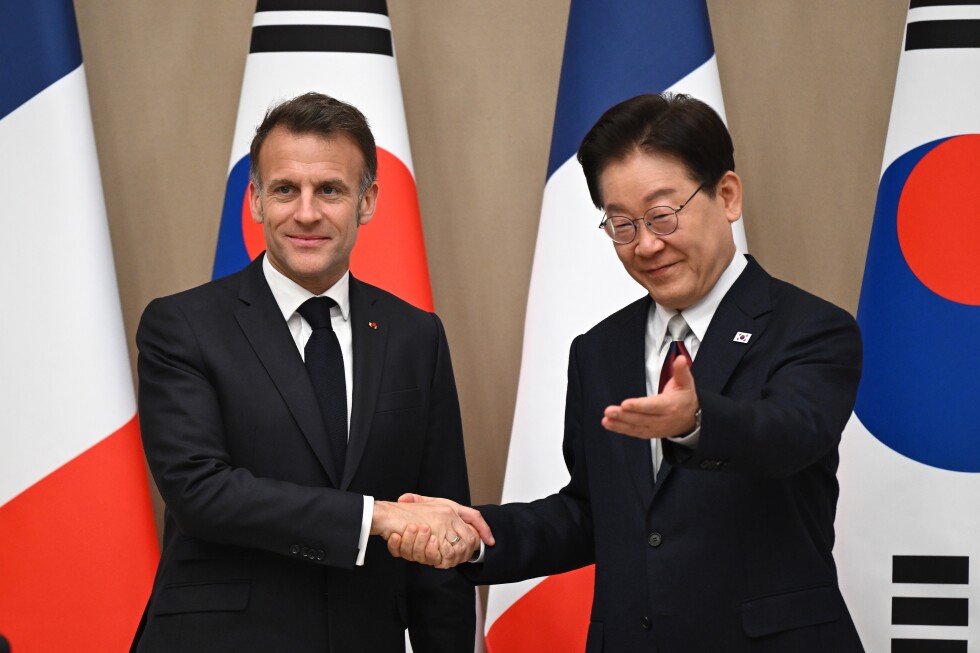
During an unprecedented Seoul summit held on Friday, French President Emmanuel Macron and South Korean President Lee Jae Myung announced a shared commitment to collaborative diplomatic action aimed at reopening the Strait of Hormuz and easing cascading global economic turbulence sparked by ongoing Middle East conflict. The meeting marked Macron’s first visit to South Korea since he assumed office in 2017, wrapping up the East Asian leg of a regional tour that already included a stop in neighboring Japan. It also unfolded against a backdrop of growing public friction between U.S. President Donald Trump and U.S. global allies, with Trump repeatedly lashing out at partners for failing to back Washington and Israel in their campaign against Iran.
Opening the bilateral talks, Macron emphasized that both middle-power nations France and South Korea hold unique influence to help de-escalate tensions across the Middle East, particularly around the Strait of Hormuz, where Iran’s control of the strategic waterway has sent major shocks through global energy markets. In a subsequent joint televised briefing to the public, Macron reiterated that coordinated action between Paris and Seoul was critical to clearing the waterway for commercial transit and rolling back rising hostilities across the region. Lee echoed this commitment, confirming the two leaders had “affirmed their resolves to cooperate to secure the safe shipping route in the Strait of Hormuz.”
Notably, the two leaders did not take questions from reporters, nor did they lay out specific operational details for how their cooperation would unfold to reopen the strait. The 21-mile waterway, wedged between Iran and Oman, typically carries roughly one-fifth of the world’s daily oil supplies, making its disruption a critical threat to global energy and economic stability.
“We need to clearly define, at the international level, the conditions for a process to ease the crisis and conflict in the Middle East,” Macron stated during the briefing. “We need to ensure that the Strait of Hormuz is reopened.” The French leader has previously ruled out a unilateral military operation to reopen the waterway, calling that approach unrealistic.
Beyond their Middle East diplomacy, the two leaders also used the summit to advance deepened bilateral cooperation across technology, energy, and critical resource sectors. Officials from both countries signed three landmark agreements covering collaboration on nuclear fuel supply chains, joint investment in a large-scale offshore wind project off southern South Korea, and partnership on critical minerals development. For South Korea, these agreements align with ongoing domestic energy policy shifts: President Lee has prioritized ramping up output at existing nuclear reactors to ease ongoing energy shortages, and accelerated the transition to renewable energy, noting the Middle East conflict has laid bare the country’s dangerous overreliance on imported fossil fuels.
Macron’s Asian tour comes as Trump has stepped up public criticism of U.S. allies over their lack of engagement on the Hormuz issue. During a speech Wednesday, Trump claimed the United States “doesn’t need” the strait, and argued that other major economies that depend on the waterway “must grab it and cherish it.” At an earlier Easter event at the White House, Trump explicitly called on U.S. Asian allies and China to take the lead on reopening the waterway. “Let South Korea, you know, we only have 45,000 soldiers in harm’s way over there, right next to a nuclear force — let South Korea do it,” Trump said. “Let Japan do it. They get 90% of their oil from the strait. Let China do it.” Official U.S. deployment data contradicts Trump’s claim: roughly 28,000 U.S. troops are stationed in South Korea, a deployment meant to deter potential aggression from North Korea, not for Middle East operations. South Korean officials have confirmed they are in ongoing communication with Washington about the Hormuz issue, but have ruled out the option of paying transit fees to Iran to secure South Korean fuel shipments through the waterway.