Against a backdrop of often tense and headline-dominating high-level geopolitical discussions between China and the United States, a quiet, people-centered initiative is anchoring the bilateral relationship in mutual understanding and friendship, one handwritten wish at a time.
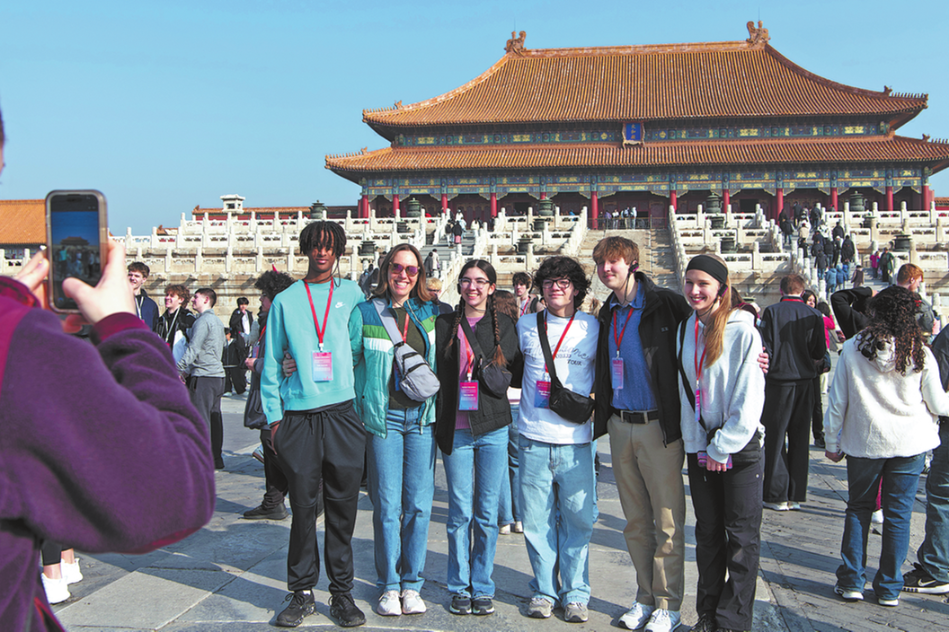
This past March, between the 14th and 22nd, 100 student delegates from the U.S. state of Iowa embarked on a multi-city tour of China, stopping in Beijing, Shanghai, and Shijiazhuang, the capital of China’s Hebei province. At Shijiazhuang Foreign Language School, alongside their Chinese peers, the visiting students tied handwritten red wish cards to the budding branches of a ginkgo tree, filling each small note with hopes for peace, shared prosperity, and lasting friendship between the two nations. This collective act was the core of the China-U.S. Friendship Tree — Ginkgo Project, an initiative designed to carry forward the decades-old sister-state relationship between Hebei and Iowa.
The exchange is part of the transformative “50,000 in Five Years” youth exchange program, first announced by Chinese President Xi Jinping during his 2023 visit to San Francisco, with the goal of expanding and deepening people-to-people connections between the youth of both countries.
The Ginkgo Project, founded by Luca Berrone, a board member of Iowa Sister States, draws on long-standing cultural symbolism of the ginkgo tree: a species renowned for its resilience, longevity, and ability to form enduring, deep roots over centuries. The initiative invites participants from both China and the United States to express their hopes for bilateral relations through writing or art, tying those aspirations to the tree as a permanent, visible testament to shared goodwill.
While the project itself centers on the simple, intimate act of exchanging wish cards, its origins stretch back more than 40 years, to 1983, when Hebei and Iowa formally established their sister-state relationship. What began as a formal intergovernmental agreement has grown over decades into a critical lifeline for sub-national diplomacy, serving as a stable counterweight to shifts in top-level geopolitical dialogue. As Berrone emphasizes, the most enduring bilateral bonds are almost always built from the bottom up, one personal connection at a time.
During their 9-day tour, the Iowa students experienced the full breadth of Chinese life, from exploring iconic historical landmarks including Beijing’s Palace Museum to engaging with hands-on traditional cultural activities such as Chinese knot weaving and martial arts training. They competed in friendly sports matches with local Chinese youth, toured university and high school campuses, and for many delegates, the trip included the deeply personal experience of staying with local Chinese families, bringing them face to face with the warmth and hospitality of ordinary Chinese people.
For Berrone, the project and the 2026 student exchange hold deeply personal meaning. His own connection to China dates back to 1985, when as a young county official in Iowa, he helped coordinate then-visit of a Chinese delegation led by Xi Jinping, and traveled alongside the group across the state. He still recalls Xi as a sharp, curious, and inherently warm person, a memory that has shaped his decades-long commitment to building cross-Pacific friendship.
That long history of connection led Berrone and other Iowa friends of China to send New Year greetings to President Xi earlier this year, affirming their commitment to growing people-to-people ties. On February 16, President Xi responded with a personal Chinese New Year card, recalling the warm welcome he received in Iowa 41 years earlier. In his reply, Xi emphasized that the future of China-U.S. relations rests with the people, its foundation lies in grassroots connections, its growth depends on youth engagement, and its vitality comes from sub-national exchanges.
For Berrone, the reply was a moving confirmation of what the Ginkgo Project has worked to prove: that ordinary people’s connections remain the most important ballast for the bilateral relationship, even during periods of uncertainty. Sarah Lande, another long-time Iowa friend of China who has nurtured cross-Pacific ties for decades, echoed that sentiment in a pre-recorded video message delivered at an icebreaking event for Chinese and American students. Recalling her own friendship with Xi dating back to his 1985 visit, Lande described that connection as “a living testament to how genuine human connections can bridge differences and build lasting bonds of understanding and respect.”
“Real diplomacy is rooted in people-to-people ties, in shared laughter, shared experiences and mutual respect,” Lande told the assembled students, noting that the young participants themselves are not just beneficiaries of this long history, but active ambassadors of friendship, peace, and mutual understanding between the two countries.
For many of the visiting Iowa students, the trip reshaped their understanding of China far beyond what they had seen in media or learned in classrooms. What had once felt like a distant, unfamiliar nation quickly became a place of familiar human connection, where shared hopes and kindness transcended political differences — one handwritten wish on a ginkgo tree branch at a time.