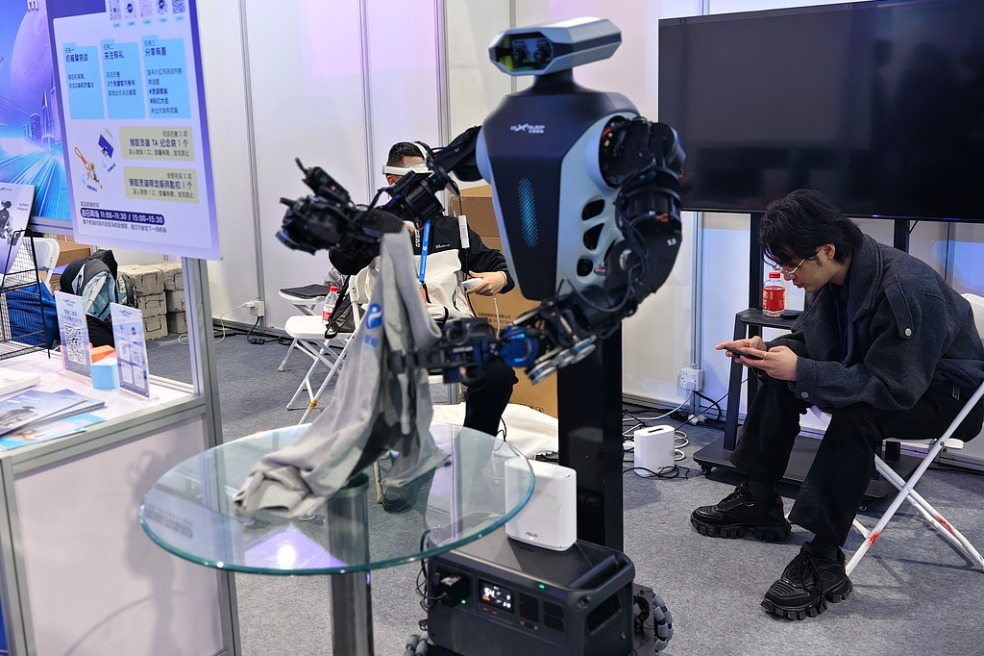
Against the backdrop of shifting demographics and rising consumer demand for professional household care, China’s vast, traditionally labor-heavy domestic service industry is undergoing a rapid digital transformation, with artificial intelligence and robotics becoming core tools to reshape service delivery and matching efficiency. A groundbreaking example of this tech integration can be found in Hefei, the capital of Anhui province, where a smart diaper sensor developed through a partnership between local domestic service provider Wansao and an AI startup is redefining infant care. The wearable device, fitted with high-sensitivity odor and humidity detectors, automatically tracks a newborn’s physical condition, logs real-time digestive data, and sends instant alerts to caregivers’ wearable wristbands when a diaper change or attention for an upset stomach is needed. This data is then synced with a cloud-based digital platform alongside caregiver-kept feeding records to build a personalized health profile, enabling nannies and parents to monitor infant development with far greater precision than traditional manual care. The developers have already outlined plans to adapt the technology for use with frail, elderly care recipients who require round-the-clock monitoring, expanding its impact beyond childcare. This smart device is just one of dozens of technology trials transforming China’s domestic service sector, which already hit a market value of 1.2 trillion yuan ($174 billion) and employed more than 30 million workers nationwide in 2024. Beyond sensor-based monitoring solutions, AI-powered digital platforms are overhauling the outdated worker-client matching process. Wansao president Ding Xiaomei explained that the company is building large language model-powered platforms trained on years of aggregated domestic service industry data and private industry knowledge bases. These platforms do not only address common questions from both families and domestic workers, but also generate detailed digital work profiles for service providers, allowing the system to quickly match households with candidates that fit their specific needs from a database of tens of thousands of workers. Robotics is also carving out a key space in the market, particularly in the fast-growing eldercare segment. Across multiple Chinese cities, companion robot Xiaoli, developed by Beijing-based Seelink Technology, is already deployed in nursing homes and private family homes. The robot conducts routine health checks including blood pressure and blood oxygen monitoring, sends automatic alerts to family members when abnormal health indicators are detected, and provides conversational companionship to socially isolated elderly residents. Li Yang, a representative of Seelink Technology, noted that the company has launched two tailored versions of Xiaoli — one for institutional eldercare facilities and another for home-based care — and plans to continuously expand the robot’s service capabilities to meet evolving needs. Two major forces are driving this rapid tech adoption in the domestic service space: surging consumer demand and targeted government policy support. Demographic change has been the core demand driver: by the end of 2024, China was home to more than 310 million people aged 60 and above, accounting for roughly 22 percent of the total population. Combined with shrinking average household sizes that leave fewer family members available to provide informal care, demand for both professional childcare and eldercare domestic services has skyrocketed. Industry data from Chinese research firm Zero Power Intelligence Group shows that China’s eldercare robot market already surpassed 30 billion yuan in 2024, with projections to hit 50 billion yuan by 2025. Li Yang noted that just a few years ago, only a small number of companies were developing intelligent companion robots for eldercare, but today, new market entrants are increasing rapidly, making the sector increasingly dynamic. Policy support has also acted as a key catalyst for transformation. In April 2025, China’s Ministry of Commerce joined eight other central government departments to release a policy guideline supporting the upgrading of household service consumption. The guideline explicitly called for accelerating the sector’s digital transformation, and encouraging the adoption of emerging technologies to expand innovative application scenarios across all segments of household services. Despite the clear growth trajectory and promising potential, industry insiders point out that the sector still faces tangible practical barriers to widespread adoption. For one, current robotics solutions remain prohibitively expensive for most average households. Additionally, most existing smart machines can only perform narrow, simple tasks, as navigating the unstructured, complex environment of a typical household requires far more advanced perception and mechanical dexterity than current commercial technologies offer. Data security and standardization also remain major sticking points: domestic work inherently involves processing highly sensitive personal information, and the absence of unified industry-wide data standards makes secure, efficient data sharing and processing far more complicated. Still, industry observers remain optimistic about the long-term future of tech integration in the space. As Yang noted, the development trajectory is clear and manageable, and smart technologies will likely evolve from serving as specialized assistants in commercial care settings to becoming reliable, everyday companions in ordinary households across China.