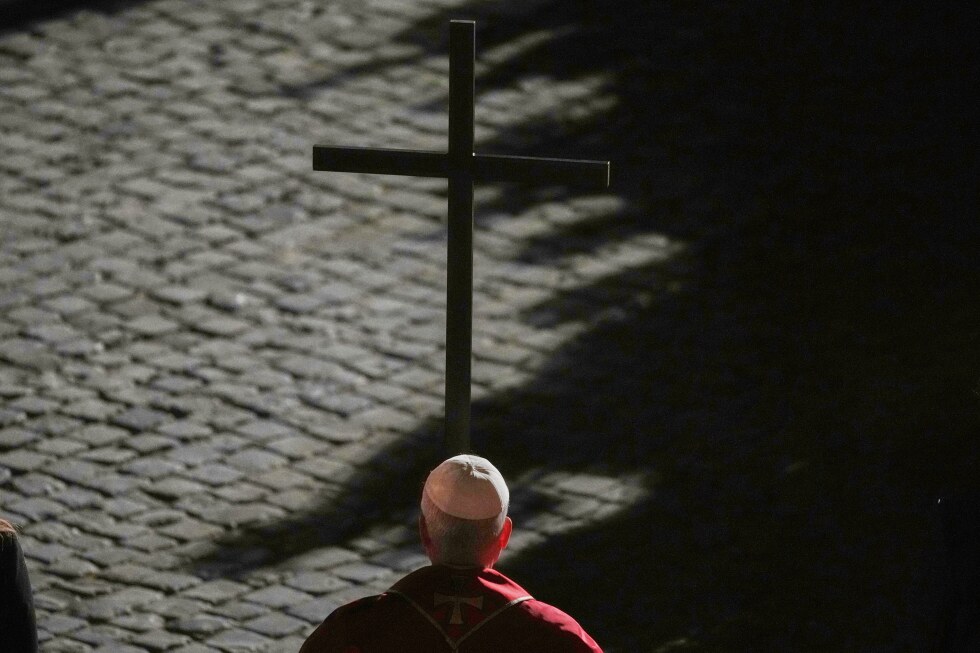
ROME – In a striking break from recent papal practice that revives a tradition not seen in nearly 30 years, Pope Leo XIV personally carried a wooden cross through all 14 stations of the iconic Good Friday Way of the Cross procession at Rome’s Colosseum, marking a meaningful milestone during his first Holy Week as head of the Roman Catholic Church.
Speaking to reporters earlier this week outside the papal retreat of Castel Gandolfo, the new pontiff framed the act as more than a ceremonial gesture. He emphasized that the cross-bearing carries a profound spiritual message for the modern world: “I think it will be an important sign because of what the pope represents, a spiritual leader in the world today, and for this voice, that everyone wants to hear, that says Christ still suffers,” he said. “I carry all of this suffering in my prayer.”
Flanked by two torchbearers who stayed at his side for the full hour-long journey, Pope Leo lifted the cross to launch the rite inside the ancient Colosseum. The procession wound through thousands of gathered faithful outside the monument, climbed the steep slopes of Palatine Hill, and concluded with the pontiff delivering the final blessing at the traditional end point.
The meditations for each station, crafted specifically for Pope Leo’s inaugural Good Friday by Rev. Francesco Patton, who served as Custodian of the Holy Land from 2016 to 2025 overseeing Christian sacred sites, carried a sharp focus on the moral weight of power. At the opening station, which commemorates Jesus’ condemnation to death, the meditation highlighted that all holders of authority will ultimately answer to God for how they exercise their influence. “The power to judge; the power to start or end a war; the power to instill violence or peace; the power to fuel the desire for revenge, or for reconciliation,” the text read.
Roughly 30,000 pilgrims and faithful from around the world gathered for the event, joining the recitation of the stations broadcast over loudspeakers. Among them was Sister Pelenatita Kieoma Finau, a member of the Missionary Sisters of the Society of Mary from Samoa, who described the experience as unparalleled. “We have been part of our parish stations of the cross, but this is so exciting,” she said. “It is very meaningful to have the experience of being with the people of Rome on this special occasion.”
To understand the significance of Pope Leo’s choice, it is necessary to look back at recent papal tradition. John Paul II carried the cross for the entire procession from his first Good Friday as pontiff in 1979 until he underwent hip surgery in 1995, after which he only bore the cross for part of the route. During his first two years as pope, Benedict XVI carried the cross only for the opening station inside the Colosseum before following other cross-bearers for the remainder of the procession to Palatine Hill. Pope Francis never personally carried the cross, participating in the procession only until his declining health forced him to step back; he died last year on Easter Monday, April 21, after a long period of illness.
Age and physical health have long shaped popes’ participation in the procession. John Paul II was just 58 when he assumed the papacy and was famously an avid hiker and outdoor enthusiast. His two immediate successors were both in their late 70s when they began their papacies, and Francis lived with partial lung loss from a youth pulmonary infection. At 70, Pope Leo is in excellent physical condition: he is an enthusiastic tennis player and regular swimmer, and his former trainer has confirmed that before his election, he worked out consistently at a gym near the Vatican following a fitness routine typical of a man decades younger.
In his introduction to the procession’s meditations, Patton outlined the core purpose of the centuries-old ritual, which commemorates the final hours of Jesus’ life, from his death sentence to crucifixion, death and burial. “The Way of the Cross is not intended for those who lead a pristinely pious or abstractly recollected life,” Patton wrote. “Instead, it is the exercise of one who knows that faith, hope and charity must be incarnated in the real world.”
The Good Friday procession kicks off a full schedule of Holy Week observances for the new pontiff. On Holy Saturday, he will preside over the overnight Easter Vigil, where he will baptize new converts to Catholicism and lead the Church into Christianity’s most sacred celebration of Jesus’ resurrection. On Easter Sunday, he will celebrate an open-air Mass in St. Peter’s Square, deliver his first official Easter message as pope, and bestow the traditional “Urbi et Orbi” blessing to the city of Rome and the entire world.