Across the entire island of Ireland, communities and political leaders gathered this week to mark the 110th anniversary of the 1916 Easter Rising, a defining moment in Ireland’s long push for sovereign independence that continues to shape modern political discourse around unification.
The Easter Rising, a coordinated rebellion launched to end centuries of British rule in Ireland, remains one of the most consequential events in Irish history. On Easter Monday 1916, rebel leader Pádraig Pearse stood on the steps of Dublin’s General Post Office (GPO) — the rebellion’s central headquarters — and read a proclamation declaring an independent Irish republic. What followed was six days of urban fighting concentrated in Dublin, which ultimately ended with the rebels’ surrender to British forces. More than 450 people lost their lives in the conflict, and 16 rebel leaders were executed in the weeks after the surrender. Though the rising itself was militarily defeated, historians widely credit the harsh British response, particularly the executions, with shifting Irish public opinion from initial hostility to widespread sympathy for the republican cause, ultimately laying the groundwork for the creation of the Irish Free State and later the fully independent Republic of Ireland.
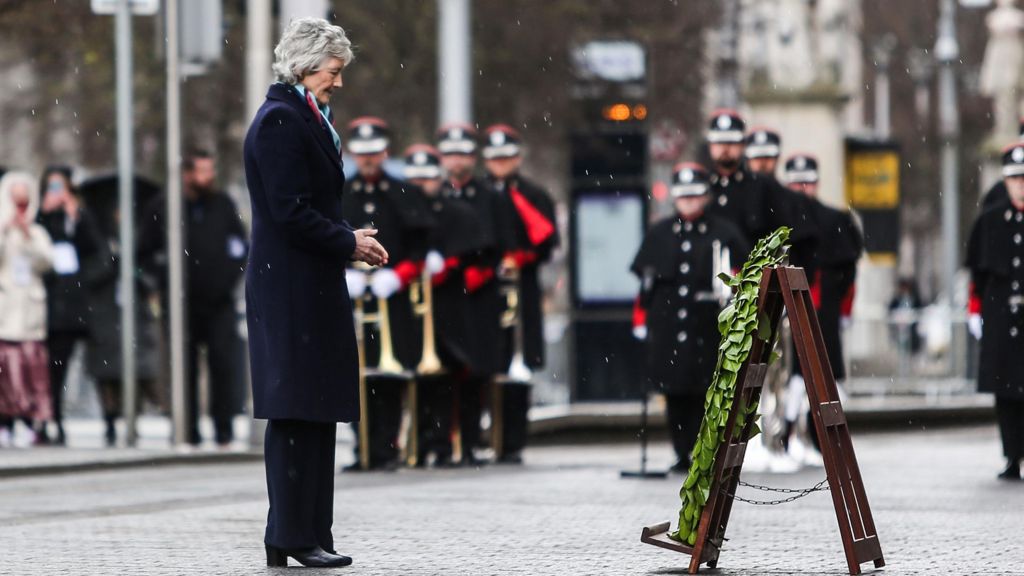
This year’s commemorative events centered on the GPO in Dublin, the symbolic heart of the 1916 rising. Irish presidential official Catherine Connolly opened the proceedings by laying a ceremonial wreath at the site, a tradition that honors all those who lost their lives in the rebellion. Dignitaries from across the island joined the event, including Northern Ireland First Minister Michelle O’Neill, Irish Taoiseach Micheál Martin, Tánaiste Simon Harris, Defence Minister Helen McEntee, Dublin Lord Mayor Ray McAdam, and Sinn Féin leader Mary Lou McDonald. More than 200 personnel from the Irish Defence Forces took part in the ceremonial proceedings, and Captain Eva Houlihan delivered a reading of the original 1916 proclamation, exactly 110 years after Pearse’s historic reading from the same location.
Later in the day, speakers addressed crowds at Arbour Hill Cemetery, where 14 of the executed 1916 leaders are buried. McDonald, who serves as leader of the Irish opposition in the Dáil, used the anniversary to frame the next phase of Irish political history, tying the legacy of the Easter Rising to the contemporary push for Irish unification. With the 30th anniversary of the Good Friday Agreement approaching — the 1998 peace deal that ended decades of sectarian conflict in Northern Ireland and formalized provisions for unification via public vote — McDonald argued that the time has come for tangible progress toward a united Ireland. “We have secured the peace. Now is the time to write the next chapter of our national story — the reunification of Ireland,” she said. “This is the decade when Irish unity can be won — decided by people north and south in referendums. The conversation is underway, but conversation alone is not enough. We need vision, determination, and leadership. We need action.”
In Northern Ireland, thousands of people turned out for a major commemorative parade along the Falls Road in west Belfast, ending at Milltown Cemetery, a key site for republican remembrance. Deirdre Hargey, Sinn Féin’s South Belfast Member of the Legislative Assembly (MLA), addressed the assembled crowds, echoing McDonald’s call for progress toward unity. “While we must never forget, we must also look forward with confidence and hope in building a new and united Ireland,” she said. Hargey also drew a connection between the 1916 fight for Irish self-determination and modern global struggles for sovereignty, noting that “as we continue working towards this, we must reflect on those countries whose own sovereignty and self-determination is being threatened throughout the world.” She added that upcoming 2027 regional and local elections are expected to energize the growing campaign for Irish unification.
The anniversary commemorations come at a moment of shifting political dynamics across Ireland. Opinion polling in recent years has shown growing support for unification in both Northern Ireland and the Republic, and the 30th anniversary of the Good Friday Agreement next year is expected to bring renewed focus to the issue. For republicans across the island, the 110th anniversary of the Easter Rising serves not just as a time to honor the sacrifice of the 1916 rebels, but as a catalyst to advance the goal of completing the Irish independence project that Pearse and his fellow rebels first proclaimed a century ago.