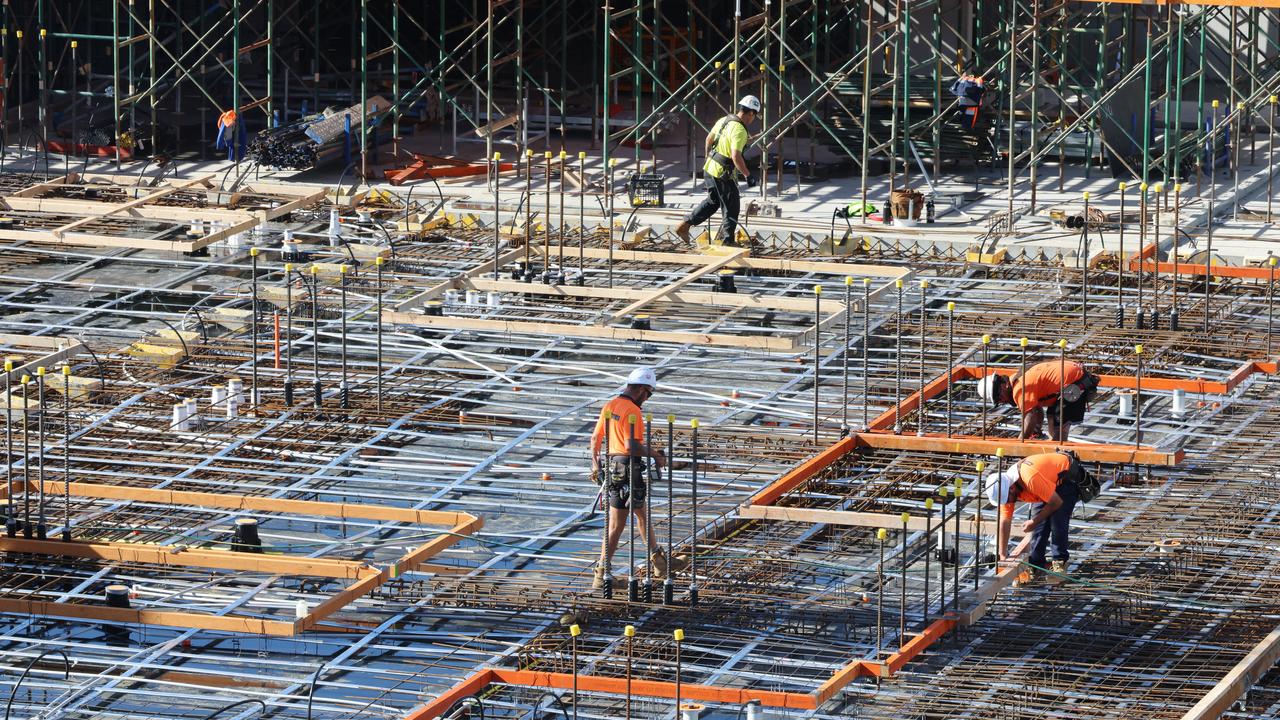
Australia’s new residential construction sector saw a dramatic jump in project approvals during February, even in the face of consecutive central bank interest rate hikes, though the country continues to fall short of its ambitious national housing supply goal, new official data shows.
New statistics released by the Australian Bureau of Statistics (ABS) reveal that total dwelling approvals climbed 29.7% month-on-month in February, hitting 19,022 projects. The strong uptick was driven almost entirely by multi-unit developments: raw data shows apartment approvals skyrocketed 191.2% to 5,398 units, marking a 29.8% annual increase compared to February 2023. Townhouse approvals also rebounded sharply, rising 73.8% to 2,981 dwellings after a 38.7% drop in January.
Despite the monthly surge, experts warn the overall pace of new home development is still not enough to meet the targets set out in the National Housing Accord, which aims to build an extra 1 million new homes over five years to address critical national supply shortages. To hit this goal, Australia needs to approve and complete roughly 20,000 new homes every month, but long-term approval trends remain well below this benchmark.
AMP senior economist My Bui noted that monthly approval data is notoriously volatile, so a longer-term perspective offers more accurate insight into the sector’s trajectory. Looking across a longer timeframe, annualized approval levels have held steady around 196,000 new homes per year. While this volume roughly balances demand amid the current slowdown in population growth, it falls far short of the 240,000 annual approvals needed to make up for the cumulative supply shortfall that built up during the rapid population growth of 2023 and 2024. Bui added that completion rates have also failed to pick up as projected, remaining flat rather than following the upward trend that earlier approval numbers suggested would emerge by 2025.
Notably, February’s approval surge occurred even after the Reserve Bank of Australia (RBA) implemented a 25-basis-point cash rate hike that pushed the benchmark rate to 3.85% that month. The central bank followed with another 25-basis-point increase in March, lifting the cash rate to 4.10%, and financial markets broadly expect another rate hike when the RBA’s board meets again in May.
Beyond project approvals, the total value of the nation’s residential development pipeline also hit a new record high in February. Total combined approval value across all construction types reached $20.43 billion, representing a 14.4% annual increase. Residential construction alone accounted for most of the growth, jumping 30.8% to an all-time high of $12.5 billion, with new home builds rising 35.9% to $11.21 billion. That growth was partially offset by a 1.2% dip in renovation and extension project approvals, which fell to $1.29 billion. Non-residential construction, including offices, retail spaces and industrial facilities, also saw a 4.4% drop in approvals to $7.93 billion, following an unusually strong performance in January.
As the development pipeline grows, national property market data indicates the sector has hit a clear turning point in its current cycle, with rising interest rates beginning to temper the rapid home price growth seen over the past two years. New figures from property analytics firm REA Group show national median home prices rose just 0.3% in March, pushing the national median value to $908,000. While that leaves prices 9.4% higher than one year ago – a gain of roughly $94,800 for the median property – the pace of growth has slowed significantly.
REA Group senior economist Eleanor Creagh explained that slowing price growth confirms a clear shift in market momentum, as rising borrowing costs weigh on buyer activity. “Recent rate rises will weigh on buyer sentiment, borrowing capacity, and erode already poor affordability,” she said. However, Creagh noted that persistent supply shortages are preventing prices from falling, even as interest rates rise. A resilient national labor market, ongoing population growth, and targeted support for first-time home buyers continue to keep demand strong against a backdrop of severely limited available housing stock, she added.