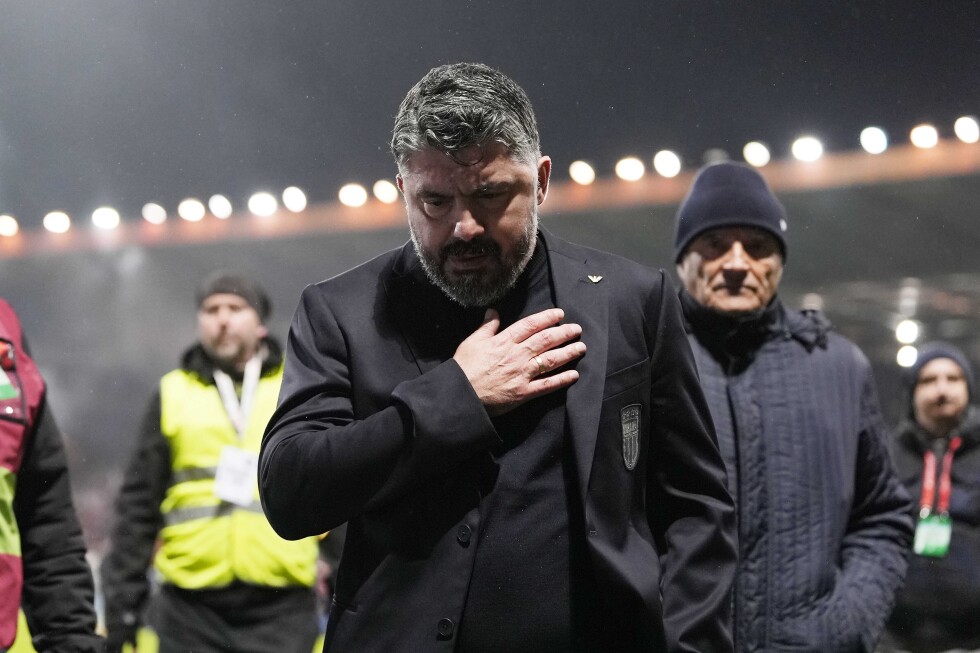
For the four-time World Cup winning Italian men’s national football team, a historic and devastating streak has been confirmed: the Azzurri will miss a third consecutive World Cup tournament, following a cruel penalty shootout defeat to 66th-ranked Bosnia and Herzegovina in the European qualifying playoffs on Tuesday. The result compounds decades of growing turmoil for Italian football, leaving head coach Gennaro Gattuso’s future up in the air even as the Italian Football Federation (FIGC) has publicly pushed for him to remain in the role.
Tuesday’s match was a rocky encounter from the start, with Italy reduced to 10 players for the majority of the clash. Despite the disadvantage, the side pushed the game to penalties, only to fall at the final hurdle and end their 2026 World Cup dreams. Speaking immediately after the final whistle, a clearly shaken Gattuso said he refused to discuss his own contract or future in the role, arguing that the national team’s failure far outstripped any personal questions.
“It hurts, it really hurts. More than hurting me, it hurts to see this group which has really given everything in these months and I think we deserved to get back what we put in,” Gattuso told reporters. “I honestly think it is too reductive and too immature to be talking about my future today. Here we should be talking about Italy, about the national team shirt, that it is yet another blow even though this time we didn’t deserve it. We deserved more, and that is why my future doesn’t matter.”
Gattuso was only appointed to the role last June, brought in to replace the dismissed Luciano Spalletti when Italy’s qualifying hopes were already fading. His short-term contract ran through the end of the 2026 World Cup, built in with an automatic five-year extension through 2028 if the side secured qualification. The streak of missed tournaments stretches back to 2018, when Italy fell to Sweden in qualifying playoffs, then repeated the upset loss to North Macedonia ahead of the 2022 tournament in Qatar.
While Gattuso has not yet announced whether he will step down or stay, FIGC president Gabriele Gravina made the federation’s stance clear in comments Tuesday: he has directly asked Gattuso to remain at the helm. “I have to praise Gattuso. I think he’s been a great coach, he is a great coach,” Gravina said. However, Gravina’s own position is now under intense scrutiny, as calls for his resignation grow. He called a FIGC council meeting for next week to review the situation and evaluate possible changes at the administrative level. Gravina took over the federation in 2018, after predecessor Carlo Tavecchio stepped down following Italy’s first 2018 qualifying exit, and has overseen both of the latest two disappointing qualifying campaigns.
For many Italian fans, the problem extends far beyond individual coaching or administrative roles. Speaking to reporters outside a Rome bar, 30-year-old fan Federico Barbieri argued the entire Italian football system is fundamentally broken. “I feel really bad, the system is rotten, the football system in Italy is rotten,” Barbieri said. “A country which is made for football and lives for football and now, like, everything is rotten. We knew that the team has its limits but … not going to the World Cup three times in a row? Sweden, North Macedonia and Bosnia. What else can I say?”
The aftermath of qualifying failures has not followed a fixed pattern for the federation in recent cycles. Gian Piero Ventura was fired immediately after the 2018 loss to Sweden, but Roberto Mancini retained his job despite the shock 2022 defeat to North Macedonia. That decision came just eight months after Mancini had led Italy to a surprise European Championship title, and the federation opted to retain the manager who had reinvigorated the national program. Mancini ultimately resigned just over a year later, moving to take the top job with the Saudi Arabian national side, and Spalletti was appointed in his place. After a disappointing Euro 2024 campaign, Spalletti was dismissed after just one World Cup qualifier in charge, clearing the way for Gattuso’s appointment.
For long-time fans of Italian football, the current streak feels like an unthinkable nightmare. Fifty-six-year-old Rome-based building contractor Roberto Silvi, who grew up watching Italy consistently compete for World Cup titles, called the result impossible to process. “I grew up with an Italy that always came in the top four at the World Cup,” Silvi said. “I’ve seen Italy as world champion twice, and close another couple times. I took Italy’s qualifications for granted and now it seems like a nightmare to me. I don’t even believe it. The Italy that misses a World Cup is outside of the world. The Italy that misses three, if they had told me, I never would have believed it.”