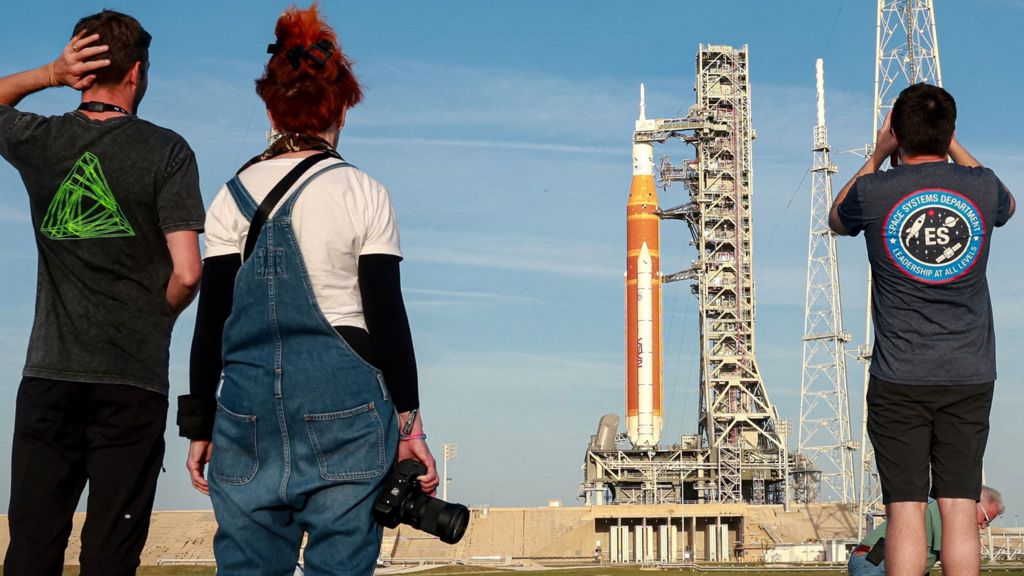
As the sun sets over Florida’s Space Coast this Wednesday, hundreds of thousands of space enthusiasts from across the United States are flooding into local causeways, public beaches, and motel balconies, all gathering to witness the long-awaited launch of NASA’s Artemis II mission — humanity’s first crewed trip around the Moon in more than 50 years.
Among the excited crowd is 8-year-old Isiah, who summed up the collective mood simply: “People going up to the Moon is kind of cool.” Traveling more than 1,000 miles from her home in New Mexico to be at the launch site, Amanda Garcia echoed that enthusiasm. “I heard it’s gonna be a great show. A lot of people are going to be here,” she said, explaining why she made the cross-country trip to be part of the historic moment.
Local authorities are describing the surge of visitors as a “historic influx”, with projections that the event will deliver an estimated $160 million boost to the regional economy. Months of preparation have gone into managing the crowds: traffic control plans are in place, local bars have rolled out moon-themed drink specials, and hotels have warned guests to expect lengthy travel delays between their accommodations and public viewing sites. Even highway streetlights will share the night sky with the glow of floodlit launch towers and the warm light of camper van barbecue grills scattered across viewing areas.
Just a mile from the launch pad, Brenda Mulberry, owner of Space Shirts — a local NASA souvenir shop that has operated on Merritt Island for 40 years — says this event is unlike any launch she has ever hosted. “We’ve wanted to go back to the Moon since the ’70s. People are excited. People are beyond excited,” she explained, noting that she has stocked her small shop full of hand-illustrated T-shirts emblazoned with rockets, mission patches and lunar landscapes to meet unprecedented demand. When asked about her long-term vision, Mulberry laughed and joked, “I want to have the first T-shirt shop on the Moon. Because if you’ve been there, you get the T-shirt, right?”
The Artemis II mission marks a critical turning point for NASA’s broader lunar exploration program, which aims to return humans to the lunar surface for the first time since Apollo 17 in 1972. Unlike the original Apollo missions, which focused on short surface visits, the long-term goal of the Artemis program is to construct a permanent lunar base camp, tap into the Moon’s untapped natural resources, and develop a sustainable starting point for the first human mission to Mars.
Speaking ahead of the launch, Artemis II commander Reid Wiseman emphasized the program’s intergenerational mission. “In our lifetime, we’ve looked at the Moon knowing that people had been there. And now in the Artemis generation, kids will walk out and look at the Moon going, we are there. We are there now, and we are going further into our solar system,” he said.
All eyes on launch night will be fixed on Launch Pad 39B, the same historic concrete launch site that supported the Apollo 11 mission that put the first humans on the Moon in 1969. Standing on the pad is NASA’s Space Launch System (SLS), a 321-foot-tall white and orange rocket that is the most powerful and heaviest launch vehicle the agency has ever built. Mounted atop the rocket is the Orion crew capsule, a vehicle roughly the size of a small van that will carry four astronauts on the 10-day unlanded test flight. This mission marks the first time Orion will be tested with a full human crew on board.
The launch window opens between 18:24 and 20:24 local Florida time on Wednesday. The four-person crew — commander Reid Wiseman, pilot Victor Glover, mission specialist Christina Koch, and Canadian astronaut Jeremy Hansen, who will make his first trip to space on this mission — will board the capsule approximately four hours before liftoff.
The mission follows a carefully planned 10-day timeline. After reaching Earth orbit, the crew will spend their first day testing manual flight controls and life support systems before setting a course for the Moon. On day two, a major engine burn will put Orion on a free-return trajectory that will naturally carry it around the Moon and back to Earth, with only small course corrections needed along the way. Each day of the flight is dedicated to new system tests and operational challenges, with the most anticipated milestone coming on day six, when Orion is scheduled to fly behind the far side of the Moon. For roughly 40 minutes, all radio contact between the capsule and ground control will be cut off, leaving flight controllers waiting for the spacecraft to emerge from behind the lunar disk. During this pass, Orion will travel between 4,000 and 6,000 miles above the lunar surface, and depending on its exact trajectory, it could surpass the 1970 Apollo 13 record for the farthest any human crew has ever traveled from Earth.
The most high-stakes phase of the mission comes on re-entry day. Orion will plummet through Earth’s atmosphere at roughly 25,000 miles per hour, generating external temperatures hot enough to melt rock, which must be absorbed by the capsule’s reinforced heat shield. After the 2022 uncrewed Artemis I test flight, engineers discovered that chunks of the heat shield’s protective coating had cracked and broken away during the mission’s two-stage “skip” re-entry maneuver. The maneuver — designed to reduce heat stress, G-force loads, and improve splashdown accuracy — dips the capsule into the upper atmosphere before briefly climbing back up and making a final plunge. For Artemis II, engineers have retained the two-stage approach but adjusted the entry angle and timing to reduce the time Orion spends in the initial, gentle atmospheric dip. Modeling suggests this change will reduce the heat and structural stress that caused the earlier damage, but this mission will be the first real-world test of the adjusted design with a crew on board.
If Artemis II completes its mission successfully, the next large-scale gathering on the Space Coast will come for the next step in the program: bringing humans back to walk the surface of the Moon, half a century after the last Apollo astronauts left their footprints in the lunar regolith. And as thousands of visitors carry home their custom mission T-shirts from Space Shirts, many will already be sharing Brenda Mulberry’s quiet, playful dream: that one day, her shop’s logo will not only be printed on Florida cotton, but featured in a photograph taken on the surface of the Moon.