A multinational research consortium has unveiled a groundbreaking conformal and stretchable piezoelectric microsystem (CSPM) that promises to revolutionize cardiovascular health monitoring through unprecedented accuracy in long-term blood pressure tracking without requiring recalibration.
The innovation, detailed in Nature Communications, addresses the critical limitation of current cuffless devices that suffer from accuracy degradation during extended use. Developed through collaboration between Tianjin University, the Chinese University of Hong Kong, City University of Hong Kong, and the Hong Kong Centre for Cerebro-cardiovascular Health Engineering, the CSPM integrates advanced hardware design with sophisticated algorithmic processing.
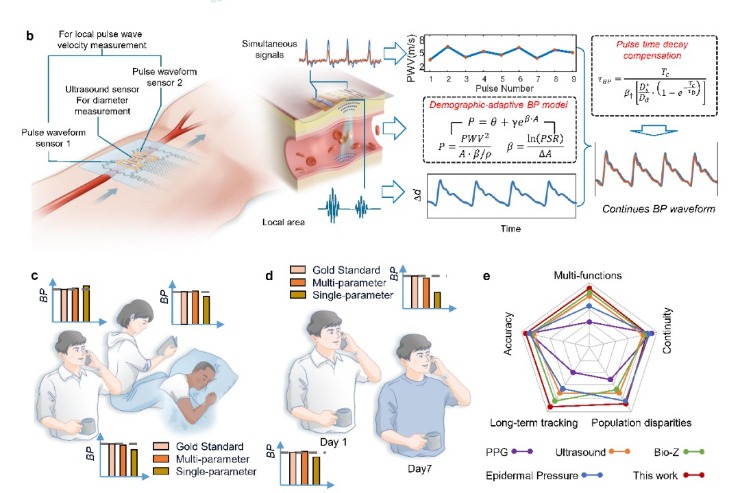
At the core of the system are two specialized sensing modules that operate simultaneously within the same vascular region, achieving sensitivity levels far surpassing conventional designs. The device captures pulse wave signals with remarkable precision while measuring vascular diameter and its dynamic changes in real time at resolutions up to 4.928 micrometers. This dual-sensing capability enables synchronous measurement of pulse wave velocity and vascular dimensions, providing comprehensive hemodynamic parameters essential for accurate blood pressure calculation.
The microsystem’s engineering breakthroughs extend to its wearability profile. At under 450 micrometers thick and weighing less than one gram, the device features low-stiffness silicone rubber encapsulation that allows up to 40% stretch capacity, ensuring perfect conformity to curved skin surfaces like the wrist. Its hydrophobic, sweat-resistant properties combined with exceptional biocompatibility enable stable thermal performance during continuous operation for three-hour intervals, meeting rigorous long-term monitoring requirements.
Complementing the hardware advances, the research team developed a demographics-based adaptive blood pressure model that eliminates individual calibration needs. A novel time-decay compensation strategy counteracts measurement deviations caused by minor sensor slippage, ensuring sustained accuracy throughout extended wear periods.
Clinical validation involving 45 subjects demonstrated consistent performance across diverse demographics including variations in gender, age, and skin tone. The system successfully tracked blood pressure fluctuations during daily activities over seven consecutive days while maintaining accuracy comparable to professional cuff-based medical devices.
This technological advancement overcomes two fundamental challenges that have hindered cuffless blood pressure monitoring: frequent calibration requirements and limited population adaptability. The innovation holds significant potential for hypertension screening, cardiovascular disease early warning systems, and long-term chronic disease management applications.