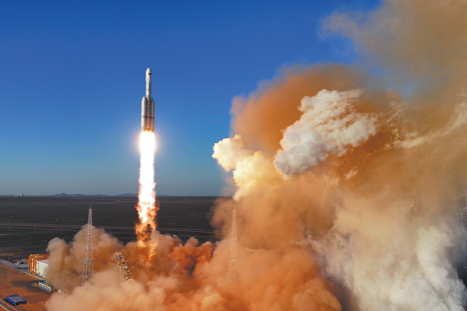
In a groundbreaking advancement for China’s commercial space sector, CAS Space successfully conducted the inaugural launch of its Kinetica 2 medium-lift rocket from the Jiuquan Satellite Launch Center on Monday evening. The landmark mission deployed multiple payloads into designated orbits, including the innovative New March 02 experimental robotic cargo spacecraft.
The 53-meter-tall liquid-fuel rocket, developed by the Beijing-based commercial space enterprise, ignited its nine first-stage engines at 7:00 PM local time, casting an intense glow across the Gobi Desert landscape. The launch vehicle demonstrated exceptional performance by precisely delivering its payloads to predetermined orbital positions within a remarkably short flight duration.
Among the deployed assets, the New March 02 cargo vessel represents a significant technological achievement. Designed and manufactured by the Chinese Academy of Sciences’ Innovation Academy for Microsatellites, the 4.2-ton spacecraft incorporates advanced systems capable of sustaining orbital operations for up to three years. This development introduces a new dimension to China’s space logistics capabilities, previously dominated by the larger Tianzhou series of cargo vehicles.
Project Manager Yang Haoliang emphasized the strategic importance of this achievement: ‘Kinetica 2 provides mission planners with enhanced flexibility for space station resupply missions. The coexistence of multiple launch systems ensures mutual backup capability, substantially strengthening our cargo transportation infrastructure.’
The rocket’s innovative modular design features a common booster core configuration where the first-stage core and two side boosters utilize identical modules. This engineering approach allows for customizable configurations by adding or removing boosters to meet varying mission requirements while maintaining cost efficiency through component commonality with its predecessor, Kinetica 1.
Notably, the mission marked the first integration of commercial rocket technology within China’s manned space program framework. With a payload capacity of 8 tons to sun-synchronous orbit and 12 tons to low-Earth orbit, Kinetica 2 demonstrates competitive specifications comparable to international counterparts.
The company has announced ambitious plans for booster recovery systems in subsequent flights, with Deputy Chief Designer Lian Jie revealing that future missions will attempt integrated recovery of all three boosters as a single unit. This approach promises improved aerodynamic performance, enhanced reliability, and reduced manufacturing complexity.
CAS Space is establishing production capacity for 20 Kinetica 2 rockets annually at its newly operational facility in Shaoxing, Zhejiang province. The company projects that achieving reusability could reduce launch costs to approximately half that of SpaceX’s Falcon 9 rocket.
Looking forward, the development of the Kinastra 1 upper stage, scheduled for maiden flight later this year, will enable the rocket family to reach high-altitude orbits including geosynchronous transfer and lunar transfer trajectories—positioning CAS Space as China’s first commercial enterprise with such advanced capabilities.