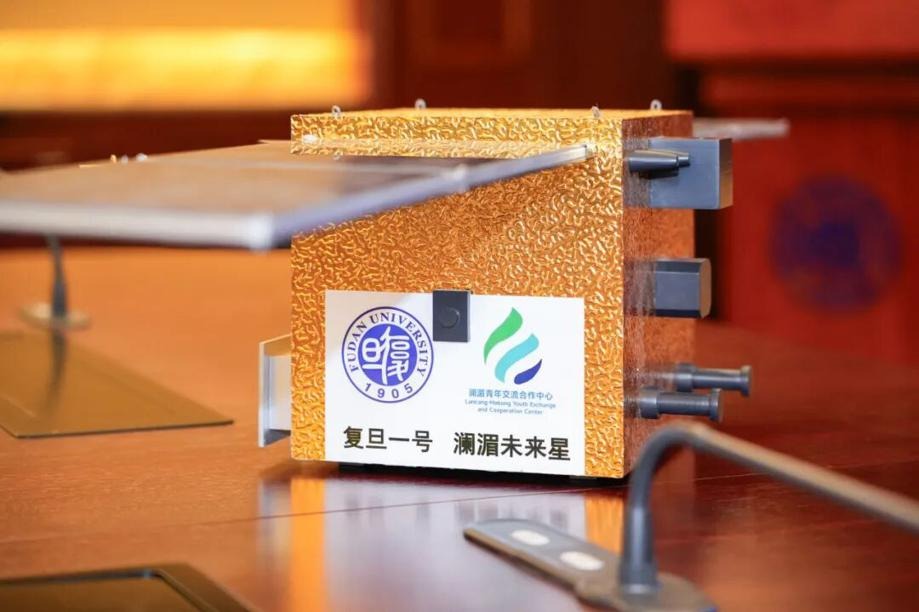
Shanghai’s prestigious Fudan University has unveiled groundbreaking advancements in next-generation space infrastructure through its development of very low Earth orbit (VLEO) satellite technology. The institution announced on Thursday that it has achieved significant breakthroughs in core technologies that could position China as a leader in the emerging space sector.
The university revealed that a prototype satellite is nearing completion, with an engineering model expected by late 2026 or early 2027. This development comes at a crucial time when the United States maintains dominance in satellite infrastructure with over 11,000 satellites in orbit, representing more than 70% of global operations. SpaceX’s Starlink constellation alone accounts for over 10,000 satellites, creating substantial first-mover advantages in the space industry.
VLEO satellites operate at altitudes between 150-300 kilometers, significantly lower than traditional low-earth orbit satellites that function at 350-2,000 kilometers. This proximity to Earth provides exceptional advantages including reduced launch costs (up to 90% savings), minimal radiation exposure, easier deorbiting processes, and substantially less space debris. The technological superiority of VLEO systems includes Earth observation resolution reaching 0.1-0.5 meters—comparable to aerial drone capabilities—and communication speeds more than ten times faster than conventional satellites with signal latency as low as 5 milliseconds, approaching fiber-optic performance levels.
The primary challenge in VLEO deployment has been atmospheric drag at these lower altitudes, which requires continuous propulsion to maintain orbital stability. Fudan University’s breakthrough solution involves innovative air-breathing plasma propulsion technology that captures nitrogen and oxygen from the thin atmosphere to use as propellant. This system achieves perfect thrust-drag balance, enabling indefinite orbital maintenance with a design life exceeding two years.
Professor Zhao Qiang, Party Secretary of the Institute of Modern Physics at Fudan University, emphasized the institution’s commitment to “advancing core technologies and promoting the integration of industry, academia and research to establish VLEO as a strategic advantage for China.”
The university also announced plans for a joint research initiative focusing on civilian applications of VLEO technology in the Lancang-Mekong region. Associate Professor Yang Yang revealed that the project may eventually deploy five additional satellites, forming a six-satellite constellation capable of revisiting the same ground location within one hour, significantly enhancing regional economic development and public welfare applications.
Concurrently, Fudan University celebrated the successful 18-month operation of its “Fudan No. 1 Lancang-Mekong Future Satellite,” which has produced remarkable scientific achievements including China’s first domestic “front view” image of the sun using Mg II k spectra. This breakthrough enables high-resolution extreme ultraviolet spectral observations better than 0.1 nanometer, contributing significantly to solar activity research and space weather forecasting capabilities. The research has already been integrated into Fudan University’s space weather prediction models, demonstrating promising results in ionospheric space weather forecasting.