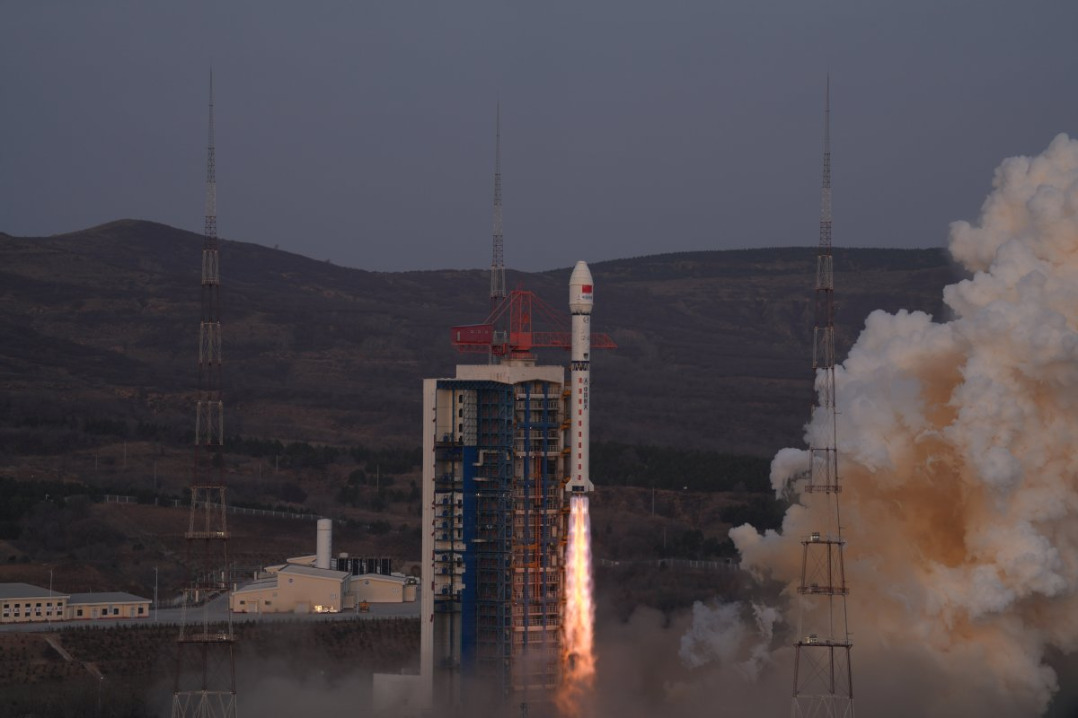
China has successfully deployed two advanced Earth observation satellites into orbit using a Long March 2D carrier rocket. The launch occurred at 6:51 am on March 26, 2026, from the Taiyuan Satellite Launch Center in Shanxi province, marking China’s 18th space mission of the year.
The satellites, designated Siwei Gaojing 2E and 2F, were developed by the Shanghai Academy of Spaceflight Technology, a subsidiary of the state-owned China Aerospace Science and Technology Corporation (CASC). These sophisticated satellites are equipped with high-resolution radar systems designed to capture detailed Earth observation data.
Following successful in-orbit testing, operational control will transfer to China Siwei Surveying and Mapping Technology, another CASC subsidiary specializing in satellite operations. The satellites’ advanced capabilities will support multiple critical applications including natural resource management, public security operations, emergency response coordination, marine monitoring, and various public service functions.
The Long March 2D rocket, measuring 40.6 meters in height with a 3.35-meter diameter and a liftoff weight of 251 metric tons, successfully delivered its payload to the predetermined orbit. This medium-lift launch vehicle specializes in transporting satellites to both low-Earth and sun-synchronous orbits.
This mission represents the 634th flight of China’s Long March rocket series, demonstrating the country’s continuing advancement in space technology and Earth observation capabilities. The successful deployment enhances China’s orbital infrastructure for environmental monitoring and resource management applications.