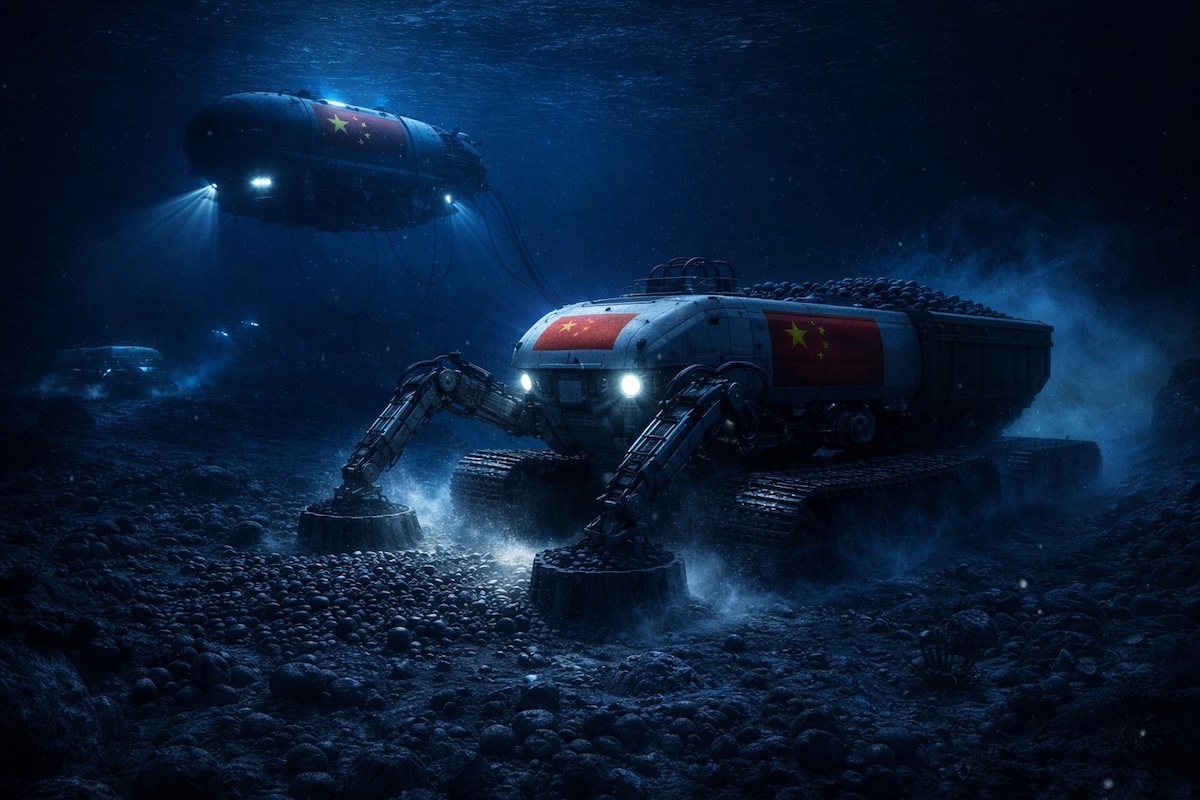
China is accelerating a comprehensive deep-sea exploration initiative across the Pacific, Indian, and Arctic Oceans that combines scientific research with strategic military preparation, according to recent intelligence assessments. Dozens of state-linked research vessels have conducted extensive seabed surveys near critical maritime zones including Taiwan, Guam, the Philippines, and key international chokepoints.
These missions, documented by multiple international news organizations, involve sophisticated mapping of underwater terrain, deployment of sensor arrays, and collection of hydrographic data on temperature, salinity, and acoustic conditions. Analysis of vessel movements reveals concerning patterns including frequent disabling of tracking systems and operations beyond licensed zones, suggesting military-civil fusion objectives under China’s strategic MCF doctrine.
Senior U.S. naval commanders testified before Congress that China is developing an ‘Underwater Great Wall’—a layered surveillance architecture integrating fixed sensors, unmanned systems, and data networks. Vice Admiral Richard Seif stated this system aims to contest U.S. submarine advantages through detailed bathymetric knowledge and seabed sensing capabilities. Rear Admiral Mike Brookes added that environmental data collection directly enhances sonar performance and enables persistent detection in strategic waterways.
The strategic implications extend beyond military preparedness. China currently holds five of the International Seabed Authority’s 31 exploration contracts, positioning itself as a leader in the emerging deep-sea mining industry. This expansion aligns with China’s dominance in rare earth elements, controlling 60% of global supply and 85% of processing capacity. According to RAND Corporation analysis, China’s seabed mining activities focus on securing critical mineral supply chains and establishing early influence in this developing sector.
Particular concern centers on Taiwan’s vulnerability, as the island relies almost entirely on undersea internet cables. Experts warn China’s detailed seabed knowledge could enable selective cable disruption, potentially creating a ‘digital quarantine’ that cuts bandwidth by 99% during conflict scenarios. Additionally, China’s nuclear submarine expansion benefits from extensive hydrographic mapping, enabling operations beyond the First Island Chain into the broader Pacific and Indian Oceans.
This integrated approach represents a fundamental shift in undersea competition, blurring boundaries between commercial exploration and military preparation while creating new dependencies in critical mineral supply chains.