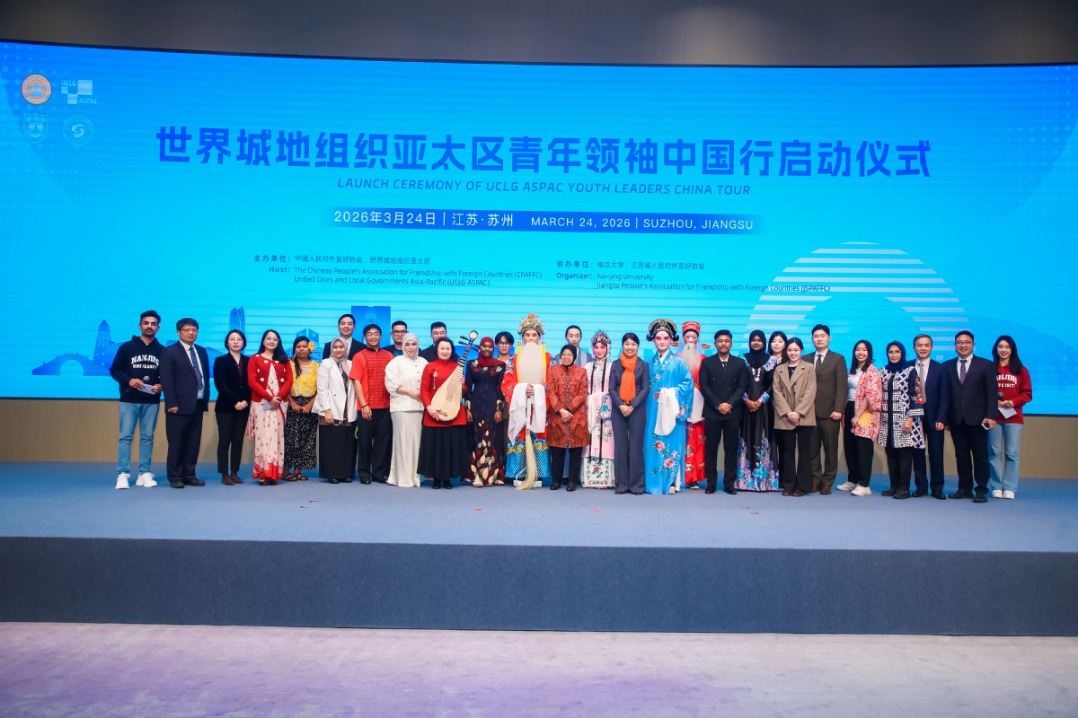
Suzhou, China – The United Cities and Local Governments Asia-Pacific (UCLG ASPAC) Youth Leaders China Tour commenced on March 24th at Nanjing University’s Suzhou Campus, marking the beginning of a significant cross-cultural exchange initiative. The opening ceremony featured a unique blend of formal proceedings and cultural performances, including an excerpt from the classic Kunqu Opera ‘The Peony Pavilion’ performed by university students.
The program, jointly hosted by the Chinese People’s Association for Friendship with Foreign Countries (CPAFFC) and UCLG ASPAC, brings together emerging youth leaders from across the Asia-Pacific region for an immersive six-day journey through Jiangsu province. From March 23rd to 28th, participants will explore Suzhou, Wuxi, and Yancheng, examining China’s advancements in sustainable development, technological innovation, and cultural preservation.
Professor Tan Tieniu, Chinese Academy of Sciences member and Party Secretary of Nanjing University, emphasized the significance of the gathering: ‘The Asia-Pacific region, with its diverse civilizations, represents one of the world’s most dynamic areas. This event creates a meaningful platform for cultural exchange, idea sharing, and friendship building.’
CPAFFC President Yang Wanming highlighted youth’s critical role as drivers of peace and development, noting that the program specifically aims to foster intercity cooperation through youth engagement. UCLG ASPAC Secretary-General Bernadia Irawati Tjandradewi described the tour as ‘a journey across cities, ideas, cultures, and perspectives’ designed to empower the next generation of leaders.
International participants expressed enthusiasm for the learning opportunity. Arjan Shrestha, Senior Financial Officer of Nepal’s Neelakantha municipality, stated: ‘We’re excited to witness China’s achievements in green development and innovation firsthand. This initiative powerfully demonstrates how youth can contribute to sustainable development and socio-economic transformation.’
The program represents a strategic effort to strengthen regional cooperation through people-to-people exchanges, with participants gaining direct exposure to China’s development model while building networks that span the Asia-Pacific region.