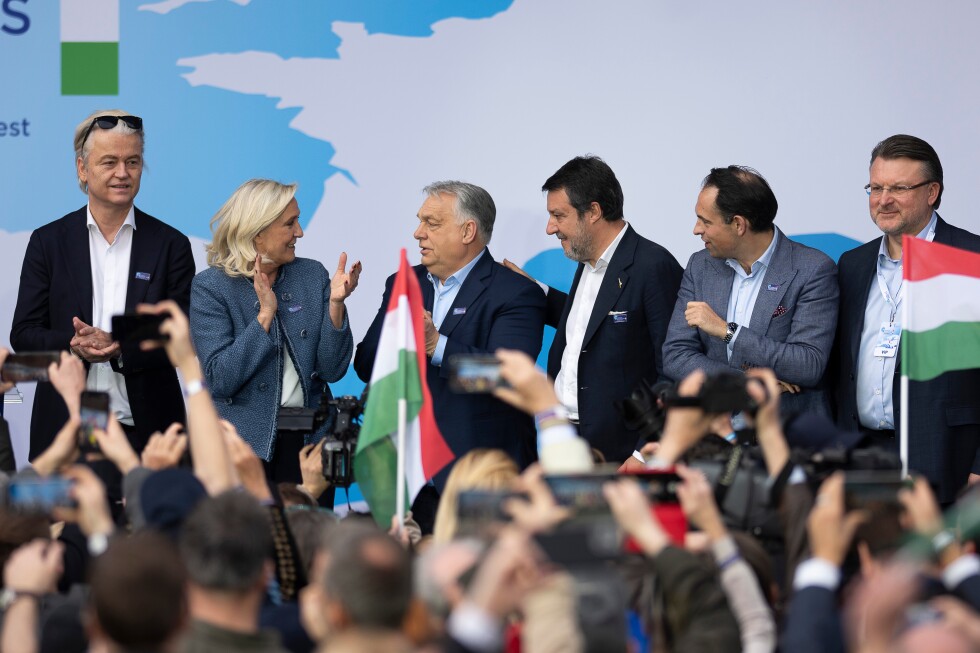
BUDAPEST, Hungary — In a significant demonstration of political solidarity, leaders from more than a dozen European far-right parties assembled in Budapest on Monday to rally behind Hungarian Prime Minister Viktor Orbán. This gathering occurs just three weeks before a pivotal national election that could potentially conclude Orbán’s 16-year administration.
The event, organized under the banner “Patriots for Europe,” featured prominent figures including France’s Marine Le Pen, Italy’s Matteo Salvini, and the Netherlands’ Geert Wilders. This coalition, now the third-largest bloc in the European Parliament, represents parties from 13 EU nations united by their opposition to immigration, advocacy for national sovereignty over European integration, and commitment to conservative social values.
Orbán, who regained power in 2010, has long been regarded as a pioneering figure in global nationalist politics, predating the rise of former U.S. President Donald Trump. His political achievements—including four consecutive electoral victories, extensive control over government institutions, media, and academia, and his emphasis on traditional values—have made him an inspirational model for conservative movements worldwide.
However, recent polling data indicates Orbán’s Fidesz party trails behind a center-right challenger, suggesting his prolonged dominance may be weakening due to economic stagnation, deteriorating public services, and corruption allegations.
Princeton University professor Kim Lane Scheppele noted the significance of Orbán’s potential defeat: “Hungary represents proof of concept that MAGA-style politics can work. If Orbán loses, the movement loses considerable credibility.”
The Budapest assembly served as both a strategic coordination effort and a campaign event, with speakers urging Hungarian voters to support Orbán in the April 12 election. Le Pen praised Orbán’s stance on “immigration, identity and sovereignty,” describing Hungary as “an emblem of resistance against oppression.”
Orbán himself declared the coalition’s ambition to “take control of the European Union” and “transform the center of Brussels,” reflecting his long-predicted vision of a far-right nationalist resurgence across Europe.
The convergence of European and American conservative interests was further highlighted by Budapest’s recent hosting of the Conservative Political Action Conference (CPAC), where Orbán characterized current Western politics as undergoing “the greatest political realignment of the past hundred years.” Trump endorsed Orbán’s reelection bid via video message, commending his defense of “borders, culture, heritage, sovereignty, and values.”
Analysts observe striking parallels between Orbán’s political trajectory in Hungary and the aspirations of Trump’s movement in the United States, noting their interconnected political networks and mutual reinforcement. As both leaders face electoral challenges, the April election in Hungary carries significant implications for the future of nationalist conservatism on both sides of the Atlantic.