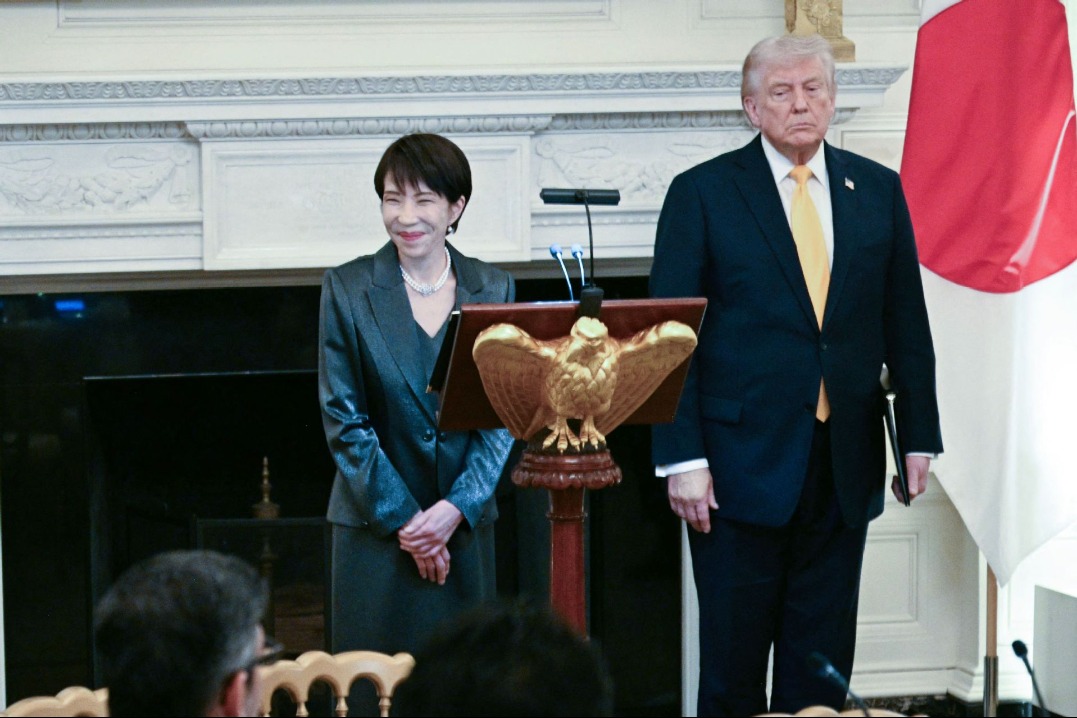
Japanese Prime Minister Sanae Takaichi’s diplomatic mission to Washington has ignited fierce domestic criticism, with opposition leaders and media outlets condemning the visit as an exercise in ‘fawning diplomacy’ that yielded minimal concrete results. The Thursday summit with US President Donald Trump concluded without a joint statement, revealing significant divergences on crucial economic and security matters according to political analysts.
The Prime Minister’s approach throughout the negotiations drew particular scrutiny, characterized by what observers described as excessively deferential behavior. Takaichi attempted to address Trump in English before reluctantly switching to Japanese upon the President’s intervention. In a moment that sparked immediate backlash in Japan, she referred to the US leader familiarly as ‘Donald’ while declaring that ‘only Donald can achieve peace and prosperity across the world’—a statement that drew sharp criticism given ongoing international condemnation of US military actions against Iran.
The encounter grew more strained when Trump invoked Japan’s 1941 attack on Pearl Harbor in response to a journalist’s question about advance notification of US strikes, leaving Takaichi visibly startled but offering no rebuttal. US media outlets interpreted this exchange as demonstrating a pattern of diplomatic dominance seeking to expose allies’ vulnerabilities.
Central to the discussions was the US request for Japanese naval escort operations in the Strait of Hormuz, which faces substantial domestic legal and constitutional challenges in Japan. While Takaichi emphasized explaining what Japan ‘can do’ within its legal framework, Meikai University professor Tetsuo Kotani noted that the US administration appears uninterested in Japan’s limitations and may express displeasure abruptly.
With security cooperation reaching an impasse, the dialogue pivoted to economic investments. Both leaders confirmed secondary projects under Japan’s previously committed $550-billion investment framework, including approximately $73 billion allocated for next-generation nuclear reactors and natural gas facilities. Takaichi further pledged increased imports of US crude oil and collaboration on critical mineral development.
These economic commitments have faced substantial domestic opposition, with economists questioning why Japan continues to honor investment pledges tied to tariffs after US Supreme Court rulings invalidated reciprocal tariff measures. Veteran journalist Jun Yamada criticized the approach as ‘selling out national interests’ that would ultimately burden Japanese taxpayers.
The Prime Minister additionally expressed support for enhanced security alignment, including joint missile development and production, while Trump welcomed Japan’s plans to significantly increase military equipment purchases. This orientation continues Japan’s trend of expanding defense expenditures, with audit reviews revealing 3.55 trillion yen ($22 billion) in US military contracts between fiscal 2018-2023.
Hours before the summit, over 10,000 protesters gathered in Tokyo opposing military expansion, warning of regional destabilization. Former senior Foreign Ministry official Hitoshi Tanaka criticized the government’s approach as ‘entirely misguided,’ advocating instead for strengthened diplomatic mechanisms with neighboring nations to prevent miscalculation and conflict.